Saturday, March 19, 2016

SWEET SWAN OF AVON
To the Memory of My Beloved the Author, Mr. William Shakespeare


Shakespeare’s Saints and Sinners
Mar. 19, 2016 
Heliconian Hall, Toronto

‘How doth the city sit solitary’ exclaims Jeremiah at the beginning of his Lamentations. It’s not clear who sits solitary (sedet sola) in Holborne’s pavan. Ecce Quam Bonum are the first words of Ps. 133: ‘Behold, how good and how pleasant it is for brethren to dwell together in unity.’ Lord Rivers compares the self-sacrifice of the righteous fighters against tyranny to Jesus’s sacrifice. We reply with a snippet of Taverner’s Mass Gloria Tibi Trinitas. The plainsong melody of Gloria Tibi Trinitas is only heard at the words ‘In nomine Domini’ in the Sanctus. The tune became the subject for instrumental consorts for 150 years. Johnson puts the tune in the top voice of his version.
Sedet Sola Anthony Holborne (1545-1602)
Ecce Quam Bonum Holborne
Lord Rivers from Richard III [III:1]
In nomine Domini John Taverner (ca. 1490-1545) – arr. Anon.
In Nomine Robert Johnson (ca. 1500-1560)


There was little difference for the Jacobeans between the care of the soul and the care of the sick in mind. Timothy Bright, author of a Treatise on Melancholy, a book Shakespeare probably read, was both a physician and a divine, so would have been the ideal minister for the mind and soul of Lady Macbeth. We respond with a penitential text and another In Nomine, this time with the tune in the tenor.
The Doctor from Macbeth [V:1]
Ne reminiscaris John Wilbye (1574-1638)
Remember not, Lord, our offences, neither those of our fathers:
and do not wreak vengeance for our transgressions.
Spare, Lord, spare your people,
whom you redeemed with your precious blood:
lest you be angry with us for ever.
In Nomine Thomas Tallis (c. 1505-1585)

Campion’s meditation on ‘the light of the world’ is from his book of ayres ‘contayning divine and morall songs’ and has correspondences in this short exchange from Henry VI Pt. II. A Mr. Golder remarkably harmonizes the ‘minor’ key In Nomine into a major key.
A man, then the King from Henry VI Pt. II [II:1]
Author of light    Thomas Campion (1567-1620)
In Nomine (Robert?) Golder (1510-1563)


Griffith describes the last hours of Cardinal Wolsey who himself conceded that  he had not ‘served God as diligently as I have done the King.’ Dowland’s last songbook, A Pilgrimes Solace, contains several ‘divine and moral songs’ including this and the Thou Mighty God cycle. Baldwin ingeniously transforms the In Nomine with triple time figures.
Griffith from Henry VIII [IV:2]
If that a Sinners sighes John Dowland (1563-1626)
In Nomine John Baldwin (d. 1615)

Bedford alludes to the Canticle of Simeon, sung at Evensong, in his speech. Simeon had been promised he’d see the Messiah before he died, and when He is revealed to him, Simeon exclaims ‘Lord, now lettest thou thy servant depart in peace.’ Or much more verbosely in this metrical paraphrase, set to one of the Old Church Tunes used for the Psalms and Canticles, and arranged by Allison. Dowland keeps the In Nomine tune going in the top voice of his curiously titled lute fantasy.
Bedford from Henry VI Pt. 1 [III:2]
Nunc Dimittis Richard Allison (c. 1560-c. 1610)
Farwell Dowland

Intermission


Dowland’s intense three-part setting of a meditation on patience is framed by a speech from Lear, whose troubles parallel those of Job, and some less sympathetic characters from The Merchant of Venice and Hamlet. We have some dance music which alludes to In Nomine to lighten the mood.
Patiencia Holborne
Lear from King Lear [II:2]
Thou mighty God Dowland
Antonio from Merchant of Venice [IV:1]
When Davids life Dowland
The Queen from Hamlet [III:4]
When the poore criple Dowland
In Nomine Pavan & Galliard Nicholas Stroggers (fl. 1560-1575) arr. Anon.


What is one of the most famous passages in all of Shakespeare needs little set up. Campion’s song is from his ‘divine and morall’ collection of ayres again. Ward’s In Nomine, the latest we play, has virtuoso figures and looks forward even to Purcell’s version from the end of the 17th century.
Hamlet from Hamlet [I:2]
Never weather beaten saile Campion
In Nomine John Ward (1571-1638)

Pericles, Prince of Tyre, thanks the divine for his and his daughter Marina’s delivery from trouble. Though Pericles was probably not written (and possibly not all by Shakespeare) till the reign of James, the audience would still be familiar with Elizabeth’s delivery from the Armada’s threat from the sea.
Pericles from Pericles [V:1]
Benedicam Domino   Robert Johnson
I will bless the Lord at all times;
I will always declare his praise with my mouth.
O Lord with all my heart…..
To praise His name wherever we go,
His praise shall continually be in my mouth.
In Nomine  William Byrd  (1539/40-1623)

The illegitimate Edmund is lying in his report that Gloucester’s legitimate son is planning to kill him, but gives a plausible characterization on the opinion of parricides. That King David’s son Absalom had rebelled against him makes his defeat and death no less painful for the king.
Edmund from King Lear [2:1]
When David heard Michael East (1580-1648)


The Musicians In Ordinary
Named after the singers and lutenists who performed in the most intimate quarters of the Stuart monarchs’ palace, The Musicians In Ordinary for the Lutes and Voices dedicate themselves to the performance of early solo song and vocal chamber music. Soprano Hallie Fishel and lutenist John Edwards have been described as ‘winning performers of winning music.’ A fixture on the Toronto early music scene for over 10 years, in 2012 MIO became Ensemble in Residence at St. Michael’s College in the University of Toronto. They have concertized across North America and lecture regularly at universities and museums. Institutions where MIO have performed range from the scholarly to those for a more general public and include the Shakespeare Society of America, the Renaissance Society of America, the Shakespeare Association of America, Grinnell College, the Universities of Alberta, Toronto and at California at San Diego, the Kingston Opera Guild, Syracuse, Trent and York Universities and the Bata Shoe Museum. They have been Ensemble in Residence at Lafayette College in Easton, Pennsylvania.

David Klausner taught at the University of Toronto in the Department of English and the Centre for Medieval Studies for 45 years until his retirement in 2012, specializing in early English drama and Welsh literature.  He was a founding member of The Toronto Consort, with which he played for twenty years; he has been a regular teacher at early music workshops in Canada, the US, the UK, and Austria.  His interests in early music and literature led to a study of historical pronunciation, and he now acts as pronunciation advisor to early music singers around the world. In addition to his continuing research for the project Records of Early English Drama, he performs widely in the Toronto area on bassoon, contrabassoon, and baroque bassoon.

Due to a scheduling problem Christopher Verrette is unable to join us for tonight’s performance, but will return on April 23rd. Thanks to Trish for standing in.

Patricia Ahern has a BA and BMus. from Northwestern University, MMus from Indiana University, and performer diploma from the Schola Cantorum in Basel, Switzerland. She has taught baroque violin at the Freiburg Conservatory and Oberlin’s Baroque Performance Institute, and given masterclasses at McGill, Wilfrid Laurier, York and Grand Valley State Universities, and the Universities of Windsor, Wisconsin and Toronto. She has concertized on five continents performing with Milwaukee Baroque, Ars Antigua, Chicago Opera Theater, Kingsbury Ensemble, Aradia, I Furiosi, Newberry Consort, Musica Pacifica, and the Carmel Bach Festival. Tricia has recorded for Sony, Naxos, and Analekta, and joined Tafelmusik in 2002.

Matt Antal was born and raised in Toronto. He attended Cardinal Carter Academy for the Arts where he began playing viola at age 13 under the tutelage of Jolanta Hickey and Angela Rudden. An all-around lover of music, he has played in numerous ensembles in genres ranging from jazz to hardcore metal. He holds both a bachelor’s degree from the University of Toronto, where he studied under Katharine Rapoport, and a master’s degree from the University of Victoria, where he was a student of Joanna Hood, both in viola performance. He is currently pursuing an advanced certificate in Baroque viola with Tafelmusik.

Eleanor Verrette studied violin with Gretchen Paxson and Aisslinn Nosky, modern viola with Anna-Belle Marcotte at McGill University, where she graduated with a BMus. in 2012, and Baroque viola with Pemi Paull. She now performs regularly on Renaissance and Baroque viola with The Musicians In Ordinary, on vielle and rebec with Toronto-based medieval group Pneuma Ensemble, and on plugged-in viola with Boston-area band Hadley and the Jackal. She is featured on recent album releases by acclaimed folk-rock artists Lakes of Canada and Corinna Rose and has also performed with Aradia Ensemble and Montréal singer-songwriter Ari Swan,

Sheila Smyth is a busy performer with many ensembles, baroque and modern, on violin, viola and treble viola da gamba. She is principal violist of both Nota Bene Baroque Players and Opera York, and a supernumerary violist for Tafelmusik.  Sheila is a frequent guest soloist with the Toronto Continuo Collective and Scaramella, and has performed at various summer festivals and symposiums such as Luminato, Grand River Baroque, and the MidWest Early Keyboard Society Conference. She has been heard live in performance with the Emperor Quartet on CBC Radio 2 and CFMX Radio, and is a founding member of Musathena and the Cardinal Consort of Viols.

Originally from Hamilton, Amanda Keesmaat, bass violin, obtained her Bachelor of Music from the University of Western Ontario and her Artist Diploma from McGill University. A vibrant presence in the Montreal early music community for more than 15 years, she has recorded and performed with prominent singers such as Matthew White, Daniel Taylor, Shannon Mercer, Donna Brown, Natalie Paulin, Susie Le Blanc and Marie-Nicole Lemieux, and renowned ensembles such as Arion Baroque Orchestra, La Nef, Les Idées Heureuses and Les Boréades.  She appears regularly on concert series with Arion Baroque Orchestra, Clavecin en Concert, Studio Musique Ancienne de Montréal, La Nef and at festivals such as Montreal Baroque, Ottawa Chamber Music Festival, the Lameque Baroque Festival, and Vancouver Early Music Festival and Music and Beyond.  As a founding member of Ensemble Les Voix Baroques and Skye Consort, she has performed across Canada. Amanda has recorded for ATMA discs, Early-Music.com, Fidelio, XXI, Analekta, ombú, CBC Radio and CBC Television, BRAVO, the NFB and Radio-Canada.


Friday, March 18, 2016

The University of St. Michael’s College
in the University of Toronto

Byrd, Mass for Four Voices
with music by Dowland, Campion & others
for the Lenten Season

Friday, March 18, 2016
7:30 p.m.
St. Basil’s Church 

Program

Preludium - John Dowland (1563-1626) - John Edwards, lute
Kyrie, Mass for Four Voices - William Byrd (c.1540–1623)
If that a sinner's sighs - John Dowland - Soloists
In Nomine - Robert Johnson (c. 1500-1560)

Gloria, Mass for Four Voices - William Byrd
Author of Light - Thomas Campion (1567-1620) - Graham Robinson, Bass-baritone
In Nomine - (Robert?) Golder (1510-1563)

Credo, Mass for Four Voices - William Byrd
Never weather-beaten sail - Thomas Campion - Soloists
In Nomine Thomas Tallis (c. 1505-1585)

Sanctus/Benedictus - William Byrd
In Nomine - John Taverner (c. 1490-1545) - Hallie Fishel, Soprano
In Nomine - John Baldwin (d. 1615)

Agnus Dei, Mass for Four Voices - William Byrd
Nunc Dimittis - Richard Allison (c. 1560-c. 1610) - Soloists
In Nomine - John Ward (1571-1638)

Ave Verum Corpus - William Byrd


Refugee Sponsorship Campaign
All donations collected tonight will support Syrian refugees in Canada. Initiated by the students of the University of St. Michael’s College and supported by the President’s Office, our specific campaign is designed to raise funds to sponsor a refugee family through the Archdiocese of Toronto’s Office of Refugees. From September, we will provide a family with a home on the campus. Your donations tonight will be directed to their basic needs—clothing, baby necessities, English language classes, metro passes. The campaign has been very successful so far, raising almost $9,000 towards the goal of $12,400. With your support, we are confident the goal can be reached before the academic year comes to a close.

If you prefer to donate by cheque, please speak to one of the ushers after the concert.

On behalf of those who will be helped by your gift, the students of St. Michael’s thank you in advance for your consideration and generosity.


The Musicians In Ordinary String Band 
Violin
Chris Verrette

Viola
Matt Antal
Sheila Smyth
Eleanor Verrette

Bass Violin
Amanda Keesmaat

Lute
John Edwards


St Michael’s Schola Cantorum
Soprano
Laurel-Ann Finn
Hallie Fishel*
Barbara North
Emily Sherlock
Jane Ubertino
Mikhai-Louise Vasile
Julia Warnes
Hope Aletheia Waterman

Alto
Vanessa Chan
Cindy Dymond
Charlotte Hodgkins*
Paula Owolabi
Annemarie Sherlock
Katie Stokes
Kathryn Zaleski-Cox

Tenor
Ben Kim*
Edmund Lo
Reid Locklin
Patrick Michalski
Michael Pirri
Hugo Tang

Bass
Robert Allair
Scott Hoornaert
Paul McGrath
Graham Robinson*

Guest Director
Christina Labriola

*= soloists

Named after the singers and lutenists who performed in the most intimate quarters of the Stuart monarchs’ palace, The Musicians In Ordinary for the Lutes and Voices dedicate themselves to the performance of early solo song and vocal chamber music. Soprano Hallie Fishel and lutenist John Edwards have been described as “winning performers of winning music.” A fixture on the Toronto early music scene for over ten years, in 2012 MIO became Ensemble in Residence at St. Michael’s College in the University of Toronto. MIO have concertized across North America, and have performed to scholarly and general audiences, lecturing regularly at universities and museums, for the Shakespeare Society of America, the Renaissance Society of America, Canadian Society for Renaissance Studies, Grinnell College, the Kingston Opera Guild, and the Bata Shoe Museum, and the Universities of Alberta, Toronto, California at San Diego, Syracuse, Trent, and York. They have been Ensemble in Residence at Lafayette College, Easton, Pennsylvania.

Christopher Verrette has been a member of the violin section of Tafelmusik since 1993 and is a frequent soloist and leader with the orchestra. He holds a Bachelor of Music and a Performer’s Certificate from Indiana University. He contributed to the development of early music in the American Midwest, as a founding member of the Chicago Baroque Ensemble and Ensemble Voltaire, and as a guest director with the Indianapolis Baroque Orchestra. He collaborates with many ensembles around North America, performing music from seven centuries on violin, viola, rebec, vielle, and viola d’amore. He was concertmaster in a recording of rarely heard classical symphonies for an anthology by Indiana University Press and recently collaborated with Sylvia Tyson on the companion recording to her novel, Joyner’s Dream.

Charlotte Hodgkins, mezzo-soprano, has worked as a professional chorister for many ensembles, including Ottawa Bach Choir, Elora Festival Singers, Theatre of Early Music, St. James Cathedral Choir, and Soundstreams Canada. Charlotte is currently completing a BFA at York University, studying with Stephanie Bogle. In 2014, the university awarded her the Peggie Sampson Award for Early Music. Charlotte has sung as alto soloist with the York University Concert Choir in such works as J. S. Bach's St. John Passion, Mozart's Coronation Mass, C. P. E. Bach's Magnificat, and Rossini's Petite Messe Solenelle. Charlotte continues her work as a professional chorister, and plans to pursue choral conducting and historical performance at the graduate level.

Ben Kim is a composer and tenor Toronto. Originally hailing from Geoje, South Korea, he grew up playing the piano. It wasn't until in he joined a choir at the age of 20 that he started singing in earnest. As a singer, he has performed with various amateur and professional groups from the US and Canada. Currently, he is a member of St. James Cathedral Choir. As a composer, his music has been appreciated and performed throughout the world by many musicians and ensembles. Notably, his choral arrangement of a Korean folk song called Hangangsu Taryeong - a “dissonant tone painting,” as one reviewer put it - was performed in Disney Hall by LA Master Chorale. His music is often described as eclectic or prismatic. He is published by Renforth Music in Canada, and earthsongs in the US.

Graham Robinson is a bass-baritone hailing from Vancouver Island, British Columbia. Receiving his Bachelors of Music in Voice at the University of Victoria, Graham was a much sought after soloist during his time in B.C. Now based in Toronto, he has been featured with the Elmer Iseler Singers, Tafelmusik, La Chapelle de Québec, the Elora Festival Singers, the Nathaniel Dett Chorale as well as many others. Graham is a devoted supporter and patron of aesthetics who strongly believes that creativity will take us anywhere we want to go. “Putting one’s soul into any discipline is art. It is in those times one learns to fly.” When not making music Graham further extends his passion for the arts community through film and videography.

St. Michael’s Schola Cantorum is an auditioned ensemble drawn from staff, faculty, alumni/ae, students, and friends of USMC, and members of St. Basil’s parish choir. We sing three concerts per year, at Michaelmas, and during Advent, and Lent. Michael O’Connor is the founding Director of St. Michael’s Schola Cantorum. He teaches in the college programs at St. Michael’s and also directs the St. Mike’s Singing Club. His academic scholarship and practical music-making overlap in the theory and practice of liturgical music.

Christina Labriola is an alto, pianist, and choral conductor, ever interested in the intersection of music and spirituality. She earned a B.Mus. in piano at the University of Toronto, and Master of Sacred Music in choral conducting from Emmanuel College, and is currently a doctoral student at Regis College in the Toronto School of Theology. She has sung and worked with a number of choral ensembles, including the MacMillan Singers (2006–2010), and University of Toronto Women's Chorus as Assistant Conductor (2012–2013). Involved in church music ministry, Christina serves as music director at the Newman Centre and at St. Peter’s Catholic Church, Toronto. She plans to continue in the world of academia along with a varied musical career as church musician, conductor, teacher, choral singer, accompanist, and performer. Christina is delighted to have been invited to be the guest conductor for this evening’s concert.

Notes
Towards the end of his career, William Byrd was patronised by, and possibly just plain employed to provide music for secret Masses for the recusant Petre family. He had stayed with the family over Christmas in 1589 (Is this circumstantial evidence of a Christmas chapel music gig?) and in the early 1590s, moved to a village near the Petres’ country home. Though his three Mass settings were printed without a date, this is about the time the Masses were published. As well as being undated, the title pages also lack the name of the publisher, who perhaps wanted to keep his involvement on the down low, and are in a small format, perhaps to make the partbooks easy to conceal. Comparison of the Byrd Masses with their models show that rather than being influenced by contemporary continental settings, they look back past the English Reformation to Masses by Taverner and Tallis. Particular to Byrd, though, is a sometimes almost madrigalian texture and attention to the text, and the lack of repetition of words and phrases. Perhaps they needed to get a move on in case the constable peeped in the chapel window. That said, Queen Elizabeth asserted she would turn a blind eye to any ‘window into men’s souls’, and Byrd implies in a letter to her top official that his Catholicism had been tolerated when he was employed as composer for the Chapel Royal, the top church music job in the land.

The printed layout of the Dowland, Allison and Campion tells us that they were published for private devotions. These pieces are from books published in tabletop format, with the bass part upside down from the soprano and perpendicular to the alto and tenor. Place the open book in the middle of the table and the performers can crowd around the four sides and read their several parts. Unlike Byrd, John Dowland was not very serious about his conversion to Catholicism. His association with the troublesome Earl of Essex probably counted against him more than his faith in his failed attempt to get a job at the Elizabethan court. He stomped off to the continent in a huff, but reports in a letter from Florence that he has heard of a team of Jesuits being sent to England, and that he can get a gig at the Papal court and do some further spying if needed. In fact, he ended up working for James I. Campion published a songbook ‘Contayning divine and morall songs’ bound with a book ‘on the light conceits of lovers’ in 1613 from which his two ayres are taken. Books of Psalms like Allison’s, using metrical paraphrases of the Psalms and canticles, were the main way for singing psalms in England from the mid 16th century until well into the 18th. The Old Hundredth ‘All people that on earth do dwell’, to a Genevan tune, is probably the most famous of this repertoire. The setting of the Nunc dimittis paraphrase is from this psalter.

For some reason, the snippet of chant Gloria Tibi Trinitas, the antiphon for the first psalm for the feast of the Trinity in ‘Sarum’ usage (the chant used in England before the Reformation) became the subject of a fascination quite out of proportion to the 30 seconds it originally took up on one feast day at Vespers. John Taverner used the plainchant as the subject, or ‘cantus firmus’ for a Mass, where the tune is heard in its entirety first at the words ‘in nomine Domine’ in the Benedictus. The lute part of the solo voice version you will hear is a straightforward intabulation of the lower voice parts of this passage from the Mass from a manuscript in the library of the Paston family, also recusants. Composers, particularly for consorts of strings, took the plainchant and used it as a subject for hundreds of In Nomines for well over a hundred years after Taverner popped it into the texture of his Mass. The Petres and Pastons maintained a set of ‘viols’ in their households (the word ‘viol’ and ‘violin’ were used interchangeably in English at the time). All the pieces called In Nomine this evening, then, have the tune somewhere in the texture.

Translations
Kyrie
Lord, have mercy.
Christ, have mercy.
Lord, have mercy.

Gloria
Glory to God in the highest,
and on earth peace to people of good will.
We praise you, we bless you, we adore you, we glorify you,
we give you thanks for your great glory,
Lord God, heavenly King, O God, almighty Father.
Lord Jesus Christ, Only Begotten Son,
Lord God, Lamb of God, Son of the Father,
you take away the sins of the world, have mercy on us;
you take away the sins of the world, receive our prayer;
you are seated at the right hand of the Father, have mercy on us.
For you alone are the Holy One, you alone are the Lord,
you alone are the Most High, Jesus Christ, with the Holy Spirit,
in the glory of God the Father. Amen.

Credo
I believe in one God, the Father almighty,
maker of heaven and earth,
of all things visible and invisible.
I believe in one Lord Jesus Christ,
the Only Begotten Son of God,
born of the Father before all ages.
God from God, Light from Light, true God from true God,
begotten, not made, consubstantial with the Father;
through him all things were made.
For us men and for our salvation he came down from heaven,
and by the Holy Spirit was incarnate of the Virgin Mary, and became man.
For our sake he was crucified under Pontius Pilate,
he suffered death and was buried,
and rose again on the third day in accordance with the Scriptures.
He ascended into heaven and is seated at the right hand of the Father.
He will come again in glory to judge the living and the dead
and his kingdom will have no end.
I believe in the Holy Spirit, the Lord, the giver of life,
who proceeds from the Father and the Son,
who with the Father and the Son is adored and glorified,
who has spoken through the prophets.
I believe in one, holy, catholic and apostolic Church.
I confess one baptism for the forgiveness of sins
and I look forward to the resurrection of the dead
and the life of the world to come. Amen.

Sanctus/Benedictus
Holy, holy, holy Lord God of hosts,
Heaven and earth are full of your glory.
Hosanna in the highest.
Blessed is he who comes in the name of the Lord.
Hosanna in the highest.

In Nomine
...in the name of the Lord.

Agnus Dei
Lamb of God, you take away the sins of the world: have mercy on us.
Lamb of God, you take away the sins of the world: grant us peace.

Ave Verum Corpus
Hail, true Body, born of the Virgin Mary,
who having truly suffered,
was sacrificed on the cross for mankind,
whose pierced side flowed with blood:
May it be for us a foretaste [of the Heavenly banquet]
in the trial of death.
O sweet, O holy,
O Jesus, son of Mary,
have mercy on me. Amen.

Friday, February 12, 2016


SWEET SWAN OF AVON
To the Memory of My Beloved the Author, Mr. William Shakespeare


Shakespeare’s Lives of Girls and Women
8PM, Feb. 13, 2016 
Heliconian Hall, Toronto 

First of the Ladies Masque Anon.
Here we see Phebe attempt to set her suitor Silvius free and respond with an ayre where the poet assures his beloved that her beauty gives her not the power to decide who will be her vassal. The strings play Byrd’s variations on The Leaves be Green, the signature tune of the dedicatee of Danyel’s songbook, Miss Anne Green.
Phebe from As You Like It [III, 5]
Let not Cloris think      John Danyel (1564-c.1626)
The Leaves be Green   William Byrd (c.1540-1623) 

Ophelia is perhaps, with Lady Macbeth, Shakespeare’s most famous female role, and we present one of her most famous speeches. Campion’s song – he wrote the texts and music – comments on her distressed state, and the violin plays one of the ballad tunes she sings in her madness, tunes associated with powerful men seducing young women.
Ophelia from Hamlet [III, 1]
 My love hath vowd   Thomas Campion (1567-1620)
Bonny Sweet Robin Anon.


In the Renaissance imagination the lute replaced the ancient lyre, and was thus the instrument for ‘lyrics’. Proteus recommends the ancient guise of lutenist/ poet/lover. Danyel’s love lyric is in fact a checklist of musical terms for his student Ms. Green. The manuscript lutebook of Margaret Board, a student of John Dowland, gives us the pavan ‘He and She Alone Together.’
Proteus from Two Gentlemen of Verona [III, 2]
Like as the Lute delights Danyel
Solus cum Sola     John Dowland (1563-1626)

Hortensio has been acting as lute teacher to the irritable Katherina and has had a lute smashed over his head for his trouble. Campion’s heartstrings are all that have been broken by Corinna. A masque dance for the Ladies rounds out the set.
Hortensio from Taming of the Shrew [II, 1]
When to her lute Corinna sings Campion
Second of the Ladies Masque  Anon. 

The last stanza of this lesser known poem warns ladies against the hot sighs – or hot air – deployed by poets like that of Dowland’s song, which seem authentic enough to us. We present the ayre with the ‘viols’, as he tells us we might, and a tearful galliard (galliard means ‘gay thing’) from Holborne’s collection of dances ‘for viols or violons’. The two families were largely interchangeable in our period.
From A Lovers complaint
Go crystall teares Dowland
Teares of the Muses Antony Holborne (c.1545-1602)

The queens in the history plays have so much to weep about that it’s hard to choose just one. Dowland’s Second Book of Songs, which starts with this ayre and continues with sad song after sad song, is dedicated to Lucy, Countess of Bedford.
Queen Margaret from Henry VI Part II [III, 2]
I saw my Lady weepe Dowland 
Lady Lucies Masque Anon. 

Julia realizes she has acted rashly in tearing up a letter from her lover, which appears to have the sort of complaints the galliard song we couple with it has. We end the ‘first act’ with two pieces from Dowland’s collection of dances Lachrimae or Seaven Teares.
Julia from Two Gentlemen of Verona [I, 2]
If my complaints Dowland
Captaine Digori Pipers Galiard Dowland
Mistresse Nichols Almand  Dowland

Intermission

Paradizo Holborne 
This pavan is titled The Countess of Pembrook’s Paradice in manuscript. Countess Mary Sidney, though a fine poet, is not the ‘real’ author of Shakespeare’s works as the conspiracists contend. Enobarbus speaks of Cleopatra’s agelessness; the ayre may be the Earl of Essex’s paean to Elizabeth’s and we hear a ‘very pretty’ galliard.
Enobarbus from Antony and Cleopatra [II, 2]
Time stands still Dowland
Muy linda Holborne

Time and aging became a preoccupation of poets as Elizabeth approached the end of her reign. John Danyel sets a poem by his brother Samuel, Shakespeare’s nearest peer as a sonneteer. We lighten the mood with another masque dance.
Sonnet XII
Tyme cruell tyme Danyel 
Third of the Ladies Masque Anon. 


In this sonnet Shakespeare has the thoughts of the tired lover travel to his beloved, his drooping eyelids opening wide. In the responding lyric set by Dowland, the lover’s eyes are not just open, but weep sad fountains as his imagination ranges from his beloved’s sound sleep to the snowy mountains and the rising and setting sun. The strings take up the tears conceit as they play Holborne’s Pavana Ploravit (Weeping Pavan) which quotes Dowland’s Lachrimae motif.
Sonnet XXVII
Weepe you no more Dowland
Pavana Ploravit Holborne 

Juliet’s speech would appear to put her in the camp of the Coy Daphne text of this song, which discommends getting turned into a tree for your maidenhead like the nymph. Romeo’s report of Rosalind’s chastity would put her with the text of the contradictory ‘reply’ Chaste Daphne. Another masque dance follows.
Juliet from Romeo and Juliet [III, 2]
Coy Daphne fled Danyel
Romeo from Romeo and Juliet [I, 1]
Chast Daphne fled Danyel
The Kings Mistress Anon.

Troilus’s pearl is Helen of Troy. The text of East’s madrigal, ‘apt for voices or viols’, has a more standard Petrarchan set of pearly teeth and rosy cheeks.
Troilus from Troilus and Cressida [II, 2]
Dainty white pearle Michael East 


The Musicians In Ordinary
Named after the singers and lutenists who performed in the most intimate quarters of the Stuart monarchs’ palace, The Musicians In Ordinary for the Lutes and Voices dedicate themselves to the performance of early solo song and vocal chamber music. Soprano Hallie Fishel and lutenist John Edwards have been described as ‘winning performers of winning music.’ A fixture on the Toronto early music scene for over 10 years, in 2012 MIO became Ensemble in Residence at St. Michael’s College in the University of Toronto. They have concertized across North America and lecture regularly at universities and museums. Institutions where MIO have performed range from the scholarly to those for a more general public and include the Shakespeare Society of America, the Renaissance Society of America, the Shakespeare Association of America, Grinnell College, the Universities of Alberta, Toronto and at California at San Diego, the Kingston Opera Guild, Syracuse, Trent and York Universities and the Bata Shoe Museum. They have been Ensemble in Residence at Lafayette College in Easton, Pennsylvania.


Ruby Joy is a Canadian-American actress about to embark on her fifth season with the Stratford Festival. Since graduating from NYU Tisch School of the Arts, she has performed in theatre, film and TV. Selected theatre credits include Miranda in The Tempest (Theatre by the Bay), Mrs. Van Buren in Intimate Apparel (The Grand Theatre), Miss Casewell in The Mousetrap (Chemainus Theatre Festival), the Ghost of Christmas Past in A Christmas Carol (Theatre North West), and Helen in Cymbeline, Sorel Bliss in Hay Fever and the Princess of France in Love’s Labour’s Lost (Stratford Festival). This coming summer, she will play Susan Pevensie in The Lion, the Witch and the Wardrobe and Kate in Shakespeare in Love. She appeared as Chantel on CBC’s Republic of Doyle.


Christopher Verrette has been a member of the violin section of Tafelmusik since 1993 and is a frequent soloist and leader with the orchestra. He holds a Bachelor of Music and a Performer’s Certificate from Indiana University. He contributed to the development of early music in the American Midwest as a founding member of the Chicago Baroque Ensemble and Ensemble Voltaire and as a guest director with the Indianapolis Baroque Orchestra. He collaborates with many ensembles around North America, performing music from seven centuries on violin, viola, rebec, vielle and viola d’amore. He was concertmaster in a recording of rarely heard classical symphonies for an anthology by Indiana University Press and collaborated with Sylvia Tyson on the companion recording to her novel, Joyner’s Dream. Chris was the sound of Mark Smeaton’s violin on the TV series The Tudors.
The manuscript containing the anonymous masque dances heard tonight preserves only the tune and the bass. The inner parts for were composed for us by Christopher Verrette.


Matt Antal was born and raised in Toronto. He attended Cardinal Carter Academy for the Arts where he began playing viola at age 13 under the tutelage of Jolanta Hickey and Angela Rudden. An all-around lover a music, he has played in numerous ensembles in genres ranging from jazz to hardcore metal. He holds both a bachelor’s degree from the University of Toronto, where he studied under Katharine Rapoport, and a master’s degree from the University of Victoria, where he was a student of Joanna Hood, both in viola performance. He is currently pursuing an advanced certificate in Baroque viola with Tafelmusik.

Stephen Marvin is a writer, musician and craftsman living in Toronto. Since 1977 he has specialized in early music, performing with and leading many well known ensembles. He was principal violinist and violist with the Tafelmusik Orchestra and Chamber Players for 20 years, and now performs in about half of the season's programs. Stephen’s primary devotion to chamber music has inspired his participation in many ensembles, especially recitals and trio performances of late 18th century repertoire with fortepiano. Currently, he is the violist with the Lumiere Quartet. Stephen is represented on more than sixty CDs and other recordings, most notably with Sony. He also enjoys an international reputation as a bow-maker. For twenty-five years he has specialized in 17th and 18th century reproductions for early music specialists, like himself and has published articles and given lectures on the history and construction of old bows. He has recently begin making modern bows after examples by Tourte, Peccatte and others.

Sheila Smyth is a busy performer with many ensembles, baroque and modern, on violin, viola and treble viola da gamba. She is principal violist of both Nota Bene Baroque Players and Opera York, and a supernumerary violist for Tafelmusik. Sheila is a frequent guest soloist with the Toronto Continuo Collective and Scaramella, and has performed at various summer festivals and symposiums such as Luminato, Grand River Baroque, and the MidWest Early Keyboard Society Conference. She has been heard live in performance with the Emperor Quartet on CBC Radio 2 and CFMX Radio, and is a founding member of Musathena and the Cardinal Consort of Viols.

‘The tuneful Laura Jones’ (Barczablog) has been praised for performances on all three of her instruments: modern cello, historical cello, and viola da gamba. Her multi-faceted activities include cellist of the Windermere String Quartet, principal cellist of the Talisker Players, assistant principal of the Hamilton Philharmonic Orchestra, and principal cellist and gambist of Nota Bene Baroque Players. Recently she performed the solo viola da gamba part in George Benjamin’s Written on Skin with the Toronto Symphony, and has played to sold-out halls with Ensemble Ritmo Flamenco. She is represented on recordings by The Golden Age of String Quartets, with the Windermere String Quartet; Serenade Française, a CD of music by French composers recorded with her father, pianist Lawrence Jones; and Where Words and Music Meet: Talisker Players at Massey College.

Thursday, February 11, 2016


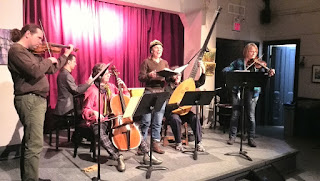
The first strain of the Teares of the Muses galliard from a rehearsal for our upcoming concert, the first of our Shakespeare anniversary shows. Chris Verrette, violin, Matt Antal, Steve Marvin and Sheila Smyth, violas and Laura Jones, bass violin. 


SWEET SWAN OF AVON
To the Memory of My Beloved the Author, Mr. William Shakespeare

This season we commemorate the 400th anniversary of the death of Shakespeare in a special series of concerts. Each program will have readings in pronunciation of the time from the plays and poems of he who Ben Jonson praised as the Swan of Avon with ayres, motets and madrigals ‘apt for voices or viols’, consort music played by our violin band led by Christopher Verrette, and lute solos.

8PM, Feb. 13th 2016
SHAKESPEARE’S LIVES OF GIRLS & WOMEN
Heliconian Hall, 35 Hazelton Ave. near Bay Subway

Running the gamut from the naughty to the tragic, the young women in the plays are never far from a lute. (Ophelia carries one; Katharina breaks one over her tutor’s head.) Love, loss and often justifiable haughtiness of the older women (in the great ladies and in the lute songs praising Elizabeth) are all considered by the playwright and in the poems set by Dowland, John Danyel, Campion and others. With dance music by Holborne, Johnson et al., actress Ruby Joy reads.

Single tickets at the door $30/$20 students & seniors

Friday, January 1, 2016


A New Year’s Day Concert

Jan. 1&2, 2016

Heliconian Hall


Sonata Op. 1, No. 12    Arcangelo Corelli (1653-1713)
Grave – Largo e puntato – Grave – Allegro

Costume di grandi  Barbara Strozzi (1619-1677)

Sonata Violino e Basso Op. 1, No. 2 Francesco Maria Veracini (1690-1768)
Preludio – Alemanda, Larghetto – Siciliana, Cantabile – Grave – Aria, Allegro 

Pièces en F                Gaspard Le Roux (c.1660-c.1707)
Prelude – Allemande Grave – Courante – Chacone

Sonata Violoncello e Basso Op. 1, No. 6 Benedetto Marcello (1686-1739)
Adagio – Allegro – Grave – Allegro

Intermission

Sonata a Violino solo Op. 1, No. 13 George Frederic Handel (1685-1759)
Afetuoso – Allegro – Larghetto – Allegro

Sonata da Camera Op. 1, No. 12 – Folia Antonio Vivaldi (1678-1741)

Serenata Con Violini – Hor che Apollo Strozzi 


The Musicians In Ordinary
Named after the singers and lutenists who performed in the most intimate quarters of the Stuart monarchs’ palace, The Musicians In Ordinary for the Lutes and Voices dedicate themselves to the performance of early solo song and vocal chamber music. Soprano Hallie Fishel and lutenist John Edwards have been described as ‘winning performers of winning music.’ A fixture on the Toronto early music scene for over 10 years, in 2012 MIO became Ensemble in Residence at St. Michael’s College in the University of Toronto. They have concertized across North America and lecture regularly at universities and museums. Institutions where MIO have performed range from the scholarly to those for a more general public and include the Shakespeare Society of America, the Renaissance Society of America, the Shakespeare Association of America, Grinnell College, the Universities of Alberta, Toronto and at California at San Diego, the Kingston Opera Guild, Syracuse, Trent and York Universities and the Bata Shoe Museum. They have been Ensemble in Residence at Lafayette College in Easton, Pennsylvania. 

Christopher Verrette has been a member of the violin section of Tafelmusik since 1993 and is a frequent soloist and leader with the orchestra. He holds a Bachelor of Music and a Performer’s Certificate from Indiana University. He contributed to the development of early music in the American Midwest, as a founding member of the Chicago Baroque Ensemble and Ensemble Voltaire, and as a guest director with the Indianapolis Baroque Orchestra. He collaborates with many ensembles around North America, performing music from seven centuries on violin, viola, rebec, vielle, and viola d’amore. He was concertmaster in a recording of rarely heard classical symphonies for an anthology by Indiana University Press and recently collaborated with Sylvia Tyson on the companion recording to her novel, Joyner’s Dream.

Patricia Ahern has a BA and BMus from Northwestern University, MMus from Indiana University, and performer diploma from the Schola Cantorum in Basel, Switzerland. She has taught baroque violin at the Freiburg Conservatory and Oberlin’s Baroque Performance Institute, and given masterclasses at McGill, Wilfrid Laurier, York and Grand Valley State Universities, and the Universities of Windsor, Wisconsin and Toronto. She has concertized on five continents performing with Milwaukee Baroque, Ars Antigua, Chicago Opera Theater, Kingsbury Ensemble, Aradia, I Furiosi, Newberry Consort, Musica Pacifica, and the Carmel Bach Festival. Tricia has recorded for Sony, Naxos, and Analekta, and joined Tafelmusik in 2002.

Borys Medicky has appeared as solo harpsichordist and continuo player in the United States, Canada, and Europe.  Resident in Toronto, Canada, he is active as a freelance performer, having appeared with major ensembles in Toronto and beyond.  He enjoys co-directing (with lutenist Lucas Harris) the Toronto Continuo Collective, an all-continuo ensemble dedicated to fostering an increased interest in the stylish basso continuo accompaniment of seventeenth-century vocal and instrumental music.  From 2006-2014 he was the artistic director of the Kitchener-based Nota Bene Baroque Players.  He serves as organist of the Fifth Church of Christ, Scientist in Toronto.  In addition he builds harpsichords and carries out harpsichord maintenance duties for institutions and private clients in the Greater Toronto area.


‘The tuneful Laura Jones’ (Barczablog) has been praised for performances on all three of her instruments: modern cello, historical cello, and viola da gamba. Her multi-faceted activities include cellist of the Windermere String Quartet, principal cellist of the Talisker Players, assistant principal of the Hamilton Philharmonic Orchestra, and principal cellist/gambist of Nota Bene Baroque Players. Recently she performed the solo viola da gamba part in George Benjamin’s Written on Skin with the Toronto Symphony, and has played to sold-out halls with Ensemble Ritmo Flamenco. She is represented on recordings by The Golden Age of String Quartets, with the Windermere String Quartet; Serenade Française, a CD of music by French composers recorded with her father, pianist Lawrence Jones; and Where Words and Music Meet: Talisker Players at Massey College.

Program Notes
Today, in order to greet the first of the year, we bring you a concert made up largely of music from the first published works of composers, printed as their Opus 1’s. Of Corelli’s Op. 1 the amateur musician and critic Roger North wrote ‘Then came over Corelly's first consort that cleared the ground of all other sorts of musick whatsoever.’ Corelli’s first sonatas were originally printed in 1681 in Rome where he worked for the top Cardinal bishops. The scoring as designated in the Roman partbooks was ‘violino primo, violino secondo, organo’ and ‘violone o arclileuto;’ but in the decades they remained popular every bass and chordal instrument then used was listed on a partbook somewhere where the sonatas were printed, from Naples to London. The title page of John Walsh’s London edition of the early 18th century gives ‘violoncello’ as the melodic bass and says the ‘through bass’ is for ‘ye organ, harpsichord or archlute.’ In Bologna the archlute is a theorbo (which you hear today). 

In publishing a collection of trio sonatas as his first opus, Vivaldi imitates Corelli in musical style and choice of scoring. A number of Corelli’s collections have a ‘ground bass’ as their last piece, and indeed, his sonata we play today, the last in Op. 1, has a descending ostinato as its ‘Largo e puntado’ movement. Vivaldi gives us a virtuoso set of variations on the Folia bass at the end of his debut. The Folia chord changes are first seen in the E-Z guitar books of the early 17th century and the charactaristic strumming pattern (strum-STRUMMM-a-strum-strum) can still be heard in Vivaldi’s and beyond. The string licks are all his own though.

Handel had worked with Corelli in Rome before settling in London. His Op. 1 sonatas for a variety of solo instruments were printed at Amsterdam in the 1720s, but the sonata you hear today, probably composed near the end of his life, was only numbered as part of that opus by the 19th century cataloguer of his works. In this, as in the Veracini sonata, you can hear the first harbingers of the Rococo style, as well as the virtuosity needed to get ‘bums on seats’ in the new musical world where royal patrons were in decline and concert goers paid for tickets. Veracini also worked in London in the 1730s and 40s.

Like Handel’s Op. 1, No. 13, whether or not Marcello’s book of ‘cello sonatas can be called Op. 1 is in doubt, since when they were printed in London in 1732 they were called Op. 2. Marcello combined composing and performing with a career in the law and the Venetian government, serving on the Council of 40.

Gaspard le Roux is a man who does need an introduction, but almost nothing is known of his life except that he taught harpsichord in Paris. We can be sure that his stylistically very French Pièces de Clavecin of 1705 is his Op. 1 as it is the only publication he left.

Almost no composers attempt the Cantata form as their first publishing foray, but we bring, we think, a first with the great Barbara Strozzi’s Serenata from her Op. 8. In this piece Strozzi could be said to have arrived at the Cantata form, where recitatives and arias are split from one another and instruments provide ritornellos and obbligatos. What a Happy New Form. And a Happy New Year.

Translations
Costume di Grandi  
The Customs of the Great
Enjoy them then leave them:
thus inconstant and false
lovers are accustomed to treat
what they hold most dear.
Thus he who lies most, 
hopes for most praise.
He cheats and enjoys.

With thieving commands

they rob one’s pleasure.

Despise and enjoy –

thus is the custom of the great.

Thus who steals 
hopes for more praise.

He cheats and enjoys.

The great and wise one

is never well-advised

to enjoy and then speak well

of the love he has enjoyed.

Thus he who censures 
hopes for more praise.
He cheats and enjoys.

Serenata Con Violini
Hor che Apollo 
Now that Thetis rests against Apollo's breast  
and my sun is in sleep's lap,  
now that I suffer thinking of him,  
on whom I may not rest my eyes,  
In this refuge, to relieve my pain,  
I come crying in love and alone.  

Yes, Filli, this heart  
that dies of love,  
comes in supplication,  
in love with your beautiful eyes.  

See my foot so heavily shackled  
my brightest star,  
and if my suffering hurts you so,  
be less cruel – or if not, less beautiful;  

if less cruel were the suffering of my slavery,  
I would know you loved me  
and if you were less beautiful, I could elude these bonds.  

See with how many thorns my heart  
you pierce, red rose,  
and when you scorn my misfortune  
be less fierce or less fair;  

but vent yourselves,  
be liberated, sighs of mine,  
for I realize now  
that I am mocked by Filli even as she sleeps.  

She laughs without a doubt at my disquiet  
and ignores the pleading of my lament.  
I should therefore leave without consolation;  
if alive you do not love me,  
dead you will see me.  

While to another place my steps do take me,  
I leave you in sweet forgetfulness,  
I am leaving Filli, my soul,  
may this be the last goodbye.