Friday, November 15, 2013


The program and notes for our concert Sat. Nov. 16, 2013, 8PM  Heliconian Hall 35 Hazelton Ave., Toronto.  Tickets $25 and $20 at the door

The Fame Which Posterity Gives – John Dowland (1563-1626)
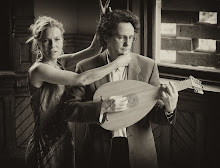
A trompe-l'œil ceiling from one of the King of Denmark's castles about the time Dowland
worked for him. Might that lute player be the only picture of Dowland?

Famam, posterias quam dedit Orpheo
Dolandi melius Musica dat sibi

‘The fame which posterity gives to Orpheus/To Dowland, Music gives the better’ Thomas Campion

Preludium
A Shepheard in a shade his plaining made
Dye not beefore thy day
His golden locks time hath to silver turnde
Sir Henry Lee with locks neither golden nor silver
Semper Dowland Semper Dolens
Sir John Smith his Almaine

It was a time when silly Bees could speake
If my complaints could passions move

Lachrimae
The Right Honourable the Lady Rich, her Galliard

Flow my tears

Times eldest sonne: First part/Then sit thee downe: Second part/When others sings Venite exultemus: Third part

Intermission

Thou mightie God/When Davids life by Saul/When the poore Criple

The Battell Galliard
Frog Galliard

Duc d'Alençon, whom Elizabeth strung along for a great while

Lady if you so spight me
Sorrow sorrow stay, lend true repentant teares
Sweet stay awhile, why will you rise?

Fantasie

In darknesse let mee dwell

Program Notes
‘My Lord of Essex chose to evaporate his thoughts in a sonnet (beeing his common way) to be sung before the Queene, (as it was) by one Hales, in whose voice she took some pleasure.’ Sir Henry Wotton wrote this some 40 years after the execution of Robert Devereaux, the Earl of Essex, in a pamphlet comparing him to another spectacular courtier who met an untimely end, the Duke of Buckingham, the ‘favourite’ of James I. But it would be very rare, even impossible, for Essex and Elizabeth to ever be alone together; court ceremony meant that the ensemble called the Lutes and Voices served right in the Queen’s bed chamber along with all the other courtiers and servants. So any courtier’s poem sung before the queen and her entourage was very much a semi-public, self-serving self-fashioning. This is most explicit in Dowland’s setting of Essex’s poem ‘It was a time when silly Bees could speak’, called 'The Earl of Essex, his Buzz’ in poetic sources, where Essex, punning heavily on thyme/time, complains to the queen bee that he is not getting his just reward for all the time he puts in getting nectar from the thyme.

The Earl of Essex, head intact
‘His golden locks’ and the ‘Times eldest sonne’ trilogy are also examples of both the late Elizabethan preoccupation with time, and a courtier sending a message to court via song. These songs are from the Accession Day celebrations of 1590. Sir Henry Lea, the queen’s champion in the stylized jousting tournaments here announces his retirement in an equally stylized manner. In the lyric of ‘Times eldest sonne’ (sung at the ceremony by the Robert Hales mentioned by Wotton above) Lea describes how he will replace the Psalms and Canticles prescribed for Morning Prayer in the Book of Common Prayer, with those used for Evening Prayer. Needless to say, Elizabeth’s still fairly new and controversial Prayerbook does not include the Ave Maria prayer for that other Blessed Virgin.

Lucy, Countess of Bedford, bankroller of Jacobethan Melancholy
But it was not only male courtiers who were projecting an image through song and poem. Dowland’s Second Book of Songs, which cements his position as the official composer of Elizabethan Melancholy, was dedicated to Lucy Countess of Bedford who also was the patron of darkness peddling poets Ben Jonson, John Donne and Samuel Danyel. Did she engage these artists because she was drawn to their work in the melancholy milieu or was Elizabethan and Jacobean melancholy made to order for the woman who wanted to bring light (N.B. Lucy=light) to these artists?
A Melancholy Man, by Isaac Oliver, sometimes said to be Philip Sidney
Pastoralism, as heard in ‘A Shepheard in a shade’, was another artistic movement at the turn of the 17th century. Sir Philip Sidney was Essex’s friend, his immediate predecessor as most sparkling young courtier, and author of Arcadia and Astrophel and Stella, works that put pastoralism and its fields on the map in England. The beloved Stella of Sidney’s sonnet cycle was Penelope Devereaux, sister of the Earl. She was unhappily married to the Lord Rich over the protestations of herself and of Sidney. The Battell Galliard sets up trumpet figures in two opposing keys in imitation of Clement Jannequin’s chanson La Battaille. Sir Philip was banished from court for a while for protesting too strongly his opinion of the queen’s possible match with the Duke of Alençon, who she referred to as ‘My frog’. Might this be the source of a somewhat less respectful dedication of a galliard than The Right Honourable the Lady Rich, her Galliard?

Monday, November 4, 2013

Here's part two of our talk on lute tablature and printing for the class Books, Media, and Music at St. Michael's College. Part one is here.

We dealt with German lute tablature pretty quickly. I have never met a lute player who reads German tablature; it's straightforward to decipher it, but reading it is a bit complicated. German lute tablature is said to have been invented by the blind organist Conrad Paumann at the end of the 15th century, when most lutes would have only had five pairs of strings (or 'courses'). So, starting with the fifth course open, and going up the strings, then up to the first fret and so on, German tablature has a letter or cipher for each intersection of string and fret. Here's a diagram from Sebastian Virdung’s Musica Getutscht, a book describing musical instruments published around 1511.


You can see that the open strings from the (in 1490) lowest to highest are 1 to 5, then the first fret from the (in 1490) lowest string to the highest is a to e, the second fret from f to k (i and j are the same letter in 1511) and so on up the neck. Once you pass z, you double the letters up. To read fluently up to the seventh fret on a five course lute, you need to memorize and react instantly to 35 symbols. But then, complicating things further, the sixth course gets added. Virdung here uses, at each fret on the sixth course, a capital of the adjacent fifth course, but other systems were used by other printers. Rhythm signs, which look like grids of 16th notes without their 'dots' at the bottom, were put over the ciphers, which are stacked up in chords. Here is a very simple little two part dance from Hans Neusidler’s Ein Newgeordent Kuenstlich Lautenbuch (1536). You can imagine how a big complicated piece like Capirola's version of a Josquin mass movement would look.


As I say, we got through German tablature pretty quickly, and so did German lute players. By the beginning of the 17th century they were all using Italian or French tablature. 

French tablature uses the same principal of having lines representing strings and ciphers representing frets as does Italian tablature, except the highest sounding string is at the top of the page and the ciphers are letters instead of numbers. The open string is 'a', the first fret 'b' and so on up the neck. Pierre Attaingnant uses five lines for the strings which implies that even in 1529, the sixth course was still thought of as 'extra'. Or he was just used to five lines from printing staff notation? Anyway, Other French publishers soon started using six lines for their tablature prints.  Here's Claudin de Sermisy's chanson, Tant que vivray arranged from four voices for one voice and lute from Attaingnant's Tres breve et familiere introduction. Compare Attaingnant's 'one stop' block method of printing with Petrucci's much more beautiful two or three pass method from the previous post. (He has also left off a nice illuminated capital T at the beginning of the type you see at the beginning of A Shepheard in a shade below.)


We can see that, nominally at least, Attaingnant's arranger thinks of his top string as G, since the singer starts on a C which means the first chord has to be an F chord. (The clef in the singing part shows that the bottom line is middle C.)

Look at the last note in the third bar of Tant. Should be a B flat right? Well, maybe not, because scribes and printers in the 16th century and earlier were not always careful about putting in what we would call 'accidental' sharp signs. The music reader, using the 'sol-fa' theory of the day and his ear, would 'just know' whether to sharp a note. This editorialising by the performer on the fly is called 'musica ficta'. Many hours have been lost in modern rehearsals with singers arguing 'No, the editor of this modern edition shold (or should not) have sharped this.' Below is the lute solo version of the same song from the same book. (The tune is a little decorated for the lute player to show off his licks.) 


That B flat in the third bar of the song (sorry, no bar lines in the lute version) is very clearly an E fret, that is the fourth fret on the top string, which is a B natural. In the case of this musica ficta problem of left out sharps, naturals and flats, then, lute tablature is more accurate than the staff notation system of the time and can give clues and examples to singers for what to sharp when. (Spoiler alert: sharp much more often than you'd think, if the lute solo versions of chansons, madrigals, motets and mass movements are to be believed.)

After spending much of the 16th century occupied with deciding whether to be Catholic or Protestant, the English were blessed with Queen Elizabeth the First, who stablized things and, importantly for us, gave a monopoly for music printing to the composers Byrd and Tallis. For some reason, perhaps they misjudged the market with their first choice of repertoire printed, they let the monopoly lie there till it ran out in 1596 so there was a giant pent up demand for lute songs and solos. A man named William Barley printed a book which pirates a French lute method and then has some very mistake prone lute solos (John Dowland describes them as 'false and unperfect') in that year and then the monopoly is renewed, this time with the much more clever Thomas Morley. Morley would take £10 off you, give you a license for you to print some music and take the risk as to whether there was a public for it yourself. 

John Dowland's First Book of Songs or Ayres to the Lute... came out in 1597 and was reprinted several times in the next few years, so about 3 or 4 thousand copies of this book were floating around in a city of maybe 300,000 where only a minority could read words, let alone lute tablature. His Second Book of Songs came out in 1600. Luckily for us, because of the success of the First Book there were some shenanigans with secret copies being printed to be sold down the pub under the table and the publisher sued the printer. Because of the court case we know all kinds of details about how much Morley got for the monopoly license, how much the dedicatee of the book, Lucy, Countess of Bedford (who funded all kinds of darkness and melancholy themed arts at the time), chipped in, how much Mrs. Dowland got for the manucript etc. This is all detailed in Diana Poulton's book on Dowland (see page 245). 

Here's the two pages of A shepheard in a shade from that book. You can see that the foolscap sized page has the optional singing parts set up facing different ways on the page so that the singers can put the book in the middle of the table and all read off the same copy. This book is printed for intimate music making at home.


Here's a closer look at the first couple of lines of that song. Again the lute comes out, nominally, as having a top string at G. The letters of the French tablature are the same (but lower case). The dropped in type blocks are the same method as Attaingnant. There are sort of 'ledger lines' for the recently adopted seventh course of the lute. 


As we saw with Italian tablature, a manuscript can have a lot more information for the player than contemporary printing methods could provide. Here's an example from Margaret Board's Lutebook. She was a lute student of John Dowland in about 1620. There are loads of marks to show you what to hold, what ornaments to use etc. See that manuscripts often use the grid system of rhythm signs that we saw in German tablature too. This is Dowland's most famous piece Lachrimae Pavan which was quoted for a hundred years after its composition when you'd have the word tear, or wanted to represent melancholy.


Dowland recycled the tune into his song Flow my teares which you can download us singing here. 


Around 1600 music publishers started using a new method of engraving the score backwards onto a copper plate and printing from that. With a skilled engraver, then, printed music could now have all of the little commas, swooping curves for phrasing, fingering dots for right hand strums that had previously only been available in manuscript. Here's the air de cour En fin la beauté by Etienne Moulinie from Airs avec tablature de luth premiere livre published by Pierre Ballard in 1624. 


The composer, then, has gained more control over the performer. When I as a lute player occasionally get to play modern music I often find myself resenting all the information the composer has put in with regards to tempo, phrasing etc. 'How dare he tell me how to play it? That's my job!' I wonder if lute players in 1620, picking up Ballard's engraved songbooks felt the same?


Wednesday, October 30, 2013

Last week we talked about the printing of lute tablature and lute song for Michael O'Connor's class called Books, Media, and Music at St. Michael's College. I'm going to break the talk into two blog entries because it's too long and I don't want you to say tl/dr.

We started off by showing an example of guitar solo music from 1980. In this line from Peter Maxwell Davies' Farewell to Stromness the arranger and editor, guitarist Timothy Walker, has fingered at least one note in every chord. Some notes even have two fingerings for a note, one for the finger and one for the string to play it on, though the string is implicit anywhere he tells you what finger to use.


So you have to think if Timothy Walker thinks that a plucked string player needs that much more information above and beyond the dots and lines of staff notation he, and he would never think this out loud, must think that staff notation is not adequate for notating plucked string music. 

One group of people who are not encumbered by the snobbery of having to 'read music' (ie. dots in staff notation), who thus think the 'music' is the sound waves, the performance, not the piece of paper with dots on it which we also call 'music', are classic rock fans. They know that tablature will give you the information you need more efficiently. There are thousands of tablature sites out there with the first bars of this famous piece. This example of Stairway to Heaven is from shredmentor.com. Reading tablature never really went away, Guitar World magazine would have examples in the back, but the new medium of the internets has certainly boosted it. 


This tablature has six lines representing the strings of the guitar with the top sounding string nearest the top of the page. The numbers on the lines are the frets of the guitar, 0= open string, 1= first fret 2= second fret, etc. 

Modern tab readers though, have not started using the rhythm signs that lutenists and guitarists used from the 16th to the 18th century, maybe because they will always have heard the song they are learning, so they'll know to play the Stairway in four square time, not swung. 

The Thibault Manuscript (Blibliothèque Nationale, Paris. Rés. Vmd. Ms. 27), probably started around 1502, has that sense of a lute player jotting down some reminders of pieces he knows already. There are no rhythm signs, but the rhythms can often be reconstructed (click on the link above) from the right hand fingering signs; when there are two thumb plucks in a row followed by a forefinger designated by a dot under the note you know the rhythm is 'taa-ti-ti', because strong beats always get the stronger sounding thumb downward pluck. The rhythm signs in the example of a decorated version of the famous Fortuna desperata are jotted in by me because I don't know the piece as well as the first person who owned the manuscript. Here the top sounding string is nearest the bottom of the page because, obviously, that string is nearest the ground when you are holding a lute or guitar. This is called Italian tablature and was used in Italy, parts of Germany and, mostly, in Spain. 


Next I played a piece from the first printed book of specifically instrumental music. Ottaviano Petrucci didn't invent music printing, but was the first successful publisher. In 1507 he printed Intabolatura de lauto libro primo and secondo of music by or arranged by Francesco Spinacino. The technique Petrucci used was to print the lines, then go back and print on the fret numbers and rhythm signs. What a beautiful job he does considering the complexity of that technique and that it is the first time anyone had ever printed lute music. And what an honour for Spinacino to be the first musician to have his instrumental works published. How strange that we know little more about him beyond his name. 


But of course, tablature is not telling you about pitches, only about where to put your fingers. I had brought three lutes, one with the top string at E, one at G and one at A. Hallie sang this song, printed in 1509 (Franciscus Bossinensis’s Tenori e contrabassi intabulati col sopran in canto figurato per cantar e sonar col lauto), with each of them. The rubric at the beginning says 'the voice of the soprano is at (ie. starts on) the fifth fret of the canto (top string)'. So, though the staff notation first note in the says she sings a D, so to harmonize with that note the top string of the lute must be an A, I can give her the first note on any of the lutes and put my fingers in the same place and she transposes up or down to where it's comfortable, depending on which lute I am playing. We agreed this song sounds best with the lute in A, but some of the ones which are for a lute in E sound better up. Maybe Petrucci was just avoiding ledger lines. Around 1500 Isabella d'Este, Marchesa of Mantua, wrote to her instrument maker Lorenzo di Pavia 'Make is a lute that is two steps smaller than the viola you made, which we find a little too low for our voice.' 


Petrucci does a beautiful job of printing, but still can't compete with the detail that you can include in a manuscript. In 1517 Vidal starts his manuscript, now in the Newberry Library in Chicago and writes this at the beginning: 
Considering that several divine works have been lost by the ignorance of their owners, and desiring that this almost divine book written by me will be preserved forever, I, Vidal, have adorned it with such noble paintings, so that if it should be owned by somebody with no knowledge in (the musical field), he would keep it for the beauty of the pictures. Surely, the things written in this book have as much harmony as the art of music may express.

In this example of Capirola you can see where to put ornaments (fret numbers in dots and slashes through fret numbers), signs that tell you where to hold and release notes (not so important on the lute which makes the very short 'plink', and you will need that finger somewhere else soon.) and of course bunnies. 


Friday, October 11, 2013


Here's the program for the Rosary concert tonight at 100 St. Joseph St. Toronto. Map on how to get there at bottom. 

The Christianty and Culture program at St Michael's College in the University of Toronto 
and 

The Musicians In Ordinary for the Lutes and Voices

present

The Rosary Sonatas – The Glorious Mysteries 


Fr. Madden Auditorium, Carr Hall 
100 St. Joseph St. 
St. Michael’s College
Oct. 11, 2013
Lecture by Rev. Lisa Wang at 7:30PM, Concert at 8PM

The Resurrection Heinrich Ignaz Franz Biber (1644-1704)
Domine in adjuvandum Maurizio Cazzati (c1620-77)
O Lord, make haste to help me. Glory be to the Father, and to the Son, and to the Holy Ghost: As it was in the beginning, is now and ever shall be, world without end, Amen.
(Text – Response from the beginning of each of the Hours )

Click on the photo to get a closer look at the crossed strings

The Ascension Biber
Vocem jucunditatis Alessandro Grandi (c.1580-1630)
Declare it with the voice of joy, and make it known, alleluia.
The Lord hath delivered His people, alleluia.
Christ has ascended on high. He has led captivity captive. He has given gifts to mankind, alleluia.
(Text – Excerpt from the Introit for the Fifth Sunday after Easter)

Pentecost Biber
Veni sancte Spiritus Giovanni Pozzo (fl. 1610)
Come Holy Spirit, you who are with the Father and the Son, one God through the ages; kindle in the depths of our hearts the flames of love, enliven us that we, loving the Lord, may enjoy you forever. O sweetest Spirit, I ask that you remain with me and keep watch over me always, so that, in the mouths of those celebrating you in song, you may be praised forever.
(Text – Free, with phrases from Sequence and Alleluia for Pentecost and Credo)


The Assumption of the Virgin  Biber
Prudentissima virgo Grandi
Virgin most wise, where are you going, Daughter of Sion, shining out as brightly as the dawn? You are most comely and merciful, beautiful as the moon, excellent as the sun, alleluia.
(Text – Magnificat Antiphon, First Vespers of the Assumption of the BVM)

The Coronation of the Virgin Biber
O Quam speciosa Grandi
O how beautiful have you become, O Mary, thou lovely, thou kindly, O Mary, sweet rose.
O Mary, sweet rose, pray for us to Jesus Christ our Saviour, that he may protect and free us. O Mary, sweet rose, thou lovely, thou kindly, thou beauteous, thou glorious mother. O Mary, sweet rose.
O Mary, sweet rose, pray for us to Jesus Christ, Son of God, to preserve us in God’s love, thou beautiful, decorous, chosen mother of God. O Mary, sweet rose. Alleluia
(Text – Free, after the Song of Solomon)


Program Notes by Christopher Verrette
Biber’s Rosary Sonatas were a product of a culture that believed in using all the senses and all available media to contemplate the divine. This included visual art, music (both in sound and notation), dances (with which his audience would have been physically familiar) and in this particular case, unorthodox tunings of the violin. Here are some concise thoughts on how these things work together to contemplate the Glorious Mysteries.

The tuning of the Resurrection sonata is arguably the most expressive in the set, because it requires the player to cross the middle strings of the violin creating a visual symbol on the instrument, while disorienting the player's right arm as much as his left hand. The opening makes extensive use of the echo, perhaps suggesting the empty burial cave. What follows is the only reference to actual sacred music in this cycle: a set of variations on the hymn Surrexit Christus Hodie, written in gigantic, antique-style note values in the Trinitarian meter of 3/1, a visually stunning notational choice. The violin is heard playing in parallel octaves, like congregational singing, which is facilitated by the unusual tuning. After a final statement of the hymn in three octaves, the sonata ends with an introspective coda.

The picture of the Ascension in the score shows only Jesus' feet disappearing upward, which is mirrored in fast rising scales in the music, but the composer is clearly showing us His arrival in heaven to trumpet music. The tuning of the violin in a C Major chord makes this possible using a maximum of open strings. Two dances follow, of which the second is especially significant: Biber uses the courante exactly three times in the cycle. Dance historian Wendy Hilton has characterised the courante as "the dance of kings", and here it affirmatively expresses the triumphant fulfillment of something hinted at in earlier mysteries, in moments of humility and humiliation.

The sheer wildness of the writing in the sonata for Pentecost may betray Biber's birth in Bohemia. He quoted genuine folk music in other works and may have called upon his experience of folk fiddlers to suggest the winds and tongues of fire. It uses a brilliant tuning allowing for swirling passages in thirds and sixths.

The Assumption of the Virgin is some of the most light-hearted music to be found in the cycle. The opening passagework ends somewhat abruptly on a high note, indicating the direction of her travel. Most of the piece is a playful set of variations on a ground bass, though the whole story is told in a nutshell at the end: the violin disappears in mid-phrase leaving the continuo players alone on earth to contemplate the empty tomb.

The Coronation of the Virgin uses the most relaxed tuning to be found, creating a warm, deep sound. More formal counterpoint is used than in the other sonatas, but dance gets the last word: a saraband with a particularly delicate – even feminine – variation.  


Saturday, September 28, 2013


Here's the program for our Concert for St. Michael's Day at St. Michael's College. 7:30PM September 28, 2013 St Basil’s Church, St Michael’s College, 50 St. Joseph St. at Bay


Concerto for Violin & Oboe in B-flat maj. Antonio Vivaldi (1678-1741)
Allegro-Grave-Aria-Allegro

Cantata - Am Michaelestage Georg Philipp Telemann (1681-1767)
Aria ‘Packe dich, gelähmter Drache!’ - Recit - Aria ‘Hinweg, o höllisches Getümmel!’

Gloria in excelsis Deo Vivaldi


From 1721 Georg Philipp Telemann, worked as the music director of five churches in the city of Hamburg. As well as providing music for church, his other civic duties, and directing the opera, he also found time to pursue the legal right to control the publication of his own music.


Among Telemann’s publishing adventures was his collection Harmonischer Gottes-Dienst. Published in two volumes in 1726, this print has a cantata for every Sunday and holiday of the church year, scored for a singer and one instrument, a violin, oboe, recorder or flute. The Lutheran service in Hamburg at the time would feature a large cantata with several singers and an orchestra (like the typical Bach cantata we are familiar with), followed by a long sermon, followed by another short cantata of the type in Harmonischer Gottes-Dienst. Since Telemann was organising the music for five churches most of the players and singers would disperse during the sermon to another church for their large cantata so he was never sure what forces would be present where for the small cantata. In the preface he recommends doubling with ripieno players ‘where there are sufficient players…They shall start to play where the F (forte-loud) is marked and play until the P (piano-soft) is seen.’


It is hard to imagine, given the present popularity of the Gloria in D major, that Vivaldi’s church music was completely forgotten until well into the 20th century. Unlike Telemann, Vivaldi’s interest in publishing seems to have been small compared to the size of his ouevre. His sacred music was mostly composed and performed as part of his duties as Maestro di Concerti at the Conservatorio dell'Ospedale della Pietà and exist mostly in manuscripts scattered thoughout Europe. The concerts given by the young women of the Pietà orphanage were a major attraction on the Venice stop of the Grand Tour taken by European gentlemen of the 18th century. Quite who would have sung the tenor and bass parts is not clear, since the boys were put out for training as apprentices before their voices had broken. The concerto we present exists in another version, but the one we perform tonight is from a manuscript in Dresden recently made available digitally. It may be an attempt by a Dresden musician, perhaps Johann Georg Pisendel, to incorporate an oboe into an existing violin concerto. This includes the unusual insertion of a French-style air for oboe solo.


The Musicians In Ordinary Orchestra
1st Violins
Chris Verrette, Emily Eng, Michelle Odorico

2nd Violins
Kathleen Kajioka, Elizabeth Loewen Andrews

Violas
Steve Marvin, Eleanor Verrette

Violoncello
Laura Jones

Contrabass
Calum MacLeod

Oboe
Marco Cera

Trumpet
Andras Molnar

Organ
Philip Fournier

Theorbo 
John Edwards

St Michael’s Schola Cantorum
Soprano
Sana Bathich, Kara Dymond, Catherine Hamilton, Bernadette Domingo, Laurel-Ann Finn, Megan Maeve McCarthy

Alto
Mekhriban Mamedova, Irene Gaspar, Ann Marie Tedesco, Annemarie Sherlock, Cindy Dymond, Connie Tsui, Irene Chan, Ana Iorgulescu

Tenor
Adam Miceli, Reid Locklin, Antonio Manco

Bass
Christian McConnell, Eric Charron, Adam Lalonde, Paul McGrath

Rehearsal pianist-Stefania Lista

The Musicians In Ordinary
Named after the singers and lutenists who performed in the most intimate quarters of the Stuart monarchs’ palace, The Musicians In Ordinary for the Lutes and Voices dedicate themselves to the performance of early solo song and vocal chamber music. Soprano Hallie Fishel and lutenist John Edwards have been described as ‘winning performers of winning music’. A fixture on the Toronto early music scene for over 10 years, last year MIO became Ensemble in Residence at St. Michael’s College in the University of Toronto. They have concertized across North America and lecture regularly at universities and museums. Institutions where MIO have performed range from the scholarly to those for a more general public and include the Shakespeare Society of America, the Renaissance Society of America, Canadian Society for Renaissance Studies, Grinnell College, the Universities of Alberta, Toronto and California at San Diego, the Kingston Opera Guild, Syracuse, Trent and York Universities and the Bata Shoe Museum. They have been Ensemble in Residence at Lafayette College in Easton, Pennsylvania. 

Christopher Verrette has been a member of the violin section of Tafelmusik since 1993 and is a frequent soloist and leader with the orchestra. He holds a Bachelor of Music and a Performer’s Certificate from Indiana University and contributed to the development of early music in the American Midwest as a founding member of the Chicago Baroque Ensemble and Ensemble Voltaire, and as a guest director with the Indianapolis Baroque Orchestra. He collaborates with many ensembles around North America, performing music from seven centuries on violin, viola, rebec, vielle and viola d’amore. He was concertmaster for a recording of rarely heard classical symphonies for a recently released anthology by Indiana University Press, and most recently collaborated with Sylvia Tyson on the companion recording to her novel, Joyner’s Dream.

Laura McAlpine is enthusing audiences with her musical interpretation, and dramatic versatility with “mellifluous singing and flashes of wit” (Opera Canada), an “impressive voice that jumps off the stage” (Paula Citron, Classical 96.3 FM), and a “fine performance, clear, expressive voice with fine artistic sensibility” (Dianne Wells, Whole Note). On the opera stage, Laura has received acclaim for her performances, and interpretations of Sesto (La clemenza di Tito), Dorabella (Cosi fan tutté), Madame Flora (The Medium), Charlotte (Werther), Cherubino (Le nozze di Figaro), Dryade (Ariadne auf Naxos), Orlovsky (Die Fledermaus), Siebel (Faust), Sarinder (Savitri and Sam), in the newly composed opera by Canadian John Mills-Cockell, with Factory Theatre, and Aunt Luce Gertrude (Kamouraska), in Charles Wilson’s workshop and premiere presentation, with Opera in Concert, and conductor Alex Pauk. Oratorio and concert performances include, Handel’s Messiah, Bach cantatas 78, 132, 133; and 147 with Victoria Symphony Orchestra, and conductor Alain Trudel, and scenes of Carmen in a concert presentation of Bizet’s Carmen, with Cambridge Symphony, and conductor Sabatino Vacca. Laura self-produced, A Poet’s Love, a staged recital production, and recording of Robert Schumann, and Ukrainian composer, Mykola Lysenko’s Dichterliebe song cycles. This past season, Laura sang the role of Mozart’s Sesto, under Jonathan Berman with Aradia Ensemble, in CO-SI’s training program in Sulmona, Italy, and was the alto soloist in the North American premiere of Krystof Maratka’s VABENI, composed for choir and orchestra with the Toronto Symphony Orchestra’s 2013 New Creations Festival, with conductor Peter Oundjian. Upcoming concert performances for this season include alto soloist in an 8-voice Bach’s Weihnachts Oratorium, Vivaldi’s Gloria, and Messiah, as well as der Komponist in Richard Strauss’s Ariadne auf Naxos.

Oboist Marco Cera studied at the Padua Conservatory of Music (Italy) and at the Musikhochschule der Stadt Basel (Switzerland). In 1996 he was chosen as first oboe for the European Union Baroque Orchestra, with which he performed in Denmark, Portugal, Germany, United Kingdom and South Africa. He regularly collaborates as a soloist with the leading baroque orchestras in Italy and Europe, including Il Giardino Armonico, Concerto Italiano, I Sonatori della Gioiosa Marca, Accademia Bizantina, Cappella della Pieta’ de’ Turchini, Ensemble Zefiro, Europa Galante, I Barocchisti, Les Talens Lyriques and Academia Montis Regalis, and has worked with conductors Jordi Savall, Gustav Leonhardt, Robert King, Jesper Christensen, Jaap ter Linden and Barthold Kuijken. His wide discography includes works for Teldec, Opus 111, Chandos, Dynamic, Tactus. Marco moved from Italy to Toronto to play with Tafelmusik from 2000-2002, and rejoined the orchestra in January 2007. 

St Michael’s Schola Cantorum is an ad hoc group drawn from staff, graduate and undergraduate students, faculty at the University of St Michael’s College, and members of St Basil’s parish choir.

Michael O’Connor has been Director of Music at St Basil’s Church since 2010, and is an Associate of the Royal School of Church Music. He teaches in the college programs at St Michael’s and runs a weekly singing club on campus. His academic scholarship and practical music-making overlap in the theory and practice of liturgical music.


Tuesday, May 28, 2013

Last week we had a whirlwind trip to San Diego. I met Hallie at Toronto Pearson Airport at 8AM for a flight at 5 to 10 - got to get there early because a) they might be sticky about carrying on the lute, and b) my name is apparently like someone's who is on some kind of list. All was well though and the Renaissance lute went in the overhead. Here's Hallie on the 5 hour flight.
'Really?'
Seth Lerer, Dean of Arts and Humanities at University of California at San Diego had invited us to talk to his Shakespeare class and give a concert. But the evening of our arrival we went to the opening of the very exciting Arthur C. Clark Center for the Human Imagination. You hear more about that with Seth on PBS here.

In the class we began by singing Lachrimae/Flow my tears from John Dowland’s Second Book of Songs, the melancholy poet of which has many parallel symptoms with Hamlet. Download us singing that here if you haven't already.

The Class
We then talked about the lute's place in Renaissance imagination. Remember when Hamlet comes in with his book all distracted? It marks him out as a Renaissance man, but scholars are in danger of becoming melancholic and mentally ill. Robert Burton in his Anatomy of Melancholy has a subsection that begins 'Love of Learning, or overmuch study Causes,' and closes 'with a Digression of the misery of Scholars, and why the Muses are Melancholy.' The lute, which for the Renaissance corresponded to the ancient lyre, was also code for a man or woman steeped in Humanist learning.


Two gentlemen showing off their Ancient Humanist learning and wearing trendy black.
Gertrude - 'Good Hamlet, cast thy nighted color off...'
Burton is writing about 20 years after Hamlet was published, but Shakespeare may have proofread Timothy Bright's Treatise of Melancholy since the playwright-to-be was working in such a capacity for Bright's publisher at the time. We discussed some of the symptoms of Hamlet and the poor poet in the song Flow my Tears to demonstrate that by early modern standards, these guys were ill.

Then we went on to talk about Ophelia’s songs, which we've thought about a lot with Prof. Deanne Williams. The 'bad quarto', the first print of Hamlet has her entering with a lute in hand. While it may be deficient in other ways (or it may just represent the play for a different context at the Inns at Court rather than the Globe) this direction is important. When she starts singing songs that a well educated young lady shouldn't have is becomes very much so. As an example of what a young lute-learning women should be singing we sang Coy Daphne fled/Chaste Daphne fled (a 2 for 1 song with different texts that praise and mock chastity) and Like as the Lute (a kind of patchwork quilt of musical definition demonstrations for the lute song student) from John Danyel’s songbook dedicated to Miss Anne Green. In the dedication he specifically says the songs were composed for her to sing.
A Ballad on the tune of Robin, (which Ophelia sings a snippet of with its original words)
on the topic of a rich powerful trying to get his way with a young woman.  

Ophelia, though, sings, with her lute in hand some of the rudest ballad songs. But not only that, we found that the texts she sings that appear to be less rude are actually associated with other near-contemporary ballad texts that where an older, richer man seduces, or attempts to seduce, a younger woman. Would the audience at the original performances have been saying ‘Oh, she’s singing that tune that has the other words of The princely wooing of the fair maid of London by King Edward’ (to the tune of Robin is to the Greenwood Gone) and ‘Oh, that’s the one that has the other words where the rich merchant is trying it on with Bess the farmer’s wife’ (to the tune of Walsingham)?

Then it was back to the hotel to get cleaned up for the concert.

The palm at the end of the mind, Beyond the last thought, rises...
This one's only at the end of the driveway of the Sheraton, though. 
Here's the program for that:

The Dean of the Division of Arts and Humanities presents


When Silly Bees Could Speak
Music by John Dowland for the 450th anniversary of his birth

Recital Hall, Conrad Prebys Music Center,
University of California San Diego
6PM - May 21st 2013

John Dowland (1563-1626)
It was a time when silly Bees could speak.
Dye not before thy day
Times eldest sonne, old age the heyre of ease: First part
Then sit thee downe, & say thy Nunc demittis: Second part
When others sings Venite exultemus: Third part

Lachrimae pavan
The Right Honourable Robert, Earl of Essex, his Galliard
The most sacred Queene Elizabeth, her Galliard

Sweet stay awhile, why will you rise?
If my complaints could passions move

Semper Dowland Semper Dolens
Sir John Smith his Almaine

A Sheperd in a shade his plaining made
Sorrow sorrow stay, lend true repentant teares

Solus cum sola
The Right Honourable the Lady Rich, her Galliard
Frog Galliard

Thou mighty God  1. part
When Davids life by Saul  2. part
When the poore Criple  3. part

Preludium
Lady if you so spight me
In darknesse let mee dwell
Our glamourous green room. 
Program Notes
‘My Lord of Essex chose to evaporate his thoughts in a sonnet (beeing his common way) to be sung before the Queene, (as it was) by one Hales, in whose voice she took some pleasure.’ Sir Henry Wotton wrote this some 40 years after the execution of Robert Devereaux, the Earl of Essex, in a pamphlet comparing him to another spectacular courtier who met an untimely end, the Duke of Buckingham, the ‘favourite’ of James I. But it would be very rare, even impossible, for Essex and Elizabeth to ever be alone together; court ceremony meant that the ensemble called the Lutes and Voices served right in the Queen’s bed chamber along with all the other courtiers and servants. So any courtier’s poem sung before the queen was to some degree a semi-public self-serving self-fashioning. This is most explicit in Dowland’s setting of Essex’s poem ‘It was a time when silly Bees could speak’, called The Earl of Essex, his Buzz’ in poetic sources, where Essex, punning heavily on thyme/time, complains to the queen bee that he is not getting his just reward for all the time he puts in getting nectar from the thyme.
There are no bees, silly or otherwise, in this flower. It is not thyme. 
The ‘Times eldest sonne’ trilogy is another example, both of the late Elizabethan preoccupation with time and with a courtier sending a message to court via song. These songs are from the Accession Day celebrations of 1590. Here Sir Henry Lea, the queen’s champion in the, by then stylized, jousting competitions announced his retirement in an equally stylized manner. In the lyric, which was sung at the ceremony by the Robert Hales mentioned by Wotton above, Lea describes how he will replace the Psalms and Canticles prescribed for Morning Prayer in the still fairly new and controversial Book of Common Prayer, with those used for Evening Prayer. Needless to say, the Book of Common Prayer does not include the Ave Mari prayer for that Blessed Virgin.

But it was not only male courtiers who were projecting an image through song and poem. Dowland’s Second Book of Songs, which cements his position as the official composer of Elizabethan Melancholy, was dedicated to Lucy Countess of Bedford who also was the patron of Ben Jonson, John Donne and Samuel Danyel. Did she engage these artists because she was drawn to their work in the melancholy milieu or was Elizabethan and Jacobean melancholy made to order for the woman who wanted to bring light (Lucy) to these dark artists?

Hallie, John and Seth by a Triton, mascot of  UCSD 's sports teams. 
Pastoralism, as heard in ‘A Sheperd in a shade’, was another artistic movement at the turn of the 17th century. Sir Philip Sidney was Essex’s friend, his immediate predecessor as most sparkling young courtier, and author of Arcadia and Astrophel and Stella, works that put pastoralism and its fields on the map in England. The beloved Stella of Sidney’s sonnet cycle was Penelope Devereaux, sister of the Earl. She was unhappily married to the Lord Rich over the protestations of herself and Sidney. Sidney was banished from court for a while for protesting too strongly his opinion of the queen’s possible match with the Duke of Alençon, who she referred to as ‘My frog’. Might this be the source of a somewhat less respectful dedication of a galliard than ‘The Right Honourable Robert, Earl of Essex, Earl Marshall of England, his Galliard’?

And on the third day...

Home again, home again, market is done. 


Friday, April 26, 2013

Final program, notes and translations for our season finale French Cantatas Mixed With Symphonies, 8PM, Apr. 27th 2013 at Heliconian Hall.


French Cantatas Mixed with Symphonies

Musette Jean-Baptiste de Bousset (1662-1725)

Piéces en Mi Mineur Marin Marais (1656–1728)
Prelude-Le Tableau de l'Operation de la Taille-Les Relevailles

Factum est silentium Louis-Nicolas Clérambault (1676-1749)

Piéces en Sol Mineur Louis Couperin (c.1626-1661)
Prelude-Allemande-Courante-Sarabande-Passacaille

Sonate a la Maresienne Marais
Un peu grave-Legerement-Un peu gay-Sarabande-Tres vivement-Gravement-Gigue

Intermission

Piéces en Sol Majeur Robert de Visée (c.1655-1732/3)
Prelude-Menuet-Entrée Des Espagnols de M De Lully-Les Sylvains de M Couperin 

Semelé-Cantate Avec Simphonie Élisabeth Jacquet de la Guerre (1665-1729)

The Musicians In Ordinary
Named after the singers and lutenists who performed in the most intimate quarters of the Stuart monarchs’ palace, The Musicians In Ordinary for the Lutes and Voices dedicate themselves to the performance of early solo song and vocal chamber music. Soprano Hallie Fishel and lutenist John Edwards have been described as ‘winning performers of winning music’. A fixture on the Toronto early music scene for over 10 years, this year MIO became Ensemble in Residence at St. Michael’s College in the University of Toronto and next month they have been invited to give lectures and a concert at University of California, San Diego. They have concertized across North America and lecture regularly at universities and museums. Institutions where MIO have performed range from the scholarly to those for a more general public and include the Renaissance Society of America, Canadian Society for Renaissance Studies, Grinnell College, the Universities of Alberta and Toronto, Syracuse, Trent and York Universities and the Bata Shoe Museum. They have been Ensemble in Residence at Lafayette College in Easton, Pennsylvania. Their CD of Elizabethan and Jacobean songs on the topic of sleep, Sleep Wayward Thoughts, is available at intermission.

Christopher Verrette has been a member of the violin section of Tafelmusik since 1993 and is a frequent soloist and leader with the orchestra. He holds a Bachelor of Music and a Performer’s Certificate from Indiana University and contributed to the development of early music in the American Midwest as a founding member of the Chicago Baroque Ensemble and Ensemble Voltaire, and as a guest director with the Indianapolis Baroque Orchestra. He collaborates with many ensembles around North America, performing music from seven centuries on violin, viola, rebec, vielle and viola d’amore. He was concertmaster for a recording of rarely heard classical symphonies for a recently released anthology by Indiana University Press, and most recently collaborated with Sylvia Tyson on the companion recording to her novel, Joyner’s Dream.

Philip Fournier is Titular Organist of the Toronto Oratory, Director of the Chant Schola & Oratory Children’s Choir. He specializes in Gregorian Chant, which he studied at Solesmes with Dom Saulnier. He gives solo organ recitals regularly at the Oratory, is guest organist of the Toronto Tallis Choir, artistic director and continuo player of the St. Vincent’s Baroque Soloists, and is active as a composer. His organ and harpsichord teachers have included James David Christie at the College of the Holy Cross, Russell Saunders, Paul O’Dette & Arthur Haas at the Eastman School of Music, and Robert Clark & John Metz at Arizona State. Mr. Fournier was the first Organ Scholar of the College of the Holy Cross, Worcester USA, and was subsequently named a Fenwick Scholar, the highest academic honour given by the College. He was one of the recitalists of the Chapel Artists Series there in 2011. He won the Historical Organ in America competition in 1992 and performed at Arizona State University on the Paul Fritts organ, and was awarded a recital on the Flentrop instrument at Duke University. Mr. Fournier was Organist & Director of Music at the Cathedral of the Immaculate Conception, Portland Maine, from 2000-2007, during which time he founded the Cathedral Schola Cantorum for the restoration of Gregorian Chant and Renaissance Polyphony to the Stational Masses of the Diocese of Portland.

Justin Haynes studied cello and viola da gamba at Harvard and the Royal Dutch Conservatory under Philippe Pierlot, Anneke Pols and Reiner Zipperling. Currently based in Toronto, he has performed with Folia, Scaramella, Tafelmusik and Opera Atelier, as well as with the Boston-based Arcturus Chamber Ensemble and Les Bostonades. He is also a founding member of the baroque chamber ensemble, L’Indiscrete. Justin’s interest in the viol includes the history and construction of the instrument itself. After making the viol he currently plays on, he was awarded a Shaw traveling fellowship to study instrument making in London and explore the great Northern European viol collections. He maintains an atelier in Boston, where he is curator of Harvard’s historical instrument collection.


At the beginning of the 18th century, books with titles like ‘Cantates Françoises Melées de Symphonies’ started coming from French music presses. André Campra boasted that in his book of cantatas he had ‘mixed with the delicacy of French music, the vivacity of Italian.’ Many pamphlets on whether the elegant, even precious French style or the direct, dramatic Italian was ‘better’ were printed in this period and melding the styles became a goal for composers. François Couperin even published a book of chamber music callled Les Goûts réunis. This Couperin is the composer of Les Sylvains, arranged from the keyboard original for theorbo by de Visée. Couperin and de Visée played together with the viol player Forqueray, the violinist Rebel and the flute player Descôteaux in 1701 at a salon. De Visée’s main job, however, was playing a nightly concert for the king in his bedchamber.


In the middle of the 17th century, lute players like the Gautiers had set the trend for depictive music by applying titles like ‘The Beautiful Murderess’ or ‘Cleopatra in Love’ to dance pieces. The opera composer Lully found this useful for Tempest and Sleep movements in his works and this was one of the French traits that, as we will hear tonight, the style reuniters retained. The thunder and lightning of Jupiter’s approach is painted in Lullian style in Semelé. Élisabeth Jacquet de la Guerre was a musical prodigy at the French court at the tender age of five performing on the harpsichord. Later, she played public concerts in Paris and was the first to bring the exotic Italian cantata to France.


We hear the bagpipes of the shepherd in Bousset’s Musette. Pastoralism was having a last hurrah in 18th century France. Bousset was a minor nobleman who worked as the maître de musique in the chapel of the Louvre and published several books of Airs. The Bibliothèque nationale de France has begun digitizing their collections of music and making it available online. After poring through dozens of the books of airs, we made an edition from the original print (which is rather difficult to read in its pixelated form) so it may be that you are hearing the North American premier of this little piece tonight.


We procured the motet for St. Michael the Archangel the same way, and again there seems to be no other modern edition but ours. We are less confident about this being the first modern performance though, since Clérambault is one of the best known French composers of the period.  He worked as organist at a large Parisian church and as a household musician for the secret wife of Louis XIV, Madame de Maintenon.


In perhaps the most famous of French Baroque depictive pieces, Marais paints us an all too vivid tableau of the bladder stone operation he endured. This piece is often said to depict a gall bladder operation, but that procedure was not performed until the 19th century. The unsqueamish can find the Traite de Lithomie (the frontispiece of which is reproduced above) on Google books. Marais has the distinction of being played by Gérard Depardieu in the movie Tous les matins du monde where he is depicted as something of a social climber. Indeed he did rise from humble origins. The Sonate a la Maresienne sees Marais in a more Italianate mood.


Louis Couperin was uncle of the forementioned François. He also worked as a church organist and may have been the first ‘reuniter of the styles’ as he absorbed the Italian style through his musical mentor Froberger, who, curiously, was a German, into his suites of dances.