The University of St. Michael’s College
in the University of Toronto presents
Star of the Sea
A concert of music for Advent
Friday, December 9, 2016 - 7:30 p.m.
St. Basil’s Church
HOPE
Rorate Caeli (Advent Prose)
Anonymous plainchant
Irene Gaspar, Annemarie Sherlock, cantors
St. Michael’s Schola Cantorum
Worldes Blis
Goderic of Finchale (c. 1070–1170)
Pneuma Ensemble
My Soul Doth Long
William Leighton (c.1560–c. 1617)
Hallie Fishel, soprano
Musicians in Ordinary String Band
Ríu, Ríu, Chíu
attrib. Mateo Flecha the Elder (+1553)
Jane Ubertino, Emily Sherlock, Robert Allair, soloists
GREETING
Gabriel From Heaven Came
Anonymous, England (13th century)
In Nomine a 4
Orlando Gibbons (1583–1625)
Ego Flos Campi
Clemens Non Papa (c.1510–1555/6)
Hanacpachap Cussicuinin
Anonymous, Peru (1631)
Tricia Postle, Hallie Fishel, soloists
EXPECTATION
Tu Nimirum
Thomas Tallis (c.1505–1585)
Fantasia a 4
William Byrd (c.1540–1623)
Quant Voi La Flor Novele
Anonymous, France (13th century)
Magnificat a 4 (SV 282)
Claudio Monteverdi (1567–1643)
Tricia Postle, cantor
Hallie Fishel, soprano
Christina Labriola, alto
TRANSLATIONS
Rorate Caeli (Advent Prose)
Drop down dew, ye heavens, from above, and let the clouds rain the Just One.
Be not angry, O Lord, neither remember iniquity forever: Behold the city of the holy one is become a wilderness: Zion is a wilderness, Jerusalem a desolation: the house of your holiness and of your glory, where our fathers praised you.
We have sinned, and have become unclean, and we all fade as a leaf; and our iniquities, like the wind, have taken us away: you have hidden your face from us, and have crushed us in the hand of our iniquities.
See, O Lord, the affliction of your people, and send the one who is to be sent: the Lamb, the ruler of the earth, from the rock of the desert to the mount of the daughter of Zion: that he himself will take away the yoke of our captivity.
Be consoled, be consoled, O my people: for your salvation shall not delay: why are you consumed with grief, why is your pain renewed? I will save you; fear not, for I am the Lord your God, the Holy One of Israel, your redeemer.
From Isaiah 45
Worldes Blis
Worldly bliss lasts not a moment;
it wanes and goes away anon.
The longer that I know it,
the less I find value thereon;
for all it is mingled with care,
with sorrows and with evil fare,
and at the last poor and bare
it leaves us, when it begins to be gone.
All the bliss that is here and there
encompasses at end weeps and moans.
No good will be there unrequited,
nor any evil will be unrepaid;
when you lie, mortal, under the mould
you shall have as you have wrought.
Bethink you well therefore, I urge,
and cleanse yourself of your misdeed,
that he may help you at your need,
he that so dearly has bought us, and to heaven’s bliss lead that ever lasts and fails not.
Goderic of Finchale
My Soul Doth Long
My soule doth long and shall depend,
for ever on God ever living:
God shall begin and make an end,
that hath giv’n all, yet ever giving,
I sigh and groane for to appeare,
before his gratious mercy seate:
As thirst’th, the heart for water cleare
so long I for thy mercy great.
I am quite tyred with my groanes,
I faint under mine heavy loade:
Of miseries breaking all my bones,
laid on me justly by my God.
O God the rocke of my whole strength
Lord of mercy behould mine anguish
O graunt me helpe and ease at length,
I faint, I fall, I sigh, I languish.
William Leighton
Ríu, Ríu, Chíu
With a cry of “Ríu, ríu, chíu,” the kingfisher, God, kept the wolf from our Lamb.
The rabid wolf wanted to bite her, but Almighty God knew how to defend her.
He decided to make her impervious to sin, even original sin this Virgin did not have.
This one who is born is the great king, , the patriarch Christ dressed in human flesh. He has redeemed us by making himself small; although he is infinite he made himself finite.
Many prophecies told of his coming,
And now in our days have we seen them fulfilled. God became man, on earth we behold him, and see man in heaven because he so willed.
I saw thousands of angels singing, flying, making heavenly music, proclaiming to the shepherds: Glory in the heavens, and peace on earth for Jesus is born.
He comes to give life to those who were dead, and to repair the fall of all. This Child is the light of the day, he is the Lamb of whom St. John the Baptist spoke.
Mark well the truth of what you have heard, that God could not make her more a mother: he that is her father is today born of her, he of whom she is the child is called her son.
Gabriel From Heaven Came
Translation from Latin:
When the angel came secretly
To the Virgin in her room,
The maiden had dread
Gently, he said: “Hail!
Hail, Queen of virgins!
The Lord of heaven and earth,
You shall conceive and bear untouched
Salvation for mankind.
You have become the gate of heaven,
A remedy for sins.”
Translation from Middle English:
Gabriel, from heaven’s king
Sent to the maid sweet,
Brought her blissful tidings,
And fair he did her greet:
“Hail be thou, full of grace aright,
For God’s Son, this heaven’s light,
For man’s love will man become
and take flesh of thee, maiden bright,
Mankind free for to make
From sin and devil’s might.”
Ego Flos Campi
I am the flower of the field, and the lily of the valleys. As the lily among thorns, so is my love among the daughters. As the apple tree among the trees of the woods, so is my beloved among the sons.
I sat down under his shadow, whom I desired: and his fruit was sweet to my taste. He brought me to the banqueting house, and his intention toward me was love.
Sustain me with raisins, refresh me with apples; for I am faint with love.
A garden fountain, a well of living water, and flowing streams from Lebanon.
Song of Songs 2:1–5; 4:15
Hanacpachap Cussicuinin
Heaven’s joy!
A thousand times shall we praise you.
O tree bearing thrice-blessed fruit,
O hope of humankind, helper of the weak, hear our prayer!
Attend to our pleas, O column of ivory, Mother of God! Beautiful iris, yellow and white, receive this song we offer you;
come to our assistance, show us the fruit of your womb!
Tu Nimirum
By the purity and integrity of your mind undefiled you have certainly surpassed by far all other maidens, as many as have existed since the very beginning of the world, or ever shall exist until the world’s end.
From the antiphon Salve intemerata virgo
Quant Voi La Flor Novele
When I see the new flowers
Blooming in the field,
Then I sing a new song
Of the virgin maid,
Who with the milk of her breast
Nursed the King,
Who from her worthy, beautiful flesh
Came to save us.
Maiden worthy and pure
In whom all goodness is purified,
Who cures us from sin.
Take care of me;
Through your dear son assure me,
By your promise,
That in heaven with certain joy
I will be rewarded.
Holy lady Mary,
Full of grace,
Be ready to aid us,
Do not forget us;
That in this mortal life
We merit reward,
That in your company
We will be able to arrive.
Flower of mercy,
Accord me to your son;
Tune the string so well
That it can never discord.
The devil can’t apply himself
To untuning me,
So that I cannot by agreement
Be returned to concord.
Mary, sweet mother,
You were never bitter;
Daughter and mother of a King,
You bore your Father.
I pray you, most gentle Mother,
Full of pity,
That God who is our Father
Cast us far from sin.
Magnificat
1.
My soul proclaims the greatness of the Lord.
2.
And my spirit rejoices in God my Saviour.
3.
For he has looked with favour on his lowly servant. From this day all generations will call me blessed.
4.
The Almighty has done great things for me, and holy is his Name.
5.
And his mercy is on those who fear him, in every generation.
6. He has shown the strength of his arm, he has scattered the proud in the imagination of their hearts.
7.
He has cast down the mighty from their thrones, and has lifted up the lowly.
8.
He has filled the hungry with good things, and the rich he has sent away empty.
9.
He has come to the help of his servant Israel for he has remembered his promise of mercy.
10.
As he spoke to our ancestors, to Abraham and his children for ever.
11.
Glory be to the Father, and to the Son, and to the Holy Spirit.
12.
As it was in the beginning, is now, and ever shall be, world without end. Amen.
Luke 1:46–55
THE SEASON OF ADVENT is bifocal: it looks forward to the end of time and the Second Coming (or advent) of Christ while also looking back at his first coming—as a baby in Bethlehem. It is a season of hope and expectation, sometimes very conscious of the need for consolation and redemption, sometimes just fixed on the grace and mercy of God. The music in tonight’s program covers all these emotions. The first group of pieces dwells on themes of hope and preparation—beginning with the ancient Advent prose, “Rorate caeli,” which sets a cluster of texts from the prophet Isaiah calling on the merciful one to answer in time of helpless need.
The hymns of Goderic of Finchale (c. 1070–1170) are the earliest English songs with extant melodies. Goderic was a successful and well-travelled merchant before becoming a hermit; his life and songs were chronicled by Reginald of Durham. His songs consist of a prayer to Mary, a prayer to St. Nicholas, a song on the death of his sister Burhcwen (who was also a hermit) and “Worldes Blis,” a meditation on the transience and frustration of earthly life.
William Leighton seems to have commissioned several composers to set his poems to music, publishing the results in Tears and Lamentations of a Sorrowful Soul (1641)—including Byrd, Bull, Dowland, Gibbons, and John Milton the Elder. He also included eight of his own settings, one of which is included in tonight’s program: “My Soul Doth Long,” a poignant expression of spiritual thirst for liberation and forgiveness.
The first group ends with a Spanish villancico celebrating God’s preparation of Mary by preserving her from original sin. The anonymous text imagines God as the kingfisher on the river bank, calling out (“ríu! ríu! chíu!”) to protect the lamb (Mary) from a wolf (the devil).
The second group of pieces places Mary at the centre. The anonymous thirteenth-century song, “Gabriel from heaven came,” tells the story of Mary’s angelic visitor in both Latin and English versions in the same thirteenth-century manuscript (BL Arundel 248). Which was the original, and which was the translation? We don’t know, but it’s the Latin version that is sung by Chaucer’s clerk Nicholas when he plays psaltery and sings in his chamber.
In his Mass, Gloria Tibi Trinitas (1530), John Taverner used an antiphon for the feast of the Trinity as the subject, or cantus firmus, for the entire Mass, weaving the polyphonic choral voices around snippets of the chant as a structural device. The first time Taverner lets you hear the chant sung in its entirety is at the words “in nomine Domine” (“Blessed is he who comes in the name of the Lord”). Following his example, many English composers took the plainchant and used it over and over as a cantus firmus for chamber music—paying homage to Taverner by calling their consorts In Nomines after the passage in his Mass rather than the original plainchant. Gibbons’s “In Nomine” for four-part strings shows that the genre was still flourishing almost a century after Taverner’s Mass.
It is not clear why Clemens Non Papa was called Clement “not the pope”: he lived for most of his life in Flanders, never travelled to Italy, and pope Clement VII died before any of the composer’s music was published. In 1550 Clemens was employed for a few months by a Marian confraternity in ’s-Hertogenbosch whose members revered Mary “sicut lilium inter spinas” (“as a lily among thorns”). In “Ego Flos Campi,” Clemens sets this phrase prominently in direct homophonic blocks contrasting with polyphonic entanglements all around, before moving on to highly fluid music for the water gardens and the flowing rivers of Lebanon. In its liturgical context, the text’s language of desire and intimacy is applied to the love between God and the Virgin Mary.
“Hanacpachap Cussicuinin” appeared for the first time in the Ritual Formulario e Institución de Curas (Lima, Peru, 1631) and is the earliest known work of Peruvian polyphony. The text, in Quechua (the language of the Incas), joyfully celebrates Mary and her wondrous child. In tonight’s performance, the separate ensembles come together to bring this vibrant music to life.
William Byrd had the top church music job at Queen Elizabeth’s court even though he was a “staunch papist,” and patronized by the recusant Petre and Paston families. These families were avid collectors of scores. The parts and a lute intabulation of Tallis’s “Tu Nimirum” are in the Paston manuscripts which include Latin motets apparently performed with viols or violins, as we do tonight. In this way, large choral pieces could be repurposed as sets of smaller pieces for domestic devotions.
Immediately following, we will hear a “Fantasia” by Byrd for the string band. In a method book, Thomas Morley describes the fantasia as the most important instrumental form: “The most principal and chiefest kind of music which is made without a ditty is the fantasy, that is, when a musician taketh a point at his pleasure, and wresteth and turneth it as he list.”
“Quant Voi La Flor Novele” is a Marian trouvère song, adapted from an anonymous pastoral (also in Old French), about a knight and a shepherdess, which may well have been a dance tune. Mary is often linked with the number five, including her symbol the five-petaled rose; it seems likely that the number of verses here reflects this. Verse four is particularly resonant for musicians.
The concert closes with a sumptuous setting by Monteverdi of the pregnant Mary’s song of praise (“Magnificat”). The even-numbered verses are set to a standard plainchant melody. In the odd-numbered verses, the composer conjures endless variations and combinations of the chant melody in two, three, and four parts, performed tonight with a combination of voices and strings.
The Musicians In Ordinary
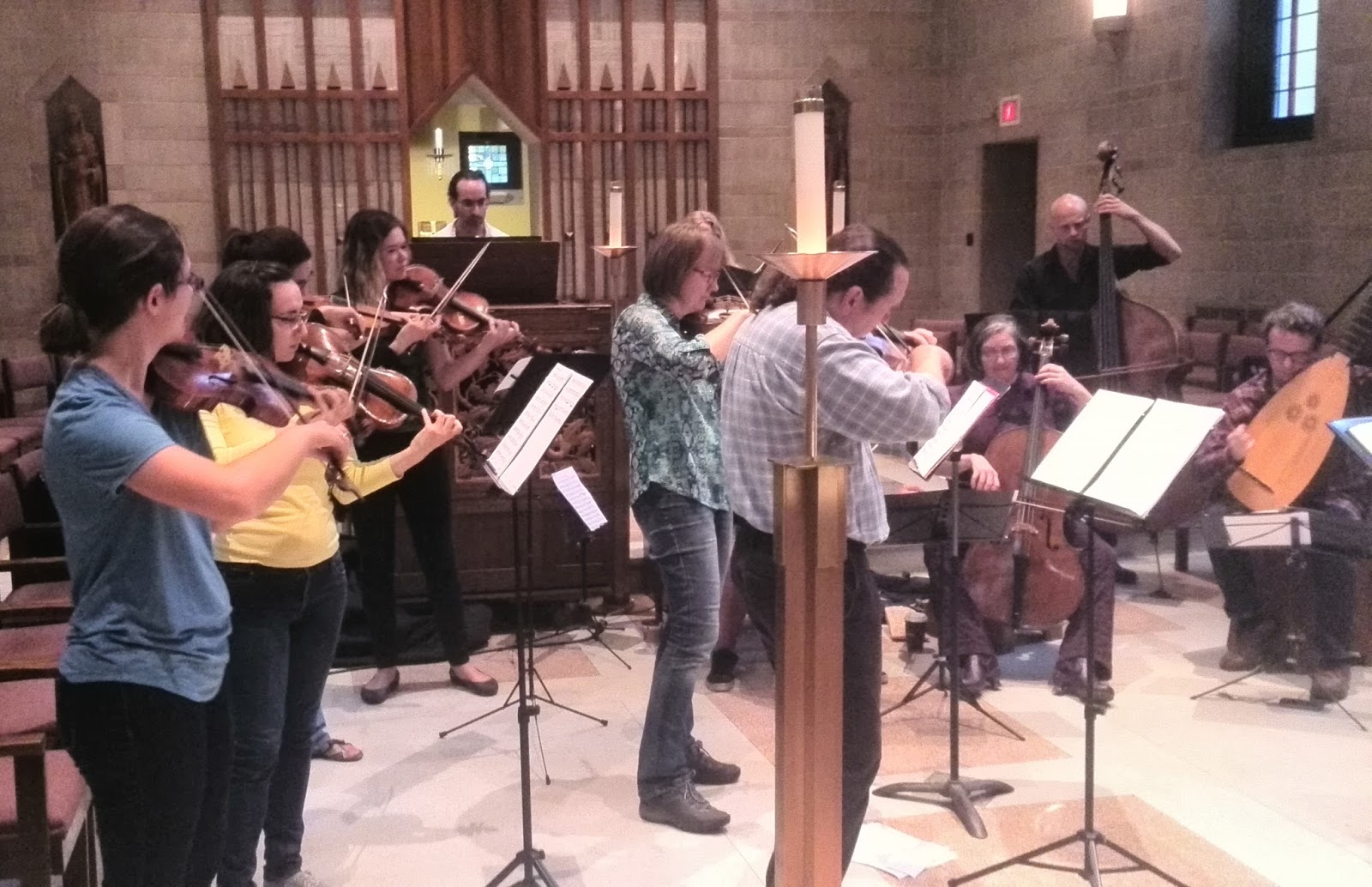
Soprano - Hallie Fishel
Violin - Chris Verrette
Viola - Matt Antal, Eleanor Verrette
Bass Violin - Amanda Keesmaat
Lutes and Theorbo-John Edwards
Pneuma Ensemble
Vielle - Eleanor Verrette
Gittern, Cittern - Gaven Dianda
Voice, Percussion, Psaltery - Tricia Postle
St. Michael's Schola Cantorum
Soprano
Madeline Dawson, Hallie Fishel*, Mekhriban Mamedova, Sheila Mulrooney, Barbara North, Emily Sherlock*, Jane Ubertino*
Alto
Irene Chan, Cindy Dymond, Irene Gaspar*, Ana Iorgulescu, Christina Labriola*, Annemarie Sherlock*, Kathryn Zaleski-Cox
Tenor
Jeremy Hernandez-Lum Tong, Ben Kim, Edmund Lo, Reid Locklin, Antonio Manco
Bass
Robert Allair*, Eric Charron, Paul McGrath, Adrian Ross
* = soloists
The Musicians In Ordinary
Named after the singers and lutenists who performed in the most intimate quarters of the Stuart monarchs’ palace,
The Musicians In Ordinary for the Lutes and Voices dedicate themselves to the performance of early solo song and vocal chamber music. Soprano Hallie Fishel and lutenist John Edwards have been described as “winning performers of winning music.” A fixture on the Toronto early music scene for over 10 years, in 2012 MIO became Ensemble in Residence at St. Michael’s College in the University of Toronto. They have concertized across North America and lecture regularly at universities and museums. Institutions where MIO have performed range from the scholarly to those for a more general public and include the Shakespeare Society of America, the Renaissance Society of America, the Shakespeare Association of America, Grinnell College, the Universities of Alberta, Toronto and at California at San Diego, the Kingston Opera Guild, Syracuse, Trent and York Universities and the Bata Shoe Museum. They have been Ensemble in Residence at Lafayette College in Easton, Pennsylvania.
Christopher Verrette has been a member of the violin section of Tafelmusik since 1993 and is a frequent soloist and leader with the orchestra. He holds a Bachelor of Music and a Performer’s Certificate from Indiana University. He contributed to the development of early music in the American Midwest as a founding member of the Chicago Baroque Ensemble and Ensemble Voltaire and as a guest director with the Indianapolis Baroque Orchestra. He collaborates with many ensembles around North America, performing music from seven centuries on violin, viola, rebec, vielle and viola d’amore. He was concertmaster in a recording of rarely heard classical symphonies for an anthology by Indiana University Press and collaborated with Sylvia Tyson on the companion recording to her novel,
Joyner’s Dream. Chris was the sound of Mark Smeaton’s violin on the TV series
The Tudors.
Matt Antal was born and raised in Toronto. He attended Cardinal Carter Academy for the Arts where he began playing viola at age 13 under the tutelage of Jolanta Hickey and Angela Rudden. An all-round lover of music, he has played in numerous ensembles in genres ranging from jazz to hardcore metal. He holds both a bachelor’s degree from the University of Toronto, where he studied under Katharine Rapoport, and a master’s degree from the University of Victoria, where he was a student of Joanna Hood, both in viola performance. He is currently pursuing an advanced certificate in Baroque viola with Tafelmusik.
Eleanor Verrette studied violin with Gretchen Paxson and Aisslinn Nosky, modern viola with Anna-Belle Marcotte at McGill University, where she graduated with a BMus in 2012, and Baroque viola with Pemi Paull. She now performs regularly on Renaissance and Baroque viola with The Musicians In Ordinary, on vielle and rebec with Toronto-based medieval group Pneuma Ensemble, and on plugged-in viola with Boston-area band Hadley and the Jackal. She is featured on recent album releases by acclaimed folk-rock artists Lakes of Canada and Corinna Rose and has also performed with Aradia Ensemble and Montréal singer-songwriter Ari Swan.
Originally from Hamilton,
Amanda Keesmaat,
bass violin, obtained her Bachelor of Music from the University of Western Ontario and her Artist Diploma from McGill University. A vibrant presence in the Montreal early music community for more than 15 years, she has recorded and performed with prominent singers such as Matthew White, Daniel Taylor, Shannon Mercer, Donna Brown, Natalie Paulin, Susie Le Blanc and Marie-Nicole Lemieux, and renowned ensembles such as Arion Baroque Orchestra, La Nef, Les Idées Heureuses and Les Boréades. She appears regularly on concert series with Arion Baroque Orchestra, Clavecin en Concert, Studio Musique Ancienne de Montréal, La Nef and at festivals such as Montreal Baroque, Ottawa Chamber Music Festival, the Lameque Baroque Festival, and Vancouver Early Music Festival and Music and Beyond. As a founding member of Ensemble Les Voix Baroques and Skye Consort, she has performed across Canada. Amanda has recorded for ATMA discs, Early-Music.com, Fidelio, XXI, Analekta, ombú, CBC Radio and CBC Television, BRAVO, the NFB and Radio-Canada.
Pneuma Ensemble (from the Greek πνεῦμα, “breath,” “spirit,” or “soul”) formed when three Toronto musicians (Tricia Postle, Eleanor Verrette, Gaven Dianda) decided to explore their shared interest in medieval monophony, such as troubadour song and minnesang. Since their first concert in the spring of 2014, they have toured in Spain and the UK, and had residencies at the Banff Centre and at the Fairview Library in North York. For more about Pneuma Ensemble, visit pneumaensemble.com, or find us on Facebook.
St. Michael’s Schola Cantorum is an auditioned ensemble drawn from students, staff, alumni/ae, faculty, and friends of USMC, and members of St. Basil’s parish choir. We sing three concerts per year, at Michaelmas, during Advent, and Lent. Michael O’Connor is the founding Director of St. Michael’s Schola Cantorum. He teaches in the college programs at St. Michael’s and also directs the St. Mike’s Singing Club. His academic scholarship and practical music-making overlap in the theory and practice of liturgical music.
We would like to extend our sincere thanks to the following:
Mike Schreiner for lute construction and maintenance
Alexandra Guerson for the MIO website design
Fr. John Reddy CSB for use of the chapel at the Flahiff Centre for rehearsal
Fr. Chris Valka CSB for the use of St. Basil’s Church this evening