Sunday, March 24, 2013

The program, translations and notes for the next concert 7:30PM St. Basil’s Church, 50 St. Joseph St., St. Michael’s College, Mar. 25th 2013. (Map here)

THE UNIVERSITY OF ST. MICHAEL’S COLLEGE PRESENTS

Pergolesi’s Stabat Mater
The Musicians In Ordinary
Hallie Fishel-Soprano, Charlotte Burrage-Mezzo-Soprano
Led by Christopher Verrette

Victoria’s Tenebrae Responsories
St. Michael’s Schola Cantorum
Directed by Michael O’Connor

St. Basil’s Church, Mar. 25th 2013

Concerto Grosso Op. 6, No. 3 Arcangelo Corelli (1653-1713)
Largo-Allegro-Grave-Vivace-Allegro

Tenebrae Responsories Tomás Luis de Victoria (1548–1611)
Eram quasi agnus-Animam meam dilectam-Caligaverunt oculi mei-Recessit pastor noster

Stabat Mater Giovanni Battista Pergolesi (1710-1736)

The Musicians In Ordinary
Named after the singers and lutenists who performed in the most intimate quarters of the Stuart monarchs’ palace, The Musicians In Ordinary for the Lutes and Voices dedicate themselves to the performance of early solo song and vocal chamber music. Soprano Hallie Fishel and lutenist John Edwards have been described as ‘winning performers of winning music’. A fixture on the Toronto early music scene for over 10 years, this year MIO became Ensemble in Residence at St. Michael’s College in the University of Toronto They have concertized across North America and lecture regularly at universities and museums. Institutions where MIO have performed range from the scholarly to those for a more general public and include the Renaissance Society of America, Canadian Society for Renaissance Studies, Grinnell College, the Universities of Alberta and Toronto, the Kingston Opera Guild, Syracuse, Trent and York Universities and the Bata Shoe Museum. They have been Ensemble in Residence at Lafayette College in Easton, Pennsylvania.

Christopher Verrette has been a member of the violin section of Tafelmusik since 1993 and is a frequent soloist and leader with the orchestra. He holds a Bachelor of Music and a Performer’s Certificate from Indiana University and contributed to the development of early music in the American Midwest as a founding member of the Chicago Baroque Ensemble and Ensemble Voltaire, and as a guest director with the Indianapolis Baroque Orchestra. He collaborates with many ensembles around North America, performing music from seven centuries on violin, viola, rebec, vielle and viola d’amore. He was concertmaster for a recording of rarely heard classical symphonies for a recently released anthology by Indiana University Press, and most recently collaborated with Sylvia Tyson on the companion recording to her novel, Joyner’s Dream.

Mezzo-Soprano Charlotte Burrage is a graduate of the University of Toronto with her Masters in Voice performance as well as the University of British Columbia’s Opera Diploma program. In 2011/2012, Charlotte toured with Vancouver Opera in Schools as Hansel in their production of Hansel and Gretel. In July she performed Pergolesi’s Stabat Mater in Italy with Kevin Mallon. Other operatic credits include Dorabella (Cosi fan tutte) with David Agler in the Opera as Theatre program in Banff, Alberta, Principessa (Suor Angelica) and Cendrillon (Cendrillon) with University of British Columbia, and the Old Maid (The Old Maid and the Thief) with Triptych Opera. Charlotte performed with Bramwell Tovey and the Vancouver Symphony Orchestra in their traditional Christmas concert series, was a soloist with VSO and Conductor Arnie Roth in Distant Worlds: Music from Final Fantasy and was the alto soloist in the Bach Magnificat BWV 243 with Graeme Langager at the University of British Columbia. In the fall of 2012 Charlotte toured as Dorabella in Cosi fan tutte with Jeunesses Musicales Canada. Most recently she has been accepted into the Canadian Opera Company’s Ensemble studio.


1st Violins
Christopher Verrette, Elizabeth Loewen Andrews, Michelle Odorico

2nd Violins 
Kathleen Kajioka, Rezan Onen Lapointe

Violas
Emily Eng, Eleanor Verrette

Violoncello 
Laura Jones

Contrabass
Calum MacLeod

Organ
Lysianne Boulva

St Michael’s Schola Cantorum is an ad hoc group drawn from staff, graduate and undergraduate students, faculty at the University of St Michael’s College, and members of St Basil’s parish choir.

Michael O’Connor has been Director of Music at St Basil’s Church since 2010, and is an Associate of the Royal School of Church Music. He teaches in the college programs at St Michael’s and runs a weekly singing club on campus. His academic scholarship and practical music-making overlap in the theory and practice of liturgical music.

Soprano
Bernadette Domingo, Kara Dymond, Laurel-Ann Finn, Anna Lubinsky

Alto
Irene Chan, Brigid Elson, Irene Gaspar

Tenor
Adam Miceli, Marcos Ramos

Bass
Eric Charron, Christian McConnell

Arcangelo Corelli was born in Fusignano, spent his early career in Bologna, but spent most of his mature years, from at least 1675, in Rome. Here he was in the service of Queen Christina of Sweden, and later was engaged by Cardinal Benedetto Pamphili as his music master at a monthly salary of ten Florentine piastres, plus room and board for him, Matteo Fornari, his companion and violin student, and a servant at cardinal's palace. When Pamphili moved to Bologna in 1690 Corelli moved into the household of Cardinal Pietro Ottoboni, the 22-year-old nephew of Pope Alexander VIII (‘Nipote’, the root of our word ‘nepotism’, means ‘nephew.’) and great friend to artists. During this period Corelli also directed operatic performances in Naples. 

Though his output was fairly small, it is impossible to overstate the influence Corelli’s music had on his contemporaries. Roger North, writing in the early 18th century said Corelli’s sonatas, at least ‘cleared the ground of all other sorts of musick whatsoever’ and ‘are to the musitians like the bread of life’ and helped ‘convert the English Musick intirely over from the French to the Italian taste’. The Twelve Concerti Grossi, Op. 6 were revised by Corelli in his last years and published in Amsterdam in 1714, the remuneration for the print going to the forementioned Fornari. The collection contains eight concerti da chiesa and four concerti da camera, which have dance movements and all have a small ‘concertino’ group of first and second violins, violoncello and a chordal instrument, alternating with the ‘grosso’ group ‘redoubling’ the parts. 


Tomás Luis de Victoria was born in Avila, a younger contemporary of St Teresa of Ávila (1515–1582). He received his early musical education at the local cathedral before moving to Rome, where he was ordained priest and established himself as a foremost church musician. After twenty years serving a variety of Roman churches, he was called back to Spain to be chaplain to the Emperor’s sister. Victoria composed his Tenebrae Responsories in Rome for a series of Holy Week evening liturgies. Of the set of eighteen (published 1585), four will be sung in tonight’s concert. Drawn mainly from the prophets and psalms, the biblical words are placed in the mouth of Christ and his enemies, telling of his betrayal, suffering, and death. The final responsory, assigned for Holy Saturday, speaks of his descent into hell, breaking down the doors of the underworld, overthrowing Satan, and freeing Adam and Eve. Each responsory follows the same form: ABCB, where C is a trio for solo voices. Victoria’s music is spare, intense, and deeply felt. Responding to the drama of the Passion story, he paints pictures of innocence, desolation, tragedy, and treachery with a restrained palate and with the subtlest gestures.


Giovanni Battista Pergolesi was born in the Papal States and moved to Naples, by then an important centre of opera, at the tender age of 15. Here he became famous particularly as a composer of opera buffa, though he also wrote church music including a Mass, a Magnificat and, most famously in the 18th century, as well as now, his Stabat Mater. 

Traditionally it has been said that the Stabat Mater was commissioned by the Confraternità dei Cavalieri di San Luigi di Palazzo to replace, or ‘soup up’ a similar setting by Alessandro Scarlatti, their former maestro di capella, which uses only two violins, soprano and alto soloists, and continuo. Scarlatti’s setting was performed on every Friday in Lent. Pergolesi wrote the Stabat in the spa town of Pozzuoli where he was trying, unsuccessfully, to recover from tuberculosis. 

It is hard to tell how much the romantic tale of the young genius struggling to complete his masterwork as he coughed out his last breath played a part in the astonishing popularity the Stabat Mater had in the following decades. Bach adapted it for a German cantata, Alexander Pope wrote an ode to fit the music, versions for solo keyboard and even violin solo versions of the fugal movements were adapted. Perhaps it was the decline of castrato singers, particularly in church, in the early 19th century that inspired an arrangement for four-part male chorus. Certainly the 19th century operas on and a ‘biography’ of Pergolesi’s life contain much fiction. 

The Stabat Mater imports from the opera a direct and dramatic harmonic vocabulary which had a great influence on the Classical style of Mozart and Haydn.

It is hard to know what forces would have been deployed for the Baroque music you hear tonight. The prefatory material for the Corelli and information from eyewitness Georg Muffat tells us that we could even do the ‘orchestral’ Concerti Grossi as a ‘perfect little trio’ with two violins and a bass, as long as the violins played loud when in the sections when the orchestra was supposed to be there. But Corelli also directed an orchestra as big as 80 players. The vocal parts would probably have been performed by castrati in church in the 18th century but none is cut out to be a singer of that kind today. Pergolesi specifies  ‘primo choro organo contrabasso, secondo coro violoncello, leuto, contrabasso’ for the continuo of a Mass, and the archlute (arcileuto) was very popular in Rome and was used in the small concertino group.


Eram quasi agnus 
I was like an innocent lamb. I was led to sacrifice, and did not know. My enemies plotted against me, saying: “Come, let us put wood into his bread, and drive him from the land of the living.” All my enemies plotted evil against me. Cruel words they spoke against me, saying: “Come...”

Animam meam dilectam  
The life that I held dear I put into the hands of the unrighteous, and my inheritance has become for me like a lion in the forest. My enemy spoke out against me: “Come, gather together and hasten to devour him.” They placed me in a desolate wilderness, and all the earth mourned for me. For there was no one to acknowledge me or give me help. They rose up against me without mercy and did not spare my life.

Caligaverunt oculi mei  
My eyes were blind with weeping; for he that consoled me is far from me. Consider, all you people, if there is any sorrow like my sorrow. All you who pass along this way, take heed and consider.

Recessit pastor noster 
Our shepherd, the fount of living water, is gone, at his passing the sun grew dark: For even he is taken, who held the first mortal captive. Today our Saviour has burst the gates and bolts of death. The bounds of hell he has destroyed and overthrown the devil’s power. 

Stabat Mater
Duet
Stood the Mother grieving 
beside the cross, weeping 
while on it hung her Son.

Soprano Aria
He whose soul, sighing,
saddened and suffering, 
was pierced by the sword.

Duet
O, how sad and afflicted 
was that blessed 
Mother of an only Son!

Alto Aria
Who mourned and grieved, 
the pious Mother, looking at 
her glorious Child’s torment.

Duet
Who is he that would not weep 
if he saw the Mother of Christ
in such torment?

Who would not be saddened 
contemplating the Mother of Christ 
suffering with her Son?

For the sins of his people
she saw Jesus in torment 
and to the scourge subjected.

Soprano Aria
She saw her sweet offspring 
dying forsaken, 
while He gave up his spirit.

Alto Aria
O Mother, fountain of love, 
make me feel the power of sorrow,
that I may grieve with you.

Duet
Cause my heart to burn 
in loving Christ the God, 
that I may please Him.

Duet
Holy Mother, may you do this: 
of the Crucified one fix the wounds 
in my heart securely. 

Of your wounded offspring, 
who deigned to suffer so much for me, 
his pains with me share.

Let me sincerely weep with you
bemoan the Crucified, for as long as I live
for as long as I live.

Beside the cross with you to stand
and to join you in your weeping, 
this I desire.

Virgin of virgins most exalted, 
to me be not now bitter, 
make me with you to lament. 

Alto Aria
Cause me to bear Christ’s death, 
of passion make me to be a partner
and the injuries to recollect.

Let me be wounded with his wounds, 
let me by the cross be inebriated 
and your Son's blood.

Duet
Lest I burn, set afire by flames, 
by you, Virgin, may I be defended
on the day of judgment.

Let me by the cross be guarded 
by Christ's death armed  
and by His grace nurtured.

Duet
When my body dies, 
grant that to my soul is given 
the glory of paradise. Amen.


Sunday, March 17, 2013


Here's the program for the last concert in our Principal's Concert Series at St. Michael's College for the season, Ladies That are Most Rare with Justin Haynes, viola da gamba, and Katie Larson doing the pre-concert talk.

Charbonnel Lounge, University of St. Michael’s College, 81 St. Mary Street, 7:30 PM, Mar. 19th 2013.
Bernini's Apollo and Daphne. One verse of the first song thinks it's dreadful to be turned into a weather beaten tree for  the sake of chastity, one thinks it's great to be forever green. 

Coy Daphne fled/Chast Daphne fled John Danyel (1564-c1626)
Eies looke no more Danyel
From depth of grief (Ps. 130) Anon.
Lyke as the Lute delights Danyel

Delacourt Pavan Anon.
Lachrimae Pavan John Dowland (1563-1626)
The Turtle Dove John Coprario (c. 1570-1626)

Go lovely Rose  Henry Lawes (1595-1622)
Sweet stay awhile Lawes

Comus with his Revellers, by William Blake
From the heav’ns now I fly Lawes
The Queenes Masque. the first Anon.
Sweet Eccho Lawes
Cuperaree or Grayes inn Coprario
The first of the Temple Robert Johnson (1583-c.1634)
Sabrina Lawes
Countrey Dance John Jenkins (1592-1678)
Country Dance Davis Mell (1604-62)
Now my taske Lawes

Hero’s Complaint to Leander Nicholas Lanier (1588-1666)

Oh mee the time has come to part Anon.

Program Notes
‘Into a most delicate and pleasant garden they came, lead by the King, who ther with true curiosities had Crowned himself in making that place the Crowne of all pleasure…Music ther was of all sorts… “Certainly,” sayd Amphilanthus, “voices resemble the heavenly music most, soe they bee rare and perfect voices.”
“Stronge voices you seeme to like the best,” sayd the King, “and such are heer (I can assure you) in all parfection, and Ladys that are most rare in that faculty.”’
- from Lady Mary Wroth’s Urania

John Danyel was the brother of the poet and playwright Samuel, who is the author of the lyrics ‘Lyke as the Lute’ and probably ‘Eies look no more.’ John Danyel’s Songs for the Lute, Viol and Voice of 1606 is dedicated to Mistress Anne Greene, the daughter of a wealthy if not particularly well-pedigreed knight, Sir William Greene.  Danyel worked as a household musician for the Greene family.  A few lines from his verse dedication will make clear the function of the songs in the collection.  ‘To Mrs. Anne Grene… That which was onely privately composed,/For your delight, Faire Ornament of Worth,/Is here, come to bee publikely disclosed:/And to an universall view put forth.’ These songs, then, were written for Anne to enjoy, and probably sing in her lessons with Danyel.

Before he was engaged at court, Henry Lawes also worked as a household musician, for the more illustrious Egerton family.  His duties included teaching the daughters of John Egerton, the Earl of Bridgewater, to sing.  Lawes dedicated his Ayres and Dialogues of 1653 is to Alice and Mary Egerton, by then Countess of Carbery and Lady Herbert of Cherbury. The dedication says of the songs ‘most of them were composed when I was employed to attend to your Ladishipp’s education in musick’,  that is, some 30 years earlier.  Lady Alice performed and sang in Milton’s Comus, for which Lawes wrote the music, and in which he also sang. We perform some dances from other Stuart masques between the Comus songs, since the dances have not survived, and some contemporary ‘Country Dances’ called for in the text. Since ‘Sweet stay awhile’ precedes the Comus songs in Lawes’ autograph songbook, we can presume it was written when he was still teaching the girls.

Who would have sung Lanier’s Hero’s Complaint? We know that Lanier did himself, but the song is in soprano clef. Might Lady Mary Wroth (author of ‘Oh mee’) be depicting herself as one of the strong voiced ladies by having herself depicted with her theorbo, the accompanying instrument? (See front of the program.) There is much in her Urania that is autobiographical. Her aunt was Lady Mary Sidney (author of the Psalm), and the Lanier family, the Sidneys and the Herberts were bound up in complicated bonds of loves and patronage.

Saturday, February 23, 2013


Here's the program and notes Mar. 2nd concert, 8PM Heliconian Hall 35 Hazelton Ave. Toronto called You Who Hear in These Scattered Rhymes...
A manuscript of the first poem in Petrarch's  Canzoniere
'Voi che ascoltate... ' You who hear...
You Who Hear in these Scattered Rhymes…
Preludio Terzo Giovanni Kapsberger (c.1580-1651)
Voi ch’ascoltate Sigismondo d’India (c.1582-1629)/Petrarch
Amarilli mia bella Giulio Caccini (1551-1618)/(A. or G.B.) Guarini
Tutto il dì piango Jacopo Peri (1561-1633)/Petrarch
Aria di Fiorenza Kapsberger

Vedrò’l mio sol Caccini/Giovanni Battista Guarini
Torna, deh torna Caccini/Ottavio Rinuccini
O miei giorni fugaci Peri/Rinuccini

Laura Soave Fabritio Caroso (c.1530-after 1605)
Passamezzo Michelagnolo Galilei (1575-1631)

Cantata Sopra la Ciaccona Giovanni Felice Sances (c.1600-79)/Anon.

Donna, I’ vorrei dir molto d’India/Giambattista Marino
Tempesta di dolcezza Giovanni Nauwach (c.1595-c.1630)/Marino

Intermission

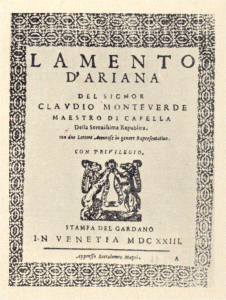
Lamento d’Arianna Claudio Monteverdi (1567-1643)/Rinuccini

Corrente detta la Brava/ Pietro Paolo Melli (1579-after 1623)
Corrente detta la Sansona/Alemana detta la Gentile
Saravanda in Varie partite Alessandro Piccinini (1566-c.1638)

O bella destra d’India/Torquato Tasso
Giunto a la tomba d’India/Tasso

Ho visto al mio dolore Biagio Marini (1594-1665)/Alessandro Striggio
Odi Euterpe Caccini/Anon.
The Harmony of the Planets and the Monochord, which Vincenzo Galilei, and his sons Galileo and Michelagnolo all worked on. 
Vincenzo Galilei would have done enough for history if he had only been the sire of Galileo the astronomer, but with Jacopo Peri and Giulio Caccini he was a key member of the group that theorized the development of ‘The New Music’. Galilei prescribes, following the Ancient Greeks and Romans, the way the composer should work; he should observe the speech of ‘the man infuriated or excited, the married woman, the clever harlot, the lover speaking to his mistress as he seeks to persuade her to grant his wishes, the man who laments…’ and follow the diction, pitch and rhythm of their speech when setting the affections of the poetry since ‘the most important and principal part of music is the imitation of the concepts of the words’. The composer for solo voice becomes a partner with the poet in the exhibition of the Classical rhetoric which permeates all the texts of the Renaissance. He almost inhabits a position between musician and drama director, telling the performer where the speech is agitated and quick, where the exclamations of the voice rise or fall into despair and below the musical clef. Peri and Caccini were the leading composers in this style. A contemporary of theirs opines that Peri’s ‘solo madrigals’ as they called them, were more true to the texts, while Caccini’s had more grace.

Claudio Monteverdi famously set his own Orfeo, with a libretto by Striggio, soon after opera's debut as Peri and Caccini's pasticcio. Though he could charm the ear as well as anyone Monteverdi was primarily an intellectual composer. When later in life he was given a text to set which was to be sung by the wind, Monteverdi said ‘Ariadne moved the audience because she was a woman.’ Indeed we are told that in the audience at the first performance of his opera L’Arianna (1608) we are told that ‘not one lady failed to shed a tear.’ Poor Ariadne has been dumped on a beach by her lover and the storms of her shifting emotions are captured by Monteverdi in an inventive tour de force.

Sigismondo d’India was a minor nobleman from Sicily who worked with the poet Marino at the Savoy court. His solo songs match the power of Monteverdi at his best, as evidenced in his setting of Petrarch’s Voi che ascoltate. This setting is almost a microcosm of all the techniques of the new music and the sonnet is carefully divided into its parts and the 'turns' of emotional gestures set by sometimes drastic key changes. Marini, Sances and Nauwach all represent the movement of the new music north of the Alps. Marini worked in Neuberg and Dusseldorf, Sances in Vienna and Giovanni Nauwach was in fact, Johann.

The organization of the music around the hyper-impassioned poetry leads, of course, to rather 'expressionistic' music. Another organizing principal the Baroque used was ground basses. Caccini's Torna uses the Romanesca, or its close relative the Passamezzo Antico. Another famous ground, often heard with its original tune, was taken from a tiny part of huge entertainment for the wedding of Caccini and Peri’s patron, Grand Duke Ferdiniand de’Medici, to Christina of Lorraine in 1589. This tune is sometimes called ‘Ballo della Gran Duca’ or ‘Laura Soave’ or, as in Kapsberger’s version, Aria di Fiorenza.
Petrarch

Voi ch’ascoltate - Petrarch
You who hear in scattered rhymes the sound
of those sighs with which I nourished my heart
at the time of my first youthful error,
when I was in part another man from what I am now,
for the varied style in which I weep and speak
between vain hopes and vain sorrow,
where there is anyone who understands love by experience,
I hope to find pity, and not only pardon.

But now I well see how for a long time
I was the talk of the crowd,
for which I often am ashamed within;
and for my raving, shame is the fruit,
and repentance, and the clear knowledge
that whatever pleases in the world is a brief dream.

Amarilli mia bella - Guarini
Amaryllis, my love, do you not believe
you are my heart's desire?
Believe it, and if doubt assails you,
take my arrow, open my breast
and you will find written in my heart:
Amaryllis is my love.

Tutto ’l dí piango - Petrarch
All day I weep: and then in the night
when wretched mortals take their rest,
I find myself weeping, redoubling my ills:
so I spend the time that’s mine in tears.
My eyes are drowned in sad moisture,
the heart with pain: and I am the worst
of creatures, the arrows of love pierce me
so all over, now that peace is exiled.

Alas, with one sun following on another,
one shadow after another, I’ve already passed
the greater part of this death, that they call life.
Another’s failing grieves me more than my own:
that living Pity, and solace of my faith,
sees the fire burning, and will not help me.

Vedrò’l mio sol Guarini
I will see my sun; I will see, before I die,
That longed for day
That makes your ray come back to me.
O my light, o my joy.

It is sweeter to be in torment for you
Than to be in delight for another.
But without death I will not be able to suffer
Such a long martyrdom
And if I die, so will die my hope ever
To see the dawn of such a beautiful day.

Torna, deh Torna Rinuccini
Return my little one,
Return, for without you I am without my heart!
Where do you hide, alas?  What have I done
That I neither see nor hear you Love?
Fly now to my arms; dissolve that bitter pain
Which consumes my heart.
Hear the plaintive sound of my voice,
Begging forgiveness with tears and sighs.
If I see not, I die not,
But seeing not, I live not;
Therefore I am dead, though not deprived of life.
O, miracle if love, ah, what a strange fate,
That living should be not life or dying death.
St. Jerome gets blasted by the Trumpet of Doom by Ribera
O miei giorni fugaci - Rinuccini
O my fleeting days,
O brief life, alas, you have already disappeared.
Now I hear, or seem to hear, the inexorable trumpet
calling me before you,
O just Lord. Already the awesome sound
resounds in my heart:
Lord have mercy on me and forgive me.

Cantata Sopra la Ciacona - Anon.
O pretty warbling birds
upon the breeze disperse
your querulous sounds
and tell of how I grieve,
of how from deep within my breast
sighs heartfelt I send forth.
Go, my languid plaintive sighs,
go to my Lydia with the wind
and tell her that in pain
I waste away without respite.
Perhaps she will now yield,
she who was then unmoved
by my sobbing and my tears.
Perhaps she'll give me peace,
perhaps she'll give me life.
Perhaps, hostile no more,
she'll say that she will grant
both peace and life
to him who was in love so bold.
A cold glance indeed reveals
angelic beauties of the soul.
He drew the dart and tore the veil.
He stole the honour with guileful zeal.
My honour, oh my honour.
Torn is now my veil,
cries out the hapless maiden
with woeful anguished wails.
And you, my sighs, reply to her
Lydia, Lydia, hush down your cries
and a virgin you are still,
for when on you my ardor I did vent
no one was there to see
no one but Lydia, my love, and me.
Marino
Donna, I’ vorrei dir molto - Marino
Woman, I would say so much
but my hesitating tongue is held by Love.
Though my tongue is silent, my glance is begging.
I am as foolish as I am miserable
not knowing what I want.
But you, who are in my heart and mind,
you certainly can read my thoughts
and see in my heart what I might want.

Tempesta di dolcezza - Marino
A tempest of sweetness
is what Love pours out upon my soul
while I kiss you, oh my treasure.
Languishing, I die.
A flood of kisses has submerged my soul.
Already from your lip,
at the sweet sonorous thunder
behind the lightning of your laughter
the thunderbolt of your tooth
has killed me.
Ariadne got married to Bacchus later and lived happily ever after.
Lamento d’Arianna Rinuccini
Let me die, Let me die!
Whom would you wish to comfort me
In such a hard fate,
In such a great suffering?
Let me die!

O Theseus, my Theseus!
For I want to call on you, since you are mine.
Though, alas, cruel man, you flee from my sight.
Turn back my Theseus,
Oh God, turn back and look once more upon her
Who abandoned her country and her kingdom for your sake.
And who now on these shores,
A prey to pitiless wild beasts,
Will leave her bare bones!

O Theseus, my Theseus!
If you knew, Oh God, alas the torment
Of miserable Ariadne, Perhaps, in remorse,
Even now you would turn back your prow to shore.
But with gentle breezes you go happily on,
While I remain, weeping,
Athens prepares you greet you with joyful festivities,
While I remain, weeping, a prey to the wild beats of these lonely shores.
Both your aged parents will embrace you with joy
But I will see you no more, O mother, O  my father.

Where, where is the faith you so often swore to me?
Is this how you restore me to my ancestor’s ancient throne?
Are these the crowns with which you adorn my hair?
Are these the sceptres, are these the jewels and the gold?
To leave me  abandoned,
To be torn by and devoured by wild beasts?
Ah, Theseus, O my Theseus,
Will you leave me to die and weep in vain crying for help,
Poor wretched Ariadne, who gave you her trust, glory and life?

Oh! you don’t even reply! To my lament his ears are as deaf as a serpent’s
O, storms, O hurricanes, O Gales
Push him down beneath the waves!
Hurry sea-monsters and whales
Fill the bottomless deep with his foul limbs.
What am I saying? Why an I raving?
Alas! Wretch that I am, what do I want?

O Theseus, O my Theseus,
It was not I who uttered those savage words.
My grief spoke, my anguish spoke,
My tongue spoke, yes, but not my heart!

Unhappy woman, I still give way
To my betrayed hope, and still
After so much scorn, the fires of love are not quenched!
O death, now extinguish the worthless flames!
O mother, O father, O proud homes of the ancient kingdom where my golden cradle rested.
O servants, O faithful friends (Ah unworthy fate)
See where wicked fate has led me.
See the grief I have inherited from my love, my trust and his deceit.
One who loves too well and trusts too much such a fate endures.
Tasso
O bella destra - Tasso
O beautiful right hand that offered me
sweet assurance of friendship and of peace,
look at you now...how can you suffer me?
And how, you loveliest limbs...are not these
the evidence of my beastlike enmity,
and sad and deadly signs of wickedness?
O my eyes, wicked as my hands, to gaze
upon the wounds that they have made.

Giunto ala tomba - Tasso
He reached the tomb, the prison house where heaven
had ordained for his living soul to dwell,
and on the stone he fixed his eyes, cold, wan,
speechless and still as if insensible.
At last he broke into a languid sigh,
Alas, as a river of weeping broke the spell.
‘O stone to highly loved, and honoured, keeping
my spirit’s flames within, without, my weeping.’

Ho visto al mio dolore - Striggio
I saw, to my grief,
shedding thousands by thousands,
from her pitiful eyes, dewy drops,
the gentle Silvia;
such as never shed before
when stung by pain to the heart
over the dead Adonis
was the love goddess.
And miserable me, who
from such water my fire takes strength,
and it inflames me all the more.
St. Cecilia with Alabaster Apple and Theorbo
Odi Euterpe - Anon.
Hear, Euterpe, the lovely song
that Love urges me to compose
and help me attune to these sweet accents
the strings of my golden lyre.
Sweet Love whispers to me verses
and compels me to sing sweetly.

 My  fair Lydia covered her bosom
with the chaste veil of night
but the moon high in the sky
uncovered it and I beheld
a wondrous treasure
brightly lit by golden flames.

Your fair bosom thus unveiled
cast out radiant flames asparkle.
While your bosom I admired
with its golden fire ablazing
I beheld in so much splendour
other treasures to desire.

Oh my Lydia, your bright eyes
shine more splendid than the sun.
They cast light upon your bosom
for my own eyes to delight,
the serene glow of your gaze
ever brightening your graces.

My heart was burning sweetly.
Every flame in Lydia's breast
made my eyes rejoice the greater,
and my heart, already wounded,
wanted wounding ever more.

Then my eager gaze was blinded
by the light of many a beauty,
sated it was not by any
restless on it searched for others,
so my eyes... they died of pleasure
on two alabaster apples.

Monday, February 11, 2013

Here's the program for the Hail Bishop Valentine Concert, 7:30PM, Feb. 12, 2013, Charbonnel Lounge, St. Michael’s College, 81 St. Mary Street. Come one, come all. 


Preludium John Dowland (1563-1626)
Excerpt from 'The life and death of our late most incomparable and heroique prince, Henry Prince of Wales by Sir Charles Cornwallis
So parted you John Coprario (c. 1570-1626)
The Prince his Almayne Robert Johnson (c.1583-1634)
John Donne
An Epithalamion, or Mariage Song on the Lady Elizabeth, and Count Palatine being married on St. Valentines Day by John Donne, Stanza 1
Come away, come sweet love Dowland
The Lady Elyza: her masque Johnson

Epithalamion Stanza 2
When Laura smiles Philip Rosseter (1567-1623)
Solus cum Sola Dowland

Epithalamion Stanza 3
Sweet stay awhile Dowland
Delyght Pavan John Johnson (c1545-94)

Epithalamion Stanza 4
Deare, if you change Dowland
Delyght Gallyard John Johnson

Epithalamion Stanza 5
Cleare of cloudie Dowland
Nowe to bed Anon.

Epithalamion Stanza 6
Time stands still Dowland
My Hart is Surely Sett Anon.

Epithalamion Stanza 7
Faine would I wed Campion
Greensleeves Francis Cutting (c.1550-1596)

Epithalamion Stanza 8
There is a Garden in her face Robert Jones (1577-1617)


George V,  grandad of Elizabeth II,  from the House of Windsor, and Charles I, brother of 
Princess Elizabeth of the House of Stuart. Family resemblance?

Program Notes
‘I may be uninspiring, but I’ll be damned if I’m alien!’ British King George V is supposed to have said in response to H.G. Wells’s criticism of the royal lack of charisma and excess of Germanness. The charisma problem was all George’s own, but we can pinpoint the source of the latter.

The first ‘British’ king, James VI of Scotland, inherited the English Tudor crown and soon set about marrying off his children to various continental dynasties to cement his ‘prince of peace’ policy. As you will hear in the reading from the Cornwallis letter, James’s daughter Elizabeth was matched with various princes, but public opinion, and particularly that of her brother Henry, Prince of Wales, settled on Frederick, Elector Palatine, who Cornwallis calls by another of his titles ‘The Palsgrave’. The sickly Henry died after a vigorous game of tennis with Frederick in October 1612. We present a song, words by Campion, music by Coprario, from the point of view of Elizabeth on that tragedy.

The official commemorative poem of the Royal Wedding of Valentine’s Day, 1613 was by John Donne, which you hear tonight read in the pronunciation of the time. Donne and Campion (his texts are heard here set by Jones, Rosseter and himself as well) seem to have competed as the official court mouthpieces. Between the verses of Donne’s wedding poem we sing some love songs of the period untouched by the cruel disdain of the harsh mistresses that breaks the hearts of so many poets and songwriters in that age of melancholy, along with some lute pieces the titles of which might allude to the delights of new love.

And about the Germanness: Frederick and Elizabeth’s grandson came to the British throne, not speaking a word of English, as George I, of the House of Hanover and his great-great-granddaughter Victoria still spoke German around the house. Public opinion in WWI forced George V to adopt the last name Windsor and lose the German sounding ‘House of Saxe-Coburg and Gotha’ handle. God Save the Queen.


Sunday, January 27, 2013


On Friday we met with Prof. David Klausner who is reading verses of the wedding poem, or epithamalion, Hail Bishop Valentine by John Donne about the wedding of Princess Elizabeth Stuart, daughter of King James I of the newly United Kingdom, as part of our next concert (Feb. 12th at Charbonnel Lounge, St. Michael’s College, 81 St. Mary Street, 7:30 PM, Tickets $25/20). Between the verses of the Donne poem we will sing Jacobean love songs and I'll play some lute solos with titles like Solus cum Sola (He and she alone together) and The Lady Elizabeth, Her Mask. Any time you meet with David it's a fun time as you can see from the picture. He is 'Acting Director of Celtic Studies' at St. Mike's College this term. You'd think such a title would get him a bigger office. David wrote the book, or at least large chunks of it, on how to pronounce early modern English for singers.

Princess Elizabeth Stuart
Now, this marriage we're celebrating the 400th anniversary of was to a German prince and, as they all were then, was a dynastic marriage to cement aspects of foreign policy. In fact, that dynasty is still on the throne of  Britain as well as, indeed, Canada, Australia and many, many more. (18th century British King George I of Hanover was Elizabeth Stuart's grandson and Queen Victoria's great-grandad, who was in turn the great-grandmother of both the present Queen Elizabeth and Prince Phillip.)

In the fall we did a concert on the 400th anniversary of the death of Henry, Prince of Wales, Elizabeth Stuart's big brother, who would have been Henry IX, had he lived. For the upcoming show we wanted to sing a song which we did at that concert, music by John Coprario and words by Thomas Campion, on Elizabeth's reaction to her brother's death, but there is no mention of the sad event in Donne's poem, though it was only a few months before the wedding. To introduce the Coprario/Campion song we'll hear a reading from this chunk of text which is from a book called The life and death of our late most incomparable and heroique prince, Henry Prince of Wales. A prince (for valour and vertue) fit to be imitated in succeeding times and purports to be a letter from Sir Charles Cornwallis to a friend.

In it you'll read about the excitement about the Royal Wedding match, which includes those foreign policy questions of whether to chum up to the Spanish or someone more Protestant. You'll read about how involved Henry Prince of Wales was in the negotiations for the marriage and how he would hang out  with his soon to be brother-in-law, Frederick, Count Palatine, here referred to as 'the Palsgrave'. And you'll read about the sad end after overdoing it at sports.

Much about the beginning of this summer, there could almost be no newes heard, but of his sister's marriage, of which many speeches went currant, according to the divers affections of protestants and papists; some wishing her to be married to the king of Spaine, some to the prince of Savoy, some to the young Landsgrave, and some to his highnesse the Palsgrave, her now husband. But he following the streame of his father's well setled affections, for Great Britain's eternal felicity, and terrour of all papists, did onely fancy the Palsgrave's motion, shortly after advancing the same by all meanes possible at the comming of the right honourable the count Hannaw, the Palsgrave's great ambassador, whose errand as the speech went, was to knit up this match, unto whose suite his highnesse did not onely give way, and second the businesse, but also insigne of love entertaine, and countenance the said count (next unto his majesty) more than any, never resting until all was agreed, as (thankes be to God) it is now finished.
Henry, Prince of Wales
At last to Saint James's he came, seeming well, but that he looked pale and ill, so that sundry did speake suspiciously of his lookes, fearing some distemper in his body: yet so strong was his minde, that complaining of nothing, he did beare out the matter very bravely in shew, being so well, that he gave his physitian (who had waited a long time) leave to goe home to his house; meane while his indisposition still continuing and increasing, there might have beene perceived in him a sudden great change; for he began to be displeased almost with every thing, and to be exceeding curious in all things, yet not regarding, but looking, as it were, with the eyes of a stranger upon them; for sundry things shewed him, which before he had wonted to talke of, aske questions, and view curiously, he now scarce vouchsafed to looke upon, turning them away with the backe of his hand, and departing, as who would say, I take pleasure in nothing; yet was he wonderfully busie in providing, and giving order for every thing belonging to his care, for his sister's marriage, advancing the same by all meanes possible, keeping also his highnesse the Palsgrave company, so much as conveniently he could, together with count Henry his excellencie, Grave Maurice his brother, whom he also much honoured and esteemed, belike because of a noble and heroicke disposition, which he saw in him fitting his humour, with whom he used to play often at cardes, and tennis, delighting much in his company; and above all the rest, one great match they had at tennis, on Saturday the 24. of October, the day before his last sicknesse, where his undaunted courage, negligently, carelesly, and wilfully (neither considering the former weake estate of his body, danger, nor coldnesse of the season) as though his body had been of brasse, did play in his shirt, as if it had beene in the heate of summer; during which time he looked so wonderfull ill and pale, that all the beholders took notice thereof muttering to one another what they feared; but he (the match being ended) carried himself so well, as if there were no such matter, having all this while a reasonable good stomack to meat; yet this night, at his going to bed, complaining more than usual of his lazinesse and head-ache.
Frederick V, Elector Palatine
But oh, whether goe I now? must I againe launch out into a sea of sorrowes, adding more griefes unto our yet bleeding wounds? Oh Death! was there no remedy? When wilt thou make an end? shall the grave devour alwayes? was thy charge so strait, that thou could'st shoote neither at great nor small, but at the prince of our Israel? doe sweete-smelling flowers so much delight thy grisly ghastly senses appetite, that thou wouldst gather none but our fairest, well beloved, scarce blowne rose? why didst thou so soone robbe us?

Sad stuff. Sadder this that Mr. Chamberlain writes to Sir Dudley Carleton on the 12th of November 1612.

The Lady Elizabeth is much afflicted with this loss, and not without good cause ; for he did extraordi- narily affect her, and during his sickness enquired after her, and the last words he spake in good sense, they say, were "Where is my dear sister?


Monday, December 31, 2012

Here's the program for the NYD concert, New Year's Day at 2PM, 2nd at 8PM at Heliconian Hall, 35 Hazelton Ave. Doors open 1/2 hr. before the concert.

A New Year’s Day Concert            

Sonata da Chiesa Op. 1 No. 1 Arcangelo Corelli (1653-1713)

Salva nos from Op. 1 No. 1 Francesco Bonporti (1672-1749)

Toccata – Partite sopra l’aria della Folia Alessandro Scarlatti (1660-1725)

Sinfonia per Liuto Anon.
Largo-Allegro-Largo-Allegro

Sonata da Chiesa Op. 3 No. 5 Corelli

Intermission

Prelude- Allemande-Prelude Thomas Baltzar (1631?-1663)

Serenata con Violini Scarlatti
Sinfonia-Recit -Aria, Largo-Recit-Ritornello & Aria-Recit-Aria, Andante-
Recit-Aria, Largo-Recit-Recit Accompagnato


Program Notes 
Few composers have been as famous and influential in their own lifetimes as Arcangelo Corelli. His trio sonatas, solo sonatas and concerti grossi were the model for all composers who wrote in those Italianate forms. Indeed, Corelli may have been a little chauvinistic when it came to French music. Corelli was in charge of the orchestra which gave the debut of the young Handel’s oratorio La Resurezzione. Handel had composed a very French Overture, rather than an Italianate Sinfonia to introduce the piece. Corelli’s orchestra fell apart and could not get through this movement, and the Italian said to Handel ‘Ma, cara sassone, - But my dear Saxon, this is in the French style, which I do not understand.’ Handel went back to his desk and composed something more Italianate.  

Corelli’s Opus 1 and 3 trio sonatas come with partbooks labeled ‘violino primo, violino secondo, organo’ and ‘violone o arcileuto’. The violone (what we would call a cello, but maybe a biggish one) and archlute book has melodic material shared with the violins, but also has the same figures above the notes as the organ part, which suggests that the archlute player, at least, did double duty as melodic bass and chordal instrument.


A contemporary description of the demeanor of Corelli, who is said to have dressed in all black, tells us that in performance ‘it was usual for his countenance to be distorted, his eyes to become as red as fire, and his eyeballs to roll as if in an agony’. Here then is a man with the diabolical image which Tartini’s ‘Devil’s Trill’ sonata alludes to and the Romantic violinist Paganini later exploited. Indeed, Stravinsky’s A Soldier’s Tale and 1970s country rock hit The Devil Went Down to Georgia also feature violin playing devils. Thomas Baltzar moved to England from his native Germany during the Commonwealth, that interregnum where there was no British court, and so, no courtly centre for music making. The composer John Wilson, previously musician-in-ordinary to Charles I and songwriter for Shakespeare plays, was making a living presenting public concerts in this period and the stupendous violinist Baltzar wowed Wilson's audience with the new-fangled German violin playing techniques. (English players had been rather stuck in a Renaissance rut, what with the fighting a civil war and everything.) John Wilson came out of the astounded audience came and checked Baltzar’s feet to make sure that he did not have devil’s hooves for feet ‘because he acted beyond the parts of a man’ with his virtuoso performance. The diarist John Evelyn says that on March 4th, 1656 ‘This night I was invited by Mr. Roger L'Estrange to heare the incomperable Lubicer (Baltzar was from Lübeck) on the Violin’. 

Not Thomas Baltzar

That the manuscript that contains the anonymous Sinfonia for archlute and continuo comes from a manuscript which had been in the library of a Czech/Austrian dynasty of counts means it is probably Italian. Lutenists and theorbo players like Francesco Conti were employed at the Imperial court throughout the 18th century and Vivaldi, who died and is buried in Vienna, wrote some lute works in a texture that was being cultivated in German speaking lands. The Corelli-esque slow movements of this piece suggest the type of ornamentation that Estienne Roger published in Amsterdam claiming that they were Corelli’s own very florid ornaments.  

Since so few High Baroque operas beyond a few of Handel’s are performed today Alessandro Scarlatti, who was a successful composer in that form, is perhaps less famous today than he might be. Similarly, his keyboard works are not as famous as those of his son Domenico though as you will hear, he was a spectacular composer for the harpsichord. The chord changes of his variations on La Folia will not be unfamiliar to regular Musicians In Ordinary concert-goers, who will have heard violin variations, guitar variations and even vulgar political songs performed to the stock bass line and tune which developed from a guitar ground of the early 17th century. (Listen for the ‘strum-strummmm-a-strum-strum’ rhythm.) Corelli has his own variations on the Folia for violin and continuo and Liszt and Rachmaninov (who erroneously calls it a ‘Theme of Corelli) wrote variations on it in the 19th and 20th century. 

An early guitar alfabeto notation Folia shows how the strums go (down, down, up). 
There's a bit more information in the one Philip will play. 

Alessandro Scarlatti was also a very prolific composer of cantatas both with just continuo and with other instruments, again, a much under-performed genre considering what a large slice of so many composers’ works it comprises. Very often the Cantata’s text is a description of the joys or sorrows (usually the sorrows) of an amorous shepherd, in the kind of perfect love only possible in the pastoral tradition. The pains of this shepherd are usually reported by another shepherd looking on. This all sounds terribly mannered to us today, but the pastoral tradition was used for centuries to demonstrate how perfect political entities might work, how the perfect host might behave, and, in the case of song, how the perfect lover might feel. Is it any less mannered than a present day hospital drama or cop show? 

Throughout the cantata we see Scarlatti deploy the bag of tricks used by a composer of operatic ‘music-drama’. He moves seamlessly between speech-like declamation and arioso passages in the recitatives as the emotions of the shepherd swirl. The arias, with their infectious melodies, narrow the focus onto one ‘affect’ of the spurned lover and in the sad airs, use suspensions in the violins to paint his anguish. 

Happy New Year. 

Guests

Christopher Verrette has been a member of the violin section of Tafelmusik since 1993 and is a frequent soloist and leader with the orchestra. He holds a Bachelor of Music and a Performer’s Certificate from Indiana University and contributed to the development of early music in the American Midwest as a founding member of the Chicago Baroque Ensemble and Ensemble Voltaire, and as a guest director with the Indianapolis Baroque Orchestra. He collaborates with many ensembles around North America, performing music from seven centuries on violin, viola, rebec, vielle and viola d’amore. He was concertmaster for a recording of rarely heard classical symphonies for an anthology soon to be released by Indiana University Press, and most recently collaborated with Sylvia Tyson on the companion recording to her novel, Joyner’s Dream.


Edwin Huizinga has toured throughout the world with Tafelmusik and performed with the Aradia Ensemble and I Furiosi. He has soloed with the Oberlin, Note Bene and San Francisco Baroque Orchestras, the San Bernardino Symphony, the Carmel Bach Festival Orchestra, the Sacramento Baroque Ensemble and the Kitchener-Waterloo Chamber Orchestra. He has been the concert master of the San Francisco Bach Chorale, the guest director of the Atlanta Baroque Orchestra, has toured with the Wallfisch Band under Gustav Leonhardt and was a guest artist at the Conservatory of Amsterdam. Currently a member of the ensemble Passemezzo Moderno, and recently made his Carnegie Hall debut with the Theatre of Early Music, he has a passion for bringing chamber music to the people and was a founding member of the Classical Revolution in San Francisco in 2006. Throughout 2012 he toured extensively with his band The Wooden Sky. 


Philip Fournier is Titular Organist of the Toronto Oratory, Director of the Chant Schola & Oratory Children’s Choir. He specializes in Gregorian Chant, which he studied at Solesmes with Dom Saulnier. He gives solo organ recitals regularly at the Oratory, is guest organist of the Toronto Tallis Choir, artistic director and continuo player of the St. Vincent’s Baroque Soloists, and is active as a composer. His organ and harpsichord teachers have included James David Christie at the College of the Holy Cross, Russell Saunders, Paul O’Dette & Arthur Haas at the Eastman School of Music, and Robert Clark & John Metz at Arizona State. Mr. Fournier was the first Organ Scholar of the College of the Holy Cross, Worcester USA, and was subsequently named a Fenwick Scholar, the highest academic honour given by the College. He was one of the recitalists of the Chapel Artists Series there in 2011. He won the Historical Organ in America competition in 1992 and performed at Arizona State University on the Paul Fritts organ, and was awarded a recital on the Flentrop instrument at Duke University. Mr. Fournier was Organist & Director of Music at the Cathedral of the Immaculate Conception, Portland Maine, from 2000-2007, during which time he founded the Cathedral Schola Cantorum for the restoration of Gregorian Chant and Renaissance Polyphony to the Stational Masses of the Diocese of Portland.


Wednesday, November 21, 2012


On 7th of November we were up at York University for a co-lecture about Hamlet and the lyric.

Seth Lerer, Dean of Arts and Humanities at University of California at San Diego gave a talk for the first part of the event. To call him a ‘Renaissance Man’ would be an understatement given the wide range of his scholarship. Seek out his appearances on various podcasts. Check his Amazon books too.

We talked about some of Ophelia’s songs, her association with the lute in one contemporary stage direction (focused on here by Prof. Deanne Williams, the organizer of the event), some songs that she should have been singing if she had been a good girl and broadened out to some melancholy emblems that are associated with Hamlet and that occur in contemporary song lyrics.

Seth had talked about how so many songs and poems seem to be coming from the wrong mouths. The bookish Hamlet writes the worst doggerel lyric poem in a letter read out by Polonius. The rude mechanical grave digger sings a song with words taken from the posh anthology of courtly poetry Songes and Sonettes, known as Tottel’s Miscellany. And Ophelia sings, with her lute in hand some of the rudest ballad songs. But not only that, we found that the texts she sings that appear to be less rude are actually associated with other near-contemporary ballad texts that where an older, richer man seduces, or attempts to seduce, a younger woman.
Would the audience at the original performances have been saying ‘Oh, she’s singing that tune that has the other words of The princely wooing of the fair maid of London by King Edward’ (to the tune of Robin is to the Greenwood Gone) and ‘Oh, that’s the one that has the other words where the rich merchant is trying it on with Bess the farmer’s wife’ (to the tune of Walsingham)?
We then sang Coy Daphne fled/Chaste Daphne fled (a 2 for 1 song with different texts that praise and mock chastity) and Like as the Lute (a kind of patchwork quilt of musical definition demonstrations for the lute song student) from John Danyel’s songbook dedicated to Miss Anne Green as an example of what young lute-learning women should be singing. After that we looked at the mega-hit Lachrimae/Flow my tears from John Dowland’s Second Book of Songs, the melancholy poet of which has many parallel symptoms with Hamlet. Download us singing that here if you haven't already.