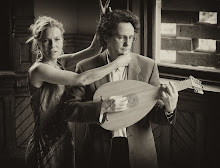
Happy Birthday (or at least, happy baptism day) Alfonso Ferrabosco the Elder, lutenist to Elizabeth I, composer, spy, accessory to murder, father of that other Alfonso and integral plot device in Rose Tremain's bestselling Music and Silence. You can download the mp3 of his pavan above for free of course by clicking here.
Monday, January 17, 2011

Friday, December 31, 2010

A New Year’s Day Concert
Cantata - Risoluto son gia Antonio Caldara (1671-1736)
Recitativo-Aria-Recitativo-Risoluto
Sonata "Victori Der Christen" Heinrich Biber (1644-1704)
Der Türken Anmarsch-Der Türken Belägerung Der Stadt Wien-Der Türken Stürmen-Anmarsch Der Christen-Treffen Der Christen-Durchgang Der Türken Victori Der Christen
Per commando del mio bene Antonio Caldara
Aria-Recitativo-Aria
Aria in Modi Variata Wolfgang Ebner (1612-65)
Intermission
Piéces in F# minor Jacques St. Luc (1616 – c. 1710)
Tombeau De Mr. François Ginter, Allemand-Courante-Sarabande -Menuet
Toccatina-Capriccio Ferdinand Richter (1651- 1711)
Cantata- All’ombra di sospetto Antonio Vivaldi (1678-1741)
Recitativo-Aria,-Larghetto-Recitativo-Aria, Allegro
The Musicians in Ordinary
Named after the singers and lutenists who performed in the most intimate quarters of the Stuart monarchs’ palace, The Musicians In Ordinary for the Lutes and Voices dedicate themselves to the performance of early solo song and vocal chamber music. Soprano Hallie Fishel and lutenist John Edwards have been described as ‘winning performers of winning music’. Now in their 10th anniversary season of concerts in Toronto, they have concertized and lectured across North America at institutions ranging from the scholarly to those for a more general public: the Universities of Alberta and Toronto, Trent, Syracuse, York Universities, the Bata Shoe Museum and Artists in Residence at Lafayette College in Easton, Pennsylvania. Their CD Sleep Wayward Thoughts, Elizabethan and Jacobean music on the various facets of slumber, is available at intermission.
Guests
Christopher Verrette is in his 18th season as a member of Tafelmusik Baroque Orchestra, with which he is a frequent soloist and concert master both in Canada and abroad. He is a graduate of Indiana University, where he was awarded the first-ever Performer's Certificate for accomplishment on the Baroque violin and was a student of Stanley Ritchie. Since that time he has been committed to the growth of Early Music in the American Midwest as a founding member of Ensemble Voltaire (Indianapolis) and the Chicago Baroque Ensemble and has collaborated with numerous period-instrument ensembles around North America. In recent seasons he has played music from six centuries on violins, vielle, rebec, viola and viola d'amore. His recordings range from old favourites like Beethoven and Mozart symphonies and Pachelbel's Canon, to hitherto unrecorded sonatas by Bertali and other seventeenth century composers, new arrangements of Playford tunes on Throw the House out of the Windowe for Marquis records, John Welsman's score for the independent Canadian film The Limb Salesman, the soundtracks of Touchstone Pictures’ Casanova and CBC Television’s series The Tudors.
Recipient of the 2007 Montreal Baroque Prize for Audaciousness and Musicality, harpsichordist Sara-Anne Churchill is in demand as an orchestral player, chamber musician and soloist. She has recently appeared with I Furiosi Baroque Ensemble, Aradia Ensemble, Orchestra London, Niagara Symphony, Mississauga Symphony, The Musicians in Ordinary and Capella Intima. One of the first graduates of the new Advanced Certificate in Performance-Baroque Option, jointly offered by the University of Toronto and Tafelmusik Baroque Orchestra, Sara has also received instruction from Olivier Fortin, Skip Sempé, Richard Egarr, Carole Cerasi and Luc Beauséjour. While completing a Bachelor of Arts in Music at the University of Western Ontario she developed an intense interest in early music and historical keyboards and studied harpsichord with Sandra Mangsen. Sara completed a Masters of Arts in Musicology at UWO in 2006. Her thesis, a translation and commentary of a French baroque harpsichord continuo treatise, was later published in Performance Practice Review. She currently studies with Charlotte Nediger and is a candidate for the Doctorate of Musical Arts in Harpsichord Performance at the University of Toronto.
A New Year’s Day Concert
After a glut of Messiahs and other pre-Christmas concerts, the Toronto concert calendar listings, and particularly those on the Early Music calendar, get rather thin in the first weeks of the New Year. We offer again this year a selection of Viennese music as an alternative to the Blue Danubes and Tristch-Trastch Polkas of the Vienna Philharmonic Orchestra’s New Year’s Day Concert and those of their imitators.
Antonio Caldara was born in Venice and was employed at St. Mark’s Church as a cellist. In 1708 he moved to Rome where he worked with Handel, Corelli and the Scarlattis. After Handel’s departure for England, Caldara followed him as Cardinal Ruspoli’s maestro di capella and in 1717 gained employment at the Imperial court in Vienna, where he was responsible for operas on the birthdays and name days of the Emperor and his consort, as well as other operas and sacred music. This enormous workload meant his salary peaked at a whopping 3900 florins, but he felt the need to supplement it by writing operas for the courts of other Austrian nobles. He is said to have died of a stroke brought on by exhaustion.
Curiously, the sonata celebrating the victory of the Imperial forces at the Siege of Vienna began life as a sonata depicting the Crucifixion composed by Biber. This rather astonishing re-application of a ‘program’ might have been made by the ‘Schmelzer’, to whom the piece is attributed in the manuscript, and who probably composed the last movement, not found in Biber’s sonata. Johann Schmelzer was a violinist at Vienna, but died before the siege, so perhaps his son Andreas was the adapter. The piece is written for scordatura violin. The three lower strings are tuned up a whole tone, but the music notates, not the pitches, but where the violinist is to put his fingers. For example, on a normally tuned violin placing the first finger on the second string gives B♭, but because it is tuned up, even though a B♭ is notated, it sounds as C. The violin part, then, looks like musical gibberish.
Ebner was the organist at Stephansdom, Vienna, and was associated with the Imperial court from 1637 until his death in 1665. He was obviously highly favoured since his salary was double that of the now more famous Froberger. Ebner began as the organist for the Kapelle and later became the Kapellmeister at the Cathedral and the official composer for the ballet. Most of his music was destroyed in World War II -- the best-known pieces that survive are the variations for harpsichord based on a theme by Emperor Ferdinand III himself. Hailing from Würzburg, Richter was recognized by Pachelbel as the greatest representative of south German keyboard music. Upon his appointment as court and chamber musician to Leopold, Richter taught two future emperors, as well as Leopold’s other children.
Italian plucked string players at the court included Orazio Clementi (theorbo and guitar) and Francesco Conti (theorbo and mandolin). These men played obbligato parts in operas. The theorbo, though we might think of it as the chordal part of the basso continuo group, was still much used as the melodic bass instrument, interchangeable with the cello or viol, well into the 18th century. It is in this role we use it in the cantatas. Lutenist Jacques Saint-Luc played the French baroque lute, which then had 11 pairs of strings and was tuned to an open d-minor chord, with basses tuned to whatever scale the piece required. His pieces show that multiculturalism flourished in the Holy Roman Empire, at least as far as matters concerning instrumental music. St. Luc was born in what is now Belgium, but was then the Hapsburg Netherlands. He came to Vienna, where he was employed by Prince Eugene of Savoy. His Tombeau on the death of François Ginter (Adam Franz Günter) is in the key favoured by French lutenists for tombeaux. The lack of open strings in F# minor gives the lute a covered quality.
Antonio Vivaldi visited Vienna on the many tours he undertook towards the end of his life, some with the singer Anna Girò. The presence of her sister as chaperone on these tours did nothing to stop gossip that Anna was his mistress, and in fact suggestions were made that the arrangement was even more scandalous than just that of an old priest sleeping with a young singer. Emperor Charles VI invited Vivaldi to come to Vienna and as Vivaldi’s music went out of fashion in Venice in his last years he picked up and moved to the Austrian capital. Before he could get established the Emperor died and a period of mourning meant a moratorium of public performances. Vivaldi himself died penniless the same year and was buried in Vienna in a pauper’s grave. His house was on the site of the hotel where Vienna’s famous Sachertorte is said to have been invented.
Translations
Risoluto son gia, tiranno amore
Recitative
I am now determined, tyrant Love, to dissolve those bonds which held me a base prisoner for so long. My rational soul teaches me that you falsely betray every faithful heart. Now I am learning to scorn the proud disdain, which brought so much torment to this unfortunate soul Now your true worth awaits you, imminently. The heart will put bitter war before treasonous peace.
Aria
Arms, deceptions, arrows, chariot, you have wielded these, blind ingrate, against this injured heart. Standing firm always affects one so that fleeing with your passion, with triumph and away from fear.
Recitative
That fearful panic that spurs the soul to flight in the face of danger is mostly submission, since it recognizes the greater of that which is the danger itself, and when the unexpected calamity arrives, it enters and tears apart the ill-defended breast, which it found already weakened, which the weapons of Love at last conquer. Better is burning courage than vile fear.
Aria
War, war, to arms, to arms! Thus shall I dare to advance into the palace of glory. My heart shall hold fast to that duty until either death or victory makes my valour worthy.
Sonata "Victori Der Christen"
Der Türken Anmarsch - Advance of the Turks
Der Türken Belägerung Der Stadt Wien-The Turks Besiege the city of Vienna
Der Türken Stürmen-The Turkish Assault
Anmarsch Der Christen-The Advance of the Christians
Treffen Der Christen-The Christian Engagement
Durchgang Der Türken-Withdrawl of the Turks
Victori Der Christen-Victory of the Christians
Per commando del mio bene
Aria
By order of my beloved, my heart languishes in a thousand sufferings, but my heart cannot endure so many injuries of guilt; It is immersed in a sea of troubles, every hope of salvation from such hardship, between help and constancy, is already lost.
Recitative
Wretched! How did I sin? What did I do? If I deserved the suffering which pierces my heart, you stars, my enemies, say it, or say it yourself tyrannous Phyllis! Say it! But before you condemn me, cruel one, to such harsh martyrdom, to such heavy scorn, I protest to you and I swear to you that I am not, nor ever was, guilty. If before punishing me you had listened to me, you would know that my faithful heart could never offend you, cruel one, neither in thought, alas, nor in desire. Wretched! How did I sin? What did I do?
Aria
Innocence is worthless, faithfulness is useless, neither do I hope for pity from a thankless beauty. Cruel disdain and false pity fear constant and faithful love with cruel indifference and proud severity.
All’ombra di sospetto
Recitative
From the shadow of suspicion, my constancy, suffering, loses somewhat its confidence, and to such beautiful allurement, some trust departs.
Aria
The heart is not accustomed to the bittersweetness of love, which soothes suffering with its fegned charm. Scorn will come to those who love passionately on impulse.
Recitative
O, how many lovers, true and faithful, are deluded by shrewd flattery amid the chains of love. Many languish, and frequently blood is shed to prove true love. Formed from the ardor of charming beauty, the soul struggles each hour, and the derided lover is deceived again and again.
Aria
False happiness is the real torture of the loving follower. Merciless beauty has darts, those glances that waver with distress.
Monday, December 20, 2010

The program for the New Year's Day concert is coming together. There'll be some late 17th century music as well as some 18th century.
Hallie will be singing two cantatas with violin by Antonio Caldara who was at Vienna from 1717 till his death from a stroke, perhaps brought on by overwork, in 1736. His court duties were to provide an opera for birthday and the name day of the Emperor and his consort as well as a large scale oratorio every Lent. The 3,900 Florins he was getting a year he was getting a year for that was not enough apparently, so he took on work composing operas for other Austrian nobles on the side.
There'll be a Vivaldi cantata. Vivaldi died and was buried in a pauper's grave in Vienna. He moved there to start afresh as an opera composer just before the Emperor died. Operas were cancelled during the period of mourning, so he never caught on.
Sara Anne Churchill will play some variations by Wolfgang Ebner on a theme by Emperor Ferdinand III and Chris Verrette will be playing a sonata attributed to 'Schmelzer' (probably Andreas, since his more famous dad, Johann was dead by the event) in the manuscript which is a programatic piece on the defeat of the Turks in the Seige of Vienna. Except it's probably really a piece by Biber and the subject is the Crucifixion. There's a picture of the score above. You'll see the violin is tuned to a scordatura with the lower three strings up a tone from where they are usually. The notes on the staff tell you where to put your fingers as if the strings were tuned normally, rather than representing the pitches that come out, so the violin part looks like musical gibberish.
There might be some pieces by Jacques St. Luc for the French lute in F# minor, which apparently the French baroque lute players thought was the saddest of all keys. (Later plucked string players have attributed that quality to the key of D minor. See this video.) Many memorial pieces called Tombeaux were composed in that key by French lutenists perhaps because it has a muted, covered quality on the French lute, since there are no open strings. The viol player Marais made his Tombeau de Lully in that key too, but says if you are going to accompany it with a keyboard, you should tune up a half step and have the keyboardist play in G minor, because the temperament in F# minor would sound awful.
Saturday, December 4, 2010

Tomorrow we are singing a set on the Christmas concert of St. Martin's Chorale. We'll be doing Alessandro Grandi's O quam tu pulchra es, which is a mash up of phrases from the Song of Solomon which is commonly applied to the adoration of the Virgin Mary. Then we'll do a motet that is specifically about her by Barbara Strozzi, O Maria. It uses phrases and images from the Song of Solomon more freely. Both of these sound like good old Italian love songs of the 1620s (Grandi) and 1650s (Strozzi). The groaning suspensions that Grandi uses to set the phrase, 'hurry up and come because I am languishing with love' is especially unrestrained in its graphic depictiveness.
The Counter-Reformation really worked hard to dazzle the church goers with beautiful things that would draw them into devotion, and the beautiful BVM and love songs to her were very popular for churches, and the chambers of princes. You'd think that people would have had enough of silly love songs, but they hadn't in church in 1630, if they were in Latin.
We'll finish off with a Cantata by Maurizio Cazzati, in Italian, so not church music if indeed the others were, and not for private devotions. It starts off 'Che fo, che tardo?' What am I doing? Why am I hanging around?' when the baby Jesus has been born. It's a great piece.
Monday, November 29, 2010

We are getting ready for a series of Advent Vespers services at the lovely chapel at St. John's Dixie Cemetery. We'll be joined by Alexa Wing, soprano, Graham Robinson, bass, and Justin Haynes on bass viol.
This week we'll be doing a Motet Psalm by William Lawes and some music from the Division Viol by Christopher Simpson.
William Lawes was killed in the Seige of Chester in the English Civil war. His Psalm settings for two trebles or tenors, a bass singer and thorough bass were published in 1648 and are dedicated to Charles I, by then deposed, but not executed, so there is a political sense to the book. As well as William's Psalms there are some by his brother Henry (who edited the book) and several elegies to William by John Wilson, Simon Ives and other composers. You can download pdfs of the part books here. There are a few of the Psalms that have been recorded, but they don't get the attention that reflects their popularity in the mid-17th century.
Tuesday, October 26, 2010
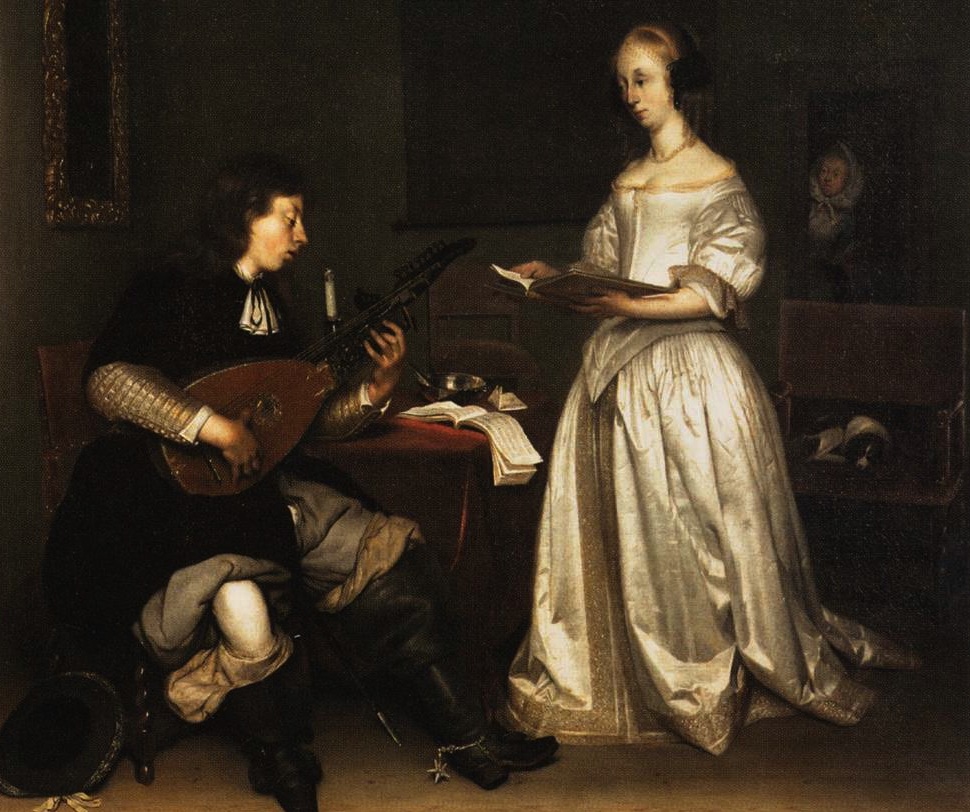
Here is the program and notes for Saturday's concert at Heliconian Hall. Click on the link for location etc. The picture above is by Gerard ter Borch. It's possible there may be one or two changes.
Songs for Anne Greene by John Danyel (1564-c1626)
Coy Daphne fled/Chast Daphne fled
Eyes looke no more
Let not Cloris thinke
Lute Lessons from Margaret Board’s Lute Book
Delyght Pavin John Johnson (d. 1594)
Delght Gallyard John Johnson
The Lady Phillyes Mask Anon.
I cannot keepe my wyfe at howme Anon.
Songs for Anne Greene by John Danyel
Time cruell Time
Thou prety Bird
Like as the Lute
Ann Twice Her Book
O let us howle some heavy note Robert Johnson (c1583-c1634)
Have you seen the bright lily grow Robert Johnson
Intermission
Eliz. Davenant Her book
Have you seen but a bright lily grow Robert Johnson
Woods rocks and mountains Robert Johnson
Songs for the Egerton Sisters by Henry Lawes (1595-1622)
Sweet stay awhile
Sweet Echo
To a Lady, singing the former Song
Lute Lessons from Margaret Board’s Lute Book
Midnight John Dowland (1563-1626)
Solus cum sola Dowland
Lady Banning her Almand John Stuart (d. 1625?)
Songs for the Egerton Sisters by Henry Lawes
The Rose
To a Lady, more affable since the War began
Tavola - In quel gelato core
The Musicians in Ordinary
Named after the singers and lutenists who performed in the most intimate quarters of the Stuart monarchs’ palace, The Musicians In Ordinary for the Lutes and Voices dedicate themselves to the performance of early solo song and vocal chamber music. Soprano Hallie Fishel and lutenist John Edwards have been described as ‘winning performers of winning music’. This is their 10th anniversary season of concerts in Toronto, and they concertize and lecture regularly at universities and museums across North America.
Before the Restoration, the English stage, was not a place where the educated woman was permitted to exercise the skills she had acquired in the sister arts of rhetoric and music. The more intimate and controlable domestic performance space, however was her’s to command.
John Danyel was the brother of the poet and playwright Samuel, who is the author of the lyrics ‘Lyke as the Lute’ and ‘Time cruell Time.’ John Danyel’s Songs for the Lute, Viol and Voice of 1606 is dedicated to Mistress Anne Greene, the daughter of a wealthy if not particualrly well-pedigreed knight, Sir William Greene. Danyel worked as a household musician for the Greene family. A few lines from his verse dedication will make clear the function of the songs in the collection.
To Mrs. Anne Grene…
That which was onely privately composed,
For your delight, Faire Ornament of Worth,
Is here, come to bee publikely disclosed:
And to an universall view put forth.
These songs, then, were written for Anne to enjoy, and probably sing in her lessons with Danyel.
Before he was engaged at court, Henry Lawes also worked as a household musician, for the more illustrious Egerton family. His duties included teaching the daughters of John Egerton, the Earl of Bridgewater, to sing. Lawes’ dedicated his Ayres and Dialogues of 1658 is to Alice and Mary Egerton, by then Countess of Carbery and Lady Herbert of Cherbury. The dedication says of the songs ‘most of them were composed when I was employed to attend to your Ladishipp’s education in musick’, that is, some 30 years earlier. Lady Alice performed and sang in Milton’s Comus, for which Lawes wrote the music. Since ‘Sweet stay awhile’ preceeds the songs Lawes wrote for that masque in Lawes’ autograph songbook, we can presume it was written when he was still teaching the girls.
While young women were not allowed to perform on the public stage in this period, we can be sure that they wanted to sing the latest stage hits at home if the contents of the songbooks written out by Ann Twice and Elizabeth Davenant are anything to go by. From Ben Jonson’s The Devil is an Ass we hear the song ‘Have you seen the bright lily grow’, and from John Webster’s The Duchess of Malfi we present the dramatic ‘O let us howle.’
Margaret Board appears to have taken some lessons from John Dowland about 1620. By this time Dowland was complaining about the new musicians at court. Perhaps he assigned Margaret the pieces in here book by long dead composers like John Johnson, while she filled in the gaps with the latest masque and ballad tunes.
Wednesday, October 20, 2010

It was all TV and radio for us for the last few days. We chatted with the excellent Donna G on her program The More the Merrier on CIUT radio on Saturday about the upcoming Her Leaves be Green concert. There is a podcast of the show available at the link to her program.
On Monday were were on Daytime Toronto, where Hallie was identified as having 'the voice of an angel' by the presenter. The other presenter, Chris, was blown away, literally and figuratively, when the diminutive Hallie opened up the hood an revved it up a bity for the higher stuff in Henry Lawes and John Donne's Sweet stay awhile, he sitting on the couch next to her. He then reached over and moved the mic on the coffee table back a foot or so.
This coming Saturday we'll be doing part of the Leaves be Green show at an academic conference at University of Toronto. Prof. Deanne Williams will doing a paper called The Paratextual Girl.
At the top is Mary Wroth with a theorbo. She is pretty proud of it I think.
Subscribe to:
Posts (Atom)