Saturday, March 7, 2009
Yesterday The Musicians In Ordinary did an 'informance' at U of Toronto's Scarborough Campus. The repertoire was songs and solos associated with Philip Sidney and the Earl of Essex. Talked some about who really wrote the 'Essex' poems (himself or his employees Henry Cuff and Francis Bacon?) and Sidney's Astrophel and Stella and The Countess of Pembroke's Arcadia. Prof. Katie Larson was the point man on setting this up. Here are some pics:
Hallie fills out the release form for our picture being taken.
Snacks at the reception afterwards.
But the real reason we wanted to go to Scarborough, St. Andrew's Scottish fish and chips shop on McCowan and Ellesmere. That's deep fried mealy pudding in the top left of my plate.
Wednesday, March 4, 2009
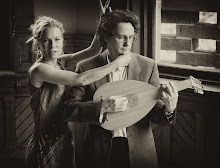
Here's a snap from last week's concert. It was great fun.

And here's the program:
Fair cruell nymph Alfonso Ferrabosco II (1572-1628)
❀
Songs on Flowers
Go lovely rose William Lawes (1602-45)
To Pansies - Ah! cruel love W. Lawes
On the Marigold - Mark how the blushful morn Henry Lawes (1596-1662)
On the Lillys - White though ye be W. Lawes
To the Sicamour - I’m sick of Love Nicholas Lanier (1588-1666)
Gather ye rosebuds W. Lawes
❀
Loves Constancy - No more may meads Lanier
Now in the sad declension of our time W. Lawes
Be not proud pretty one W. Lawes
❀
Hero’s Complaint to Leander Lanier
❀
Coranto René Saman (fl 1610-31)
Coranto (Jacques?) Gaultier (fl.1617-60)
Intermission
Songs from Plays
Tell me dearest Robert Johnson (1582-1633)
So beautie on the waters stood - Had those that dwell in error - If all the ages of the earth Ferrabosco
The Cutpurse Song - I keep my horse W. Lawes
Care charming sleep Johnson
Full fathom five - Where the bee sucks Johnson
❀
Fuggi fuggi fuggi Anon.
Tavola - In quel gelato core H. Lawes
❀
Pavan Johnson
❀
Woe’s me! Alas Robert Ramsey (fl. 1612-1644)
Darryl Edwards, tenor, has appeared to critical acclaim in oratorio, recital, and opera in England, Germany, France, Italy, Corsica, the United States, and across Canada. His recent and upcoming engagements include Kodály's Psalmus Hungaricus with the National Arts Centre Orchestra in Ottawa, the Verdi Requiem at Dalhousie University, Orff's Carmina Burana with the Toronto Mendelssohn Choir, Mozart Requiem with the Toronto Philharmonia, and Handel's Messiah with the Elmer Iseler Singers. Critics praise him as a ‘rich-voiced, cultured tenor who mastered the high notes effortlessly’ (Coburg Tageblatt, Germany), and an ‘effective communicator who expressed the text with sensitivity and fervour’ (Hamilton Spectator). His recordings and broadcasts include performances with National Public Radio, the Canadian Broadcasting Corporation and the Canadian Music Centre (Centrediscs). He is the Artistic Director of the Centre for Opera in Sulmona, Italy and the Concert Opera Group.
Named after the singers and lutenists who performed in the most intimate quarters of the Stuart monarchs’ palace, The Musicians In Ordinary for the Lutes and Voices dedicate themselves to the performance of early solo song and vocal chamber music. Soprano Hallie Fishel and lutenist John Edwards have been described as ‘winning performers of winning music’. Now in their seventh season of concerts in Toronto, they perform across North America and lecture regularly at universities and museums. Institutions where MIO have performed include the Canadian Society for Renaissance Studies, Grinnell College, the Universities of Alberta and Toronto, the Kingston Opera Guild, Trent and York Universities and the Bata Shoe Museum. They have been Ensemble in Residence at Lafayette College in Easton, Pennsylvania. Their debut CD of Elizabethan and Jacobean songs, Sleep Wayward Thoughts, is available at intermission.
Fair, Cruel Nymph
‘Wilson! There’s more words, let’s hear them all.’ King Charles I so ordered the singer John Wilson during a performance. This not only shows that the King was paying attention, but that he appreciated the disservice that Wilson was doing to the poet by leaving verses unsung.
And the delivery of the poetry had become the most important aspect of songwriting as England imported the new Italian Baroque style at the beginning of the 17th century. The complicated polyphony that the lute song composers of the John Dowland generation was gone, replaced by a bass from which the lutenist improvised chords. For this new style the English also imported the theorbo, a lute that had been invented by the Italians to provide a big bass sound. Inigo Jones, architect and designer of the sets for the court masque, is supposed to have imported the first theorbo. According to a contemporary diarist the weird instrument’s owner was interrogated by the authorities, who thought it might be ‘a machine brought from popish countries to destroy the king’. Indeed, Italian fashions dominated the vocal music of the post-Dowland generation so much that Henry Lawes set the table of contents from an Italian songbook to mock those who sang in Italian without understanding what they were singing.
The English Civil War stopped the slide to absolutism that became the political hallmark of 17th century France. If it hadn’t who’s to say that the heroic declamation of the masque, where the aristocrats assured themselves that they were rightly at the head of the body politic, and even that James’s Queen Anne was greater than Elizabeth, would not have combined with the drama of dialogues like Woe’s me to become court opera like that cultivated by Louis XIV and Lully? It’s moot though; The English were not going to stand for a despot, however benevolent, and the masque, baroque court music and the tradition of the Shakesperean theatre were all cut off by the Commonwealth. Perhaps the theorbo, which was used in these genres, did contribute to the destruction of King Charles, then.
Thursday, February 26, 2009
We've been rehearsing with Darryl Edwards for the upcoming concert which has been many lols. The repertoire is Jacobean and Carolingian music by composers like the Lawes Bros., Nicholas Lanier etc. Words are by Ben Jonson, Herrick, Shakespeare and others.
Here's some snapshots from the rehearsals.

Darryl explains how he purchased three 5 dollar footlong sandwiches, one each.
Hallie reflects on the sad fate of Hero and Leander as she prepares to rehearse Lanier's great Lament thereon.
John has been having balls of fun using English theorbo tuning, which has only the top string down the 8ve, and is 'in G'; Good for c minor and Eb major, which your English composers liked.
Here's some snapshots from the rehearsals.
Darryl explains how he purchased three 5 dollar footlong sandwiches, one each.
John has been having balls of fun using English theorbo tuning, which has only the top string down the 8ve, and is 'in G'; Good for c minor and Eb major, which your English composers liked.Saturday, January 31, 2009
Here is a picture of Hallie working with Prof. Tim McGee, who is retired from the University of Toronto Faculty of Music. Among his many accomplishments Tim started the Toronto Consort. One of the first books I read on early music was his 'beginner's guide'.
He's been working on what son might have been accompanied by the lira da braccio, an instrument much played by humanist poets in the late 15th and 16th century. They appear to have improvised, or quasi-improvised their settings. It has a flat bridge so plays drone effects though you can lean the bow over and play some melodic flourishes on the top string alone. It also has one string offboard of the fingerboard which was plucked with the left thumb. Here is the lira Tim made.

Hallie will be singing some poems by Tullia d'Aragona to this instrument and will be going with Tim to the huge Medieval conference in Kalamazoo in May.
He's been working on what son might have been accompanied by the lira da braccio, an instrument much played by humanist poets in the late 15th and 16th century. They appear to have improvised, or quasi-improvised their settings. It has a flat bridge so plays drone effects though you can lean the bow over and play some melodic flourishes on the top string alone. It also has one string offboard of the fingerboard which was plucked with the left thumb. Here is the lira Tim made.
Hallie will be singing some poems by Tullia d'Aragona to this instrument and will be going with Tim to the huge Medieval conference in Kalamazoo in May.
Wednesday, January 14, 2009
We had a busy long weekend with 3 shows in 4 days with different music. Friday was a presentation for the Centre for Reformation and Renaissance Studies on the attribution of the poems of the Earl of Essex which were set to music by Dowland, Batchelar et al. After the chin-wagging we performed the songs (except for From silent night, which uses a violin or treble viol) and it went very well. I had arranged The Earl of Essex's Second Lute Song from Benjamin Britten's Gloriana for the last piece. Here is the text that he sets:
Happy were hee could finish foorth his Fate
In some unhaunted Desert, most Obscure;
From all Society, from Love, from Hate
Of Worldly Folke! Then should Hee Sleepe Secure;
Then Wake againe, and yield God ever Praise,
Content with Hippes, and Hawes, and Brambleberry,
In Contemplation passing still his Daies,
And change of Holy Thoughts to make him Merry;
Who when Hee dies, his Tombe may bee a Bush,
Where Harmeles Robin dwells with Gentle Thrush.
Your Majesty’s Exiled Servant
Rob: Essex
Sunday afternoon was a performance for the Toronto Early Music Centre. We did our Ingrato e Crudo Amore repertoire. Music from Isabella d'Este's circle, some Verdelot madrigals and some of the music talked about in the last post. After the show we met with Prof. Katie Larson to talk about a conference in the fall at University of Maryland that she is putting together a session for.
Monday night was the Arts and Letters Club, accompanying Timothy McGee's presentation on the song Fortuna Desperata from the court of Lorenzo the Magnificent. The picture, which has sort of Leonardo da Vinci vs. Marcel Duchamp thing happening is from the washroom at the Arts and Letters Club.
Monday, January 5, 2009
To the UofT Faculty of Music library today and got Essex's Second Lute Song from Britten's Gloriana from the vocal score. Came home and arranged it for lute. Hallie was working on lira da braccio and how to sing a sonnet by Lorenzo the Magnificent to it. We also were trying to match up poems by the courtesans Tullia d'Aragona and Veronica Franco with 'aria di cantare' (textless tunes that fit to certain poetic forms) from 16th century Italy for Sunday's show for the Toronto Early Music Centre.
Saturday, January 3, 2009
Here are some pictures from preparation for the New Year's Day Show along with the program and note. Things got a little crammed together since Sara couldn't get a plane from back from down east due to fog. Show went well, though, and we had to turn people away since we sold out. I think we will have to add a second show next year.
A New Years Day Concert - Viennese Baroque Music
Cantata - Risoluto son gia, tiranno amore Antonio Caldara (1671-1736)
Hallie chats and has a cup of tea during a break. Archlute relaxes.
Sonata in C Minor, RV6 Antonio Vivaldi (1678-1741)
Preludio: Largo, Corrente: Allegro, Largo, Allemanda, Allegro non molto
Pieces for Guitar Orazio Clementi (d.1708)?
Aria-Corenta-Furioso-Spannioleta-Clorys-Les Enfarines
Cantata - Il Rosignolo Francesco Conti (1682-1721)
Largo-Recitativo-Aria
Intermission
Suite in D Minor Ferdinand Tobias Richter (1651- 1711)
Toccatina-Capriccio-Allemande-Courante-Minuett
Sinfonia à Solo di Arciliuto Anon.
Largo-Allegro-Largo-Allegro
Cantata - Lungi dal vago volto Vivaldi
Recitativo-Adagio-Recitativo-Allegro
After a glut of Messiahs and other pre-Christmas concerts, the Toronto concert calendar listings, and particularly those on the early music calendar, get rather thin in the first weeks of the New Year. We offer again this year a selection of Viennese music as an alternative to the Blue Danubes and Tristch-Trastch Polkas of the Vienna Philharmonic Orchestra’s New Year’s Day Concert and those of their imitators. But though we have moved our repertoire some 50 to 75 later than that presented in our previous New Years’ programmes, you will notice that the names of our composers have become no less Italian.
Antonio Caldara was born in Venice and was employed at St. Mark’s Church (previously the employer of Monteverdi) as a cellist. In 1708 he moved to Rome where he would have worked with Handel, Corelli and the Scarlattis. After Handel’s departure for England, Caldara followed in his footsteps as Cardinal Ruspoli’s maestro di capella and in 1717 gained employment at the Imperial court in Vienna. Here he was responsible for operas on the birthdays and name days of the Emperor and his consort, as well as other operas and sacred music including at least one large scale oratorio each Lent. This enormous workload meant that his salary peaked at a whopping 3900 florins, but he felt the need to supplement it by writing operas for the courts of other Austrian nobles. He is said to have died of a stroke brought on by exhaustion.
Among the Italian musicians at the court of Leopold I was the theorbo player, archlutenist and guitarist Orazio Clementi and it is thought that he is the composer, or at least the compiler, of a manuscript of guitar music now in the National Library of Austria. The Emperor Leopold I of the House of Habsburg played the guitar in his spare time away from prosecuting the War of the Spanish Succession. It is thought that these straightforward pieces may have been for the Emperor himself to play. Though Italian composers dominate the list of musicians and, indeed, Italian was the everyday language spoken at the Imperial court, this manuscript has a peculiarly French flavour, with its gavottes and minuets. The string crossings in the music, though, suggest the tuning recommended by the Spanish guitarist Gaspar Sanz and Spain had been a Habsburg empire for over a century. These pieces show that multiculturalism flourished in the Holy Roman Empire, at least as far as matters concerning instrumental music.
As old age crept up on Clementi a second theorbist was engaged to help with his duties. This was Francesco Conti, who hailed from Florence. Here the theorbist had been much admired by Ferdinando III de’ Medici, the great-great-grandson of the Ferdinand who employed the inventors of opera Peri and Caccini. Conti was engaged at Vienna in 1701 and his duties soon expanded beyond theorbist to composing operas and sacred music. His fame as a player had composers like Fux adding obbligato parts to arias for him, tours as far away as London, where he entertained Queen Anne with performances on the theorbo and mandolin, and earned him the epithet ‘first theorbist of the world’. As well as fame and his own fortune he married the wealthy widow and highest paid musician in Vienna, Maria Landini, who sang in many of his operas. Though a very successful composer in his time, very little of his music has been published in modern times (the motet discussed below, eight cantatas for soprano with various instruments and a duet for soprano and alto). We have edited the cantata heard today from a microfilm of an 18th century manuscript held in the Bodleian Library in Oxford. His most often heard music, though, is a motet Languet anima mia to which J.S. Bach added oboes and performed at Cöthen and Leipzig.
The possessor of the sole Germanic sounding name on our programme, Ferdinand Richter, was recognized as the greatest representative of south German keyboard music by Pachelbel. No slouch on the keys himself, Pachelbel dedicated a collection of organ music to Buxtehude (as the north German master) and Richter. Hailing from Würzburg, upon his appointment as court and chamber musician to Leopold Richter he taught two future emperors as well as other offspring of Leopold and visiting professional keyboardists eager to learn his skills. Again, the dance movements of his suite are French in style.
Completely Italianate and even Corellian, however, is the anonymous Sinfonia for archlute. The manuscript of this work was purchased from the library of the Harrach family in 1956 by the lutenist and musicologist Robert Spencer and we have obtained a transcription of it by Prof. Arthur Ness in Boston. Aloys, Count Harrach, an Austrian diplomat and politician, had a winter palace in Vienna, but was widely traveled. He may have picked up the Sinfonia while he was Viceroy in Naples, or perhaps it was by or for one of the lutenists at the Imperial court. The archlute was invented as a compromise between the large theorbo, which was cumbersome for solo music and uncomfortable above the bass range, and the smaller Renaissance lute. Both of these instruments were much used as the melodic bass instrument instead of a bowed string (cello or viol). Bass partbooks were printed with rubrics like ‘violone o arciliuto’ or ‘violoncello o tiorba’ well into the 18th century. The figures in these books suggest that the lutenist would play chords wherever practical in addition to the bass line.
It may seem strange to include that composer so closely associated with Venice, Antonio Vivaldi, on our concert of Viennese music. The Red Priest, as he was known, visited Vienna on the many tours he undertook towards the end of his life, some with the singer Anna Girò. The presence of her sister as chaperone on these tours did nothing to stop gossip that Anna was his mistress, and in fact suggestions were made that the arrangement was even more scandalous than just that of an old priest sleeping with a young singer. It has been suggested that some of Vivaldi’s works with lute class instruments were written for the Imperial orchestra. The Concerto con Multi Stromenti uses two theorboes and two mandolins; there are concertos for one and two mandolins and a trio with lute. The Concerto for viola d’amore and lute is probably for the orphanage in Venice. As Vivaldi’s music went out of fashion in Venice in his last years he picked up and moved to Vienna, perhaps with the goal of performing public opera company there. Before he could get established, the Emperor died and a period of mourning meant a moratorium of public performances. Vivaldi himself died penniless the same year and was buried in Vienna in a pauper’s grave.
The Vienna Philharmonic’s New Year’s Day concerts started in a troubled time in that city’s history. That such periods of social turmoil could still see music flourish tells us something about the healing power of our art and the hope it nurtures in us all.
A New Years Day Concert - Viennese Baroque Music
Cantata - Risoluto son gia, tiranno amore Antonio Caldara (1671-1736)
Recitativo-Aria-Recitativo-Risoluto
Hallie chats and has a cup of tea during a break. Archlute relaxes.Sonata in C Minor, RV6 Antonio Vivaldi (1678-1741)
Preludio: Largo, Corrente: Allegro, Largo, Allemanda, Allegro non molto
Pieces for Guitar Orazio Clementi (d.1708)?
Aria-Corenta-Furioso-Spannioleta-Clorys-Les Enfarines
Cantata - Il Rosignolo Francesco Conti (1682-1721)
Largo-Recitativo-Aria
Intermission
Suite in D Minor Ferdinand Tobias Richter (1651- 1711)
Toccatina-Capriccio-Allemande-Courante-Minuett
Sinfonia à Solo di Arciliuto Anon.
Largo-Allegro-Largo-Allegro
Cantata - Lungi dal vago volto Vivaldi
Recitativo-Adagio-Recitativo-Allegro
After a glut of Messiahs and other pre-Christmas concerts, the Toronto concert calendar listings, and particularly those on the early music calendar, get rather thin in the first weeks of the New Year. We offer again this year a selection of Viennese music as an alternative to the Blue Danubes and Tristch-Trastch Polkas of the Vienna Philharmonic Orchestra’s New Year’s Day Concert and those of their imitators. But though we have moved our repertoire some 50 to 75 later than that presented in our previous New Years’ programmes, you will notice that the names of our composers have become no less Italian.
Antonio Caldara was born in Venice and was employed at St. Mark’s Church (previously the employer of Monteverdi) as a cellist. In 1708 he moved to Rome where he would have worked with Handel, Corelli and the Scarlattis. After Handel’s departure for England, Caldara followed in his footsteps as Cardinal Ruspoli’s maestro di capella and in 1717 gained employment at the Imperial court in Vienna. Here he was responsible for operas on the birthdays and name days of the Emperor and his consort, as well as other operas and sacred music including at least one large scale oratorio each Lent. This enormous workload meant that his salary peaked at a whopping 3900 florins, but he felt the need to supplement it by writing operas for the courts of other Austrian nobles. He is said to have died of a stroke brought on by exhaustion.
Among the Italian musicians at the court of Leopold I was the theorbo player, archlutenist and guitarist Orazio Clementi and it is thought that he is the composer, or at least the compiler, of a manuscript of guitar music now in the National Library of Austria. The Emperor Leopold I of the House of Habsburg played the guitar in his spare time away from prosecuting the War of the Spanish Succession. It is thought that these straightforward pieces may have been for the Emperor himself to play. Though Italian composers dominate the list of musicians and, indeed, Italian was the everyday language spoken at the Imperial court, this manuscript has a peculiarly French flavour, with its gavottes and minuets. The string crossings in the music, though, suggest the tuning recommended by the Spanish guitarist Gaspar Sanz and Spain had been a Habsburg empire for over a century. These pieces show that multiculturalism flourished in the Holy Roman Empire, at least as far as matters concerning instrumental music.
As old age crept up on Clementi a second theorbist was engaged to help with his duties. This was Francesco Conti, who hailed from Florence. Here the theorbist had been much admired by Ferdinando III de’ Medici, the great-great-grandson of the Ferdinand who employed the inventors of opera Peri and Caccini. Conti was engaged at Vienna in 1701 and his duties soon expanded beyond theorbist to composing operas and sacred music. His fame as a player had composers like Fux adding obbligato parts to arias for him, tours as far away as London, where he entertained Queen Anne with performances on the theorbo and mandolin, and earned him the epithet ‘first theorbist of the world’. As well as fame and his own fortune he married the wealthy widow and highest paid musician in Vienna, Maria Landini, who sang in many of his operas. Though a very successful composer in his time, very little of his music has been published in modern times (the motet discussed below, eight cantatas for soprano with various instruments and a duet for soprano and alto). We have edited the cantata heard today from a microfilm of an 18th century manuscript held in the Bodleian Library in Oxford. His most often heard music, though, is a motet Languet anima mia to which J.S. Bach added oboes and performed at Cöthen and Leipzig.
The possessor of the sole Germanic sounding name on our programme, Ferdinand Richter, was recognized as the greatest representative of south German keyboard music by Pachelbel. No slouch on the keys himself, Pachelbel dedicated a collection of organ music to Buxtehude (as the north German master) and Richter. Hailing from Würzburg, upon his appointment as court and chamber musician to Leopold Richter he taught two future emperors as well as other offspring of Leopold and visiting professional keyboardists eager to learn his skills. Again, the dance movements of his suite are French in style.
Completely Italianate and even Corellian, however, is the anonymous Sinfonia for archlute. The manuscript of this work was purchased from the library of the Harrach family in 1956 by the lutenist and musicologist Robert Spencer and we have obtained a transcription of it by Prof. Arthur Ness in Boston. Aloys, Count Harrach, an Austrian diplomat and politician, had a winter palace in Vienna, but was widely traveled. He may have picked up the Sinfonia while he was Viceroy in Naples, or perhaps it was by or for one of the lutenists at the Imperial court. The archlute was invented as a compromise between the large theorbo, which was cumbersome for solo music and uncomfortable above the bass range, and the smaller Renaissance lute. Both of these instruments were much used as the melodic bass instrument instead of a bowed string (cello or viol). Bass partbooks were printed with rubrics like ‘violone o arciliuto’ or ‘violoncello o tiorba’ well into the 18th century. The figures in these books suggest that the lutenist would play chords wherever practical in addition to the bass line.
It may seem strange to include that composer so closely associated with Venice, Antonio Vivaldi, on our concert of Viennese music. The Red Priest, as he was known, visited Vienna on the many tours he undertook towards the end of his life, some with the singer Anna Girò. The presence of her sister as chaperone on these tours did nothing to stop gossip that Anna was his mistress, and in fact suggestions were made that the arrangement was even more scandalous than just that of an old priest sleeping with a young singer. It has been suggested that some of Vivaldi’s works with lute class instruments were written for the Imperial orchestra. The Concerto con Multi Stromenti uses two theorboes and two mandolins; there are concertos for one and two mandolins and a trio with lute. The Concerto for viola d’amore and lute is probably for the orphanage in Venice. As Vivaldi’s music went out of fashion in Venice in his last years he picked up and moved to Vienna, perhaps with the goal of performing public opera company there. Before he could get established, the Emperor died and a period of mourning meant a moratorium of public performances. Vivaldi himself died penniless the same year and was buried in Vienna in a pauper’s grave.
The Vienna Philharmonic’s New Year’s Day concerts started in a troubled time in that city’s history. That such periods of social turmoil could still see music flourish tells us something about the healing power of our art and the hope it nurtures in us all.
Subscribe to:
Posts (Atom)