Friday, March 6, 2015


John Donne on Love & Death
Mar. 7, 2015, 8PM

Heliconian Hall, Toronto


John Donne on Love & Death
An Epithalamion, or Mariage Song on the Lady Elizabeth, and Count Palatine being married on St. Valentines Day         John Donne (1572-1631)
Come away, come sweet love                    John Dowland (1563-1626)
The Lady Elyza: her masque                    Robert Johnson (c1583-c1634)

When Laura smiles                             Philip Rosseter (1567-1623)
Solus cum Sola                                  Dowland

Sweet stay awhile                                  Dowland
Delyght Pavan                                    John Johnson (c1545-94)

Deare, if you change                            Dowland
Delyght Gallyard                                 Johnson

Cleare or cloudie                               Dowland
Nowe to bed                                    Anon.

Time stands still                                Dowland
My Hart is Surely Sett                        Anon.

Faine would I wed                             Campion
Greensleeves                                 Anon./Francis Cutting (c1550-1596)
There is a Garden in her face          Robert Jones (1577-1617)

Intermission                 

A nocturnall upon S. Lucies Day, Being the shortest day Donne                                                    
Mourne, mourne                             Dowland
Countesse of Bedfords Galliard Henry Porter (1549-aft. 1605)                 

In darknesse let me dwell             Dowland
Pavana Ploravit                          Anthony Holborne (c1545-1602)

Greefe keep within                     John Danyel (1564-c1626)
A Doomp                                  E.E.?

Drop not myne eyes                   Danyel
Dump Philli                               Phillip van Wilder? (c1500-53)
Have all our passions                   Danyel

Guest Artist
Seth Lerer is Distinguished Professor of Literature at the University of California at San Diego. Well known for his scholarship and public lectures in the history of the English Language, he has also published widely on medieval and Renaissance English Literature, poetry, and Children's Literature. His books have won such awards as the Harry Levin Prize of the American Comparative Literature Association, the National Book Critics Circle Award, and the Truman Capote Prize in Criticism. His most recent book is Prospero's Son, a memoir published by the University of Chicago Press in 2013. He is currently working on music, myth, and lyric poetry in Shakespeare's last plays.

Notes

‘I may be uninspiring, but I’ll be damned if I’m alien!’ British King George V is supposed to have said in response to H.G. Wells’s criticism of the royal lack of charisma and excess of Germanness at the onset of World War I (‘...an alien and uninspiring court…’ said Wells). The charisma problem was all George’s own, but we can pinpoint the source of the latter.

The first ‘British’ king, James VI of Scotland, inherited the English Tudor crown and soon set about marrying off his children (an option not available, obviously, to the Virgin Queen Elizabeth) to various continental dynasties to cement his ‘prince of peace’ policy. James’s daughter, also Elizabeth, was matched with various princes, but public opinion, and particularly that of her brother Henry, Prince of Wales, settled on Frederick, Elector Palatine, to whom she was married on St. Valentine’s Day, 1613. Frederick and Elizabeth’s grandson of the House of Hanover came to the British throne, not speaking a word of English, as George I. His great-great-granddaughter Victoria still spoke German around the house but eventually public opinion again, in World War I, forced George V to adopt the last name Windsor and lose the German sounding ‘House of Saxe-Coburg and Gotha’ handle. 


The official commemorative poem of the 1613 Royal Wedding was by John Donne, which you hear tonight read in the pronunciation of the time. Donne and Campion, whose texts are heard here set by Jones (There is a Garden), Rosseter (When Laura Smiles) and himself as well, seem to have competed as the official court mouthpieces. Between the verses of Donne’s wedding poem we sing some love songs of the period untouched by the cruel disdain of the harsh mistresses that breaks the hearts of so many poets and songwriters in that age of melancholy, along with some lute pieces the titles of which might allude to the delights of new love. The first half of this concert may be the least miserable set of songs it is possible to compile from Jacobean songbooks, especially with so many drawn from Dowland, the official composer of Jacobethan melancholy.

The Lady Elyza: her masque appears to be a dance taken from one of the entertainments surrounding the wedding. These shows may have included all or components of Shakespeare’s The Tempest (or perhaps components of a wedding masque were interpolated into the play; it’s not clear). Settings of Ariel’s songs by Robert Johnson survive.  Solus cum Sola (perhaps best translated as ‘He and She Alone Together’) and Delyght are pavans, slow duple time dances which, it has been suggested, survive in a very dumbed down form as the wedding march. The Delyght Gallyard is the melodic and harmonic material of the pavan crammed into the gay, triple time dance most popular at the time. (John Johnson is the father of Robert, the composer of the masque dance and Shakespeare’s troupe.) The famous Greensleeves was, for the Jacobeans, the chord progression, not the tune, and Campion’s Faine would I wed uses that ‘ground bass’ as well as the lute pieces.


Historically-informed pronunciation is the kind of thing that we could spend all night wrestling, wrangling and arguing about, and still never know what the words of speech and song really sounded like, in which respect it is like right hand lute technique. But by examining poetry, song, and prose – looking for rhyming schemes, how sentences scan, and the spellings of the words themselves – we can begin to gather some general ideas about how English in the period from which we are performing tonight might well have sounded in the listener's ear(e). For example, what we have come to regard as ‘sight rhymes’ actually were not such at the time. The words ‘beare’ and ‘eare’ in the poem above really were pronounced with the same vowel sound.  Furthermore, variations in spelling, and thus pronunciation, from song to song and from poet to poet, suggest that language was profoundly influenced by factors such as region and social status. 


It has been suggested Donne’s A nocturnall upon S. Lucies Day, Being the shortest day was penned while Lucy Russell, the Countess of Bedford was very ill, so that he could have a carefully wrought tombeau ready if she did succumb. But even if it was not, she would still cast a very long shadow over our concert this evening. Lucy surrounded herself with artists working in the melancholy milieu we so associate with Elizabethan and Jacobean literature and music: Donne, Samuel Danyel (brother of this evening’s composer John) and of course, John Dowland. A poem on Lucie Bedford (look down the first letter of each line) and Dowland’s lute  from his Second Book of Songs is on the previous page. Mourne, mourne is one of the first five songs in the book, all of which make Songs of Leonard Cohen sound like Pharrell Williams’s Happy. Did Lucy choose to patronize artists working with darkness and melancholy or were these artists, and their monuments of the melancholy movement, made to measure for Lucy’s tastes?

And very carefully and densely wrought Donne’s poem is too. It claims that it is being written on the feast day of St. Lucy, which, before a calendar adjustment, was the shortest day of the year. Donne aludes to alchemy, medical theory, chemistry and astrology in this poem. (Capricorn, the goat of the last verse, is in conjunction with the sun at that time of the year.) In the second verse of Deare, if you change (from Dowland’s First Book) the anonymous poet enumerates corruptions that will come to the four incorruptible elements (air, water, fire and earth). In the Nocturnall Donne uses this ‘science’, and especially the water of tears and the cold, dry earth to demonstrate the special nothingness he has become since his beloved’s death. Earth corresponds to the melancholy humour.


The Danyel songs presented this evening are a trilogy from his songbook of 1606, titled Mrs M E her funeral tears for the death of her husband. The sorrowful Mrs. M.E. has not been identified, but the poet (Samuel Danyel? John himself?) has her wondering whether, if tears can be present at joyful situations and those merely a bit sad, shouldn’t there be more now?

In January, in our series at St. Michael’s College in the University of Toronto, we presented a concert including the ‘passionate pavans’ of Dowland’s Lachrimæ or seaven teares for violins and regular comers to MIO concerts will have heard us perform Dowland’s Flow my teares. These pavans all begin with the four-note descending scale which became a musical emblem of melancholy and with which Holborne begins his Pavana Ploravit (i.e. ‘Weeping Pavan’).

In a scene from Romeo and Juliet, Peter the servant  importunes the musicians after the discovery of the supposed death of Juliet: ‘O, musicians, …play me some merry dump, to comfort me.’ The Dump was a type of commemorative piece often based on a two-note ground bass such as those presented here. In an earlier, much shorter, version Dump Phili is called Arthurs Dumpe and it is possible that it began as a ‘Tombeau’ for Arthur Dewes by his colleague Philip van Wilder. Both were lutenists to Henry VIII but the later version has some more modern sounding variations. Perhaps later lutenists added their own divisions on the ground bass as it passed from manuscript to manuscript. Our other dump has ‘A doomp E.E.’ written at the end of it. Perhaps E.E. was the composer, perhaps the dedicatee.


Friday, January 30, 2015


The Cure of Religious Melancholy
Music by John Dowland (1563-1626) 
Fr. Madden Auditorium, Carr Hall 
St. Michael’s College
Jan. 30th, 2015
Lecture 7:30PM, Concert 8PM

Lachrimae antiquae
From silent night, true register of moanes 
Lachrimae antiquae novae
The Humble Suit of a Sinner
Lachrimae gementes
If that a Sinners sighes be Angels foode
Lachrimae tristes
Thou mighty God-When Davids life-When the poore criple
Lachrimae coactae
Where Sinne sore wounding
Lachrimae amantis
In this trembling shadow
Lachrimae verae
Sorrow Come - arr. William Wigthorpe (c.1570-1610)

The Musicians In Ordinary
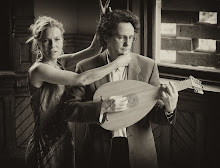
Named after the singers and lutenists who performed in the most intimate quarters of the Stuart monarchs’ palace, The Musicians In Ordinary for the Lutes and Voices dedicate themselves to the performance of early solo song and vocal chamber music. Soprano Hallie Fishel and lutenist John Edwards have been described as ‘winning performers of winning music’. A fixture on the Toronto early music scene for over 10 years, in 2012 MIO became Ensemble in Residence at St. Michael’s College in the University of Toronto. They have concertized across North America and lecture regularly at universities and museums. Institutions where MIO have performed range from the scholarly to those for a more general public and include the Shakespeare Society of America, the Renaissance Society of America, the Shakespeare Association of America, Grinnell College, the Universities of Alberta, Toronto and at California at San Diego, the Kingston Opera Guild, Syracuse, Trent and York Universities and the Bata Shoe Museum. They have been Ensemble in Residence at Lafayette College in Easton, Pennsylvania. 

Christopher Verrette has been a member of the violin section of Tafelmusik since 1993 and is a frequent soloist and leader with the orchestra. He holds a BMus and a Performer’s Certificate from Indiana University and contributed to the development of early music in the American Midwest as a founding member of the Chicago Baroque Ensemble and Ensemble Voltaire, and as a guest director with the Indianapolis Baroque Orchestra. He collaborates with many ensembles around North America, performing music from seven centuries on violin, viola, rebec,vielle and viola d’amore. He was concertmaster for a recording of rarely heard classical symphonies for an anthology by Indiana University Press and collaborated with Sylvia Tyson on the companion recording to her novel, Joyner’s Dream.

Eleanor Verrette began her studies on violin in Toronto with Gretchen Paxson and Aisslinn Nosky, going on to study viola in Montréal with Pemi Paull and Anna-Belle Marcotte at McGill University. She graduated from McGill University in 2012 with a Bachelor's in viola performance.  She appears regularly with the Musicians In Ordinary, and is featured on recent album releases by acclaimed folk-rock artists Lakes of Canada and Corinna Rose. She has also performed with Aradia Ensemble and Montréal singer-songwriter Ari Swan, and plays vielle as a founding member of the Pneuma Ensemble.

Stephen Marvin is a writer, musician and craftsman living in Toronto. Since 1977, he has specialized in early music, performing with and leading many well known ensembles. Stephen has been a principal violinist and violist with Tafelmusik Orchestra for 20 years, but now performs in about half of their season's programs. Stephen’s primary devotion to chamber music has included many ensembles, especially recitals and trio performances of late eighteenth century repertoire with fortepiano. He is the violist with the Lumiere Quartet. Stephen plays on more than 60 recordings, most notably with Sony and enjoys an international reputation as a bow-maker. For 25 years he has specialized in 17th and 18th century reproductions for early music specialists, like himself. He has published articles and given lectures on the history and construction of old bows. More recently he has begun making modern bows after examples by Tourte, Peccatte and others.

Brandon Chui is Assistant Principal Viola of the Kitchener-Waterloo Symphony Orchestra and a member of the Hamilton Philharmonic. Having held leading positions in the Verbier Festival Orchestra in Switzerland and the Schleswig-Holstein Festival Orchestra in Germany, he has also performed with the Canadian Opera Company, Tafelmusik and the Toronto Symphony Orchestra. He has worked with many of today's most celebrated conductors, such as Semyon Bychkov, Valery Gergiev, Philippe Herreweghe, Paavo Jarvi, Kurt Masur, Zubin Mehta and Esa-Pekka Salonen. Extensive touring has brought Brandon to such venues as Amsterdam's Concertgebouw, Berlin's Konzerthaus and Philharmonie, L.A.'s Walt Disney Hall, Lucerne's KKL, Zurich's Tonhalle and the opera houses of Genoa, Lyon and Versailles.

As well as being a founding member of I Furiosi Baroque Ensemble, baroque cellist and viola da gambist Felix Deak showcases his career as a freelance musician with orchestras and chamber ensembles, including Toronto's Tafelmusik Baroque Orchestra, Toronto Symphony Orchestra, Les Voix Humaines and Opera Atelier. Felix instructs orchestral classes and private students in and around Toronto. He can be heard on CBC Radio Two in performances, and has made recordings for various labels at home and abroad. 

The Reverend Lisa Wang holds degrees from the State University of New York (BA), the University of Toronto (MA, MDiv), and the University of London (PhD).  She has published in the areas of literature and theology, ecclesiology, and Biblical interpretation.  She currently teaches at the Faculty of Divinity, Trinity College, and serves at the Anglican Church of St. Mary Magdelene, Toronto.

In his Anatomy of Melancholy (first published 1621) The Second Partition, (on the Cures of Melancholy), Section 2, Subsection 3, Member 1, the thorough Robert Burton treats of the efficacy of ‘Music of all Sorts, aptly applied.’ Let’s see what the windy Burton, who loved to express himself in quotes from Ancients and Moderns and everyone between, has to say. 
  • Scaliger gives a reason of these effects, “because the spirits about the heart take in that trembling and dancing air into the body, and are moved together, and stirred up with it,” or else the mind, as some suppose harmonically composed, is roused up at the tunes of music. And 'tis not only men that are so affected, but almost all other creatures. 
Timothy Bright, whose 1586 book A Treatise of Melancholy Shakespeare may have read in his day job as the publisher’s proofreader, recommends only ‘such of that kind as most rejoyceth is to be sounded in melancholy ears’, but Burton and others acknowledge that dissonances as heard in Dowland’s mannerist music, will resonate or with the discordant troubled mind and as the music returns to consonance will ‘resolve’ the turbulent mind to consonance with it. And even the more temperate mind can enjoy melancholy music. He says:
  • Many men are melancholy by hearing music, but it is a pleasing melancholy that it causeth; and therefore to such as are discontent, in woe, fear, sorrow, or dejected, it is a most present remedy: it expels cares, alters their grieved minds, and easeth in an instant. 
The whole of the Third Partition of Burton’s Anatomy treats of Love Melancholy, and a large part of that is taken up with estrangement from God’s love, in the section on Religious Melancholy, which seems to have been a problem at the time. What we would call ‘psychologists’, physician-ministers, found it necessary to treat those driven mad by their certainty of their own damnation. Were they ill with melancholy or merely sorrowful for sin? ‘More needs she the divine than the physician’ says Lady Macbeth’s doctor. And the Cambridge theologian William Perkins wrote ‘When a man is without all hope of salvation, in his owne sense and apprehension it is not a distinct kind of trouble of mind, but the highest degree.’ 

With his alternating acts of derring-do and retirements to sullen solitude in Wanstead Wood, Robert, Earl of Essex would probably be diagnosed as being on the bipolar spectrum today, but in his day he was recognized as a classic case of Melancholia. Our first ayre, From Silent Night, from Dowland’s last songbook A Pilgrimes Solace, has words by Essex, supposedly written as he awaited execution for his last act of derring-do, an attempted coup d’état. Dowland uses a unique scoring of treble and bass viol (the word ‘viol’ was often used for both families of instruments) and lute and has the ‘tune of sad despair’ sliding chromatically in half-steps up and down. In his how-to-compose book of 1597 Thomas Morley says, ‘When you would express a lamentable passion then you must use your motions proceeding by half notes…these accidental motions may fitly express the passions 
of grief, weeping, sighs, sorrow, sobs and such like.’

In 1596 John Dowland had been kicking around the continent of Europe in a series of unsatisfactory court jobs when he received a letter from his friend the courtier Sir Henry Noel. The letter urged him to hurry back to England as Sir Henry thought he had scored him a job at Queen Elizabeth’s court. When he got back though, Dowland found his patron Noel had died, and with him his job. Dowland dedicated to Noel a manuscript collection of penitential Psalms and hymns from the standard Psalter used in England at the time which appear at first glance to be standard settings of hymn tunes, but which have fidgety rhythms and fleeting dissonance that betray the composer. 

And so, Dowland ended up back on the Continent working for Christian IV, King of Denmark where his routine seems to have been get an advance on his salary, sail back to England and get something published to keep him in the public eye, sail back and apologize for overstaying, repeat. On one such trip he had printed Lachrimæ or seaven teares figured in seaven passionate pavans set foorth for the lute, viols, or violons, in five parts. The seven pavans (the pavan was a slow dance in three repeated parts of eight measures each, but no one could have danced to these ones) which begin the collection start with has come to be called the Lachrimae motto. The piece which is called Lachrimae antiquae (Latin for Old Tears) is a re-writing of a pavan that was originally for lute solo which is found in almost all British sources of lute solos and many continental ones from the 1590s to the 1630s and beyond. This lute mega-hit had words written to it beginning ‘Flow my teares’ printed in 1600 in Dowland’s Second Book of Songs. Each of the Lachrimæ or seaven teares pavans takes the first few notes of the original as its point of departure and then wanders off, respectively through Old New Tears (Lachrimae antiquae novae), Sighing Tears (Lachrimae gementes), Sad Tears (Lachrimae tristes), Forced Tears (Lachrimae coactae), Lover’s Tears (Lachrimae amantis) and True Tears (Lachrimae verae). The Lachrimæ or seaven teares print was dedicated to the consort of the new English King James, Anne, who happened to be the sister of the King of Denmark. A job back home was not forthcoming however and Dowland was let go from the Danish court by civil servants fed up with his attendance record. (Christian was away at the time.) In 1612 the fore mentioned A Pilgrimes Solace was published, dedicated to his then employer, who was much too minor a nobleman for the greatest lutenist in Europe and the greatest songwriter in the English language (then, and, we would argue, still and ever). Probably Dowland’s grumpy preface to the book, which complains about ‘strange entertainment’ at court, and the ‘fellows who give their verdict of me behind my back’, shamed the Jacobean court into giving him a place as a lutenist there which had been empty for decades. It’s from A Pilgrimes Solace that most of the remaining ayres heard tonight are taken.

Timothy Bright, in his Treatise of Melancholy, gives us some symptoms. They will be ‘Given to weeping sometimes (if the melancholy be sanguine, they exceed in laughter) sighing, sobbing, lamentation, countenance demisse (downcast), and lowring, bashfulnesse, and blushing.’ The melancholy poet of If that a sinner’s sighes ticks many of those boxes. Dowland borrows the Italian madrigalists’ trick of writing a rest for the singer at the word ‘sigh’ to imitated the physical reaction of black bile (melancholy) expelling air from the body. 

The composer borrows yet more Italianisms in the adventurous harmonies deployed in Thou mighty God and In this trembling shadow. In his First Book of Songs Dowland had proudly printed a rather lukewarm commendation by Luca Marenzio, a pioneer of the Mannerist Madrigalists who deployed dissonance to paint the pains of lovers. The most extreme of these composers was Gesualdo, a mad nobleman, and Dowland certainly rivals his expressionistic harmonies here. 

Despair, it is held, is a sin. Dowland’s Second Book of Songs makes Songs of Leonard Cohen seem jaunty by comparison, both musically and in its verse. The third song of that book is for one voice and lute, and begins Sorrow stay. The manuscript consort song version you hear this evening gives a variant on the original text, which ends ‘Down, down down I fall/Down and arise I never shall.’ but for the religiously scrupulous the manuscript provides another more extensively rewritten text, which ends, through hope of Jesus’s intercession, with the singer ‘never falling’. 

To finish, let’s hear from Burton again:
  • In a word, it (music) is so powerful a thing that it ravisheth the soul, regina sensuum, the queen of the senses, by sweet pleasure (which is a happy cure), and corporal tunes pacify our incorporeal soul, sine ore loquens, dominatum in animam exercet, and carries it beyond itself, helps, elevates, extends it.


Wednesday, December 31, 2014


A New Year’s Day Concert
Heliconian Hall,  35 Hazelton Ave. Toronto
Jan. 1, 2PM   & Jan. 2, 8PM, 2015


Sonata Op. 1 No. 1                  Arcangelo Corelli (1653-1713)
Grave – Allegro – Adagio – Allegro

Rorate Caeli from Concerti Sacri Op. 2  Alessandro Scarlatti (1660-1725)

Sonata Violino e Basso                  Alessandro Stradella (1632-1689)
Andante – Allegro – Adagio – Vivo – Adagio – Allegro

Sonata Prima from Sonatae Unarum Fidium  Johann Schmelzer (c. 1620–1680)

Sinfonia à 2 Violini e Basso                  Stradella
Grave – Allegro – Andante – Allegro – Allegro

Intermission


Sonata 2:a        Giovanni Zamboni (1664-1721?)
Alemanda – Current – Sarabanda, Largo – Giga


Serenata con Violini          Scarlatti
Sinfonia – Recit – Aria, Largo – Recit – Ritornello & Aria – Recit – 
Aria, Andante – Recit – Aria, Largo – Recit – Recit Accompagnato

Program Note
Few composers have been as famous and influential in their own lifetimes as Arcangelo Corelli. His trio sonatas, solo sonatas and concerti grossi were the model for all composers who wrote in those Italianate forms. Corelli’s Opus 1 and 3 trio sonatas come with partbooks labeled ‘violino primo, violino secondo, organo’ and ‘violone o arcliliuto’ when printed in Rome. The archlute, then, is a substitute for the bowed bass, though the violone (what we would call a cello, but maybe a biggish one) and archlute book has the same figures above the notes as the organ part. Some latitude was used in the scoring in the bass as the sonatas spread across Europe. The title page of John Walsh’s London edition of the early 18th century says the ‘through bass’ is for ‘ye organ harpsichord or archlute.’ The archlute is a chordal instrument then.

The rather dissolute life of Alessandro Stradella would be best expressed, not in a short program note, but in an opera, which, indeed, it has been. At least two operas of the singing kind have been composed, but perhaps the soap variety would be even better. A minor nobleman, he moved to Rome to compose for Queen Christina of Sweden and the church. Some of the church’s money, though was found ‘resting in his bank account’. He fled to Venice where he was installed as music teacher to a nobleman’s mistress. She and Stradella ran off together and his former employer (the nobleman, not the church) had hitmen stab him to death in the piazza.


Schmelzer seems to have been a rather less excitable fellow. He worked all his life at the court of the Holy Roman Empire, where not only was Italian music on tap (the Neapolitan Giovanni Felice Sances was Schmelzer’s predecessor as Kappelmeister, and the list of musicians was full of Bertalis, Valentinis, Caldaras and Contis) but Italian was the main language spoken day-to day.

Printed in Lucca in 1718, the Sonate d’intavolatura di leuto Zamboni, a Roman who was lutenist at Pisa Cathedral, represents the swansong of Italian solo lute music, though the instrument continued to be used as a continuo instrument and as an obbligato instrument in operas and oratorios till the end of the baroque.


Alessandro Scarlatti was also a very prolific composer of cantatas both with just continuo and with other instruments a much under-performed genre considering what a large slice of so many composers’ works it comprises. Very often the cantata’s text is a description of the joys or sorrows (usually the sorrows) of an amorous shepherd, in the kind of perfect love only possible in the pastoral tradition. The pains of this shepherd are usually reported by another shepherd looking on. This all sounds terribly mannered to us today, but the pastoral tradition was used for centuries to demonstrate how perfect political entities might work, how the perfect host might behave, and, in the case of song, how the perfect lover might feel. Is it any less mannered than a present day hospital drama or cop show? Throughout the cantata we see Scarlatti deploy the tricks used by a composer of operatic ‘music-drama’, moving seamlessly between speech-like declamation and arioso passages in the recitatives as the emotions of the shepherd swirl. The arias, with their infectious melodies, each narrow the focus onto one ‘affect’ of the spurned lover.

Translations

Motet: Aria  Rorate Caeli
Scatter your dew heavens, Let the sweet dew fall in drops.
Let the day be joyful and happy, let the sun grow bright without fog, illuminate the whole world.


Sinfonia 
Recit - As the sun hastened toward its beloved Western horizon, his chariot star, the lazy Arcturus, was already with glittering flames turning to the sea. As the star’s glimmer dispersed the still night, revealing it as one of the most beautiful, the white Goddess arose, blushing and radiant from her pastoral bed with gleaming rays in her cheeks, and Love showed what secret flames she hid for the shepherd. It was the time when the year rejuvenates itself through the bosom of the flowers, instilling joy in the heart; when the lonely Daliso, leaning his weary side at the foot of a stone from which flowed a babbling silver spring, vented his tears and sighs, mingling them with the waves. He remained alone with his silent troubles. And from his cheeks cruel Love pitifully wiped the pearl-like tears, distilled from the sorrow of his heart. Finally, exhausted, his limbs entwined in the grass, tortured with love and gaze fixed heavenwards, sobbing, he unburdened his torment to the breezes and the wind thus:

Aria: Dark shadows that hide the glimmer of light from me, even if you should be the faithful friends of sorrow all that I now desire is that you weep for my tears.

Recit: Curilla, my soul, joy of my afflictions, if you go, I will die, my love. Ah! weep for me, my friendly stars. I ask you to shield me from these harsh tidings.

Ritornello & Aria: Fresh hoar frost so compassionate, revive these roses, kiss the tips of the flowers. Ah! fallen and pale, you turn into little tears to weep at my sorrow!

Recit: Faithful but senseless plants, who stayed the flight of the winged singer, you take from the earth only drops of bitterness because of the sorrow that is killing me, and now that Curilla has gone, you weep with me for my lost love. When her beautiful face beamed with happiness and laughter, we were transported to Paradise.


Aria: Beloved idol, tormentor of my heart, if only this harsh occurrence would betray my love. I suffer the sorrows, I hide the pains of our separation, O my love.

Recit: But you - sad eyes - tell me, what will you do when you are deprived of her radiant beauty? Ah! unhappy Daliso, know your destiny. Know that it is Love’s desire to burn in flames of grief and for the heart to bleed!

Aria-Largo: Beautiful waves, mercifully refreshing these meadows, you listen and are saddened by my mournful murmurings. Ah! you are weeping for my tears.

Recit: Curilla, my soul, ah! come and weep with me. Oh my beauty, adored light of my eyes, now I despair of all hope. But go happily wherever you are guided, my Curilla, and if spiteful fortune should take you far, it shall be far only from my eyes, not from my heart, my darling; and even if I feel the pain, I will delight in your happiness and desire only to set my love in your heart as a remembrance of me. Go, go happily, my heart. As the faithful lover I will accompany you for ever with my grief. Curilla, my soul. Curilla, farewell ...

Accompagniato: Daliso wished to say more but suddenly, from immense sorrow, he fell unconscious; and Love cried for him.

Guests:


Christopher Verrette has been a member of the violin section of Tafelmusik since 1993 and is a frequent soloist and leader with the orchestra. He holds a Bachelor of Music and a Performer’s Certificate from Indiana University. He contributed to the development of early music in the American Midwest, as a founding member of the Chicago Baroque Ensemble and Ensemble Voltaire, and as a guest director with the Indianapolis Baroque Orchestra. He collaborates with many ensembles around North America, performing music from seven centuries on violin, viola, rebec, vielle, and viola d’amore. He was concertmaster in a recording of rarely heard classical symphonies for an anthology by Indiana University Press and recently collaborated with Sylvia Tyson on the companion recording to her novel, Joyner’s Dream.

Patricia Ahern has a BA and BMus from Northwestern University, MMus from Indiana University, and performer diploma from the Schola Cantorum in Basel, Switzerland. She taught baroque violin at the Freiburg Conservatory and Oberlin’s Baroque Performance Institute, and has given masterclasses at McGill, Wilfrid Laurier, York and Grand Valley State Universities, and the Universities of Windsor, Wisconsin and Toronto. She has concertized on five continents and performed with Milwaukee Baroque, Ars Antigua, Chicago Opera Theater, Kingsbury Ensemble, Aradia, I Furiosi, Newberry Consort, Musica Pacifica, and the Carmel Bach Festival. Tricia has recorded for Sony, Naxos, and Analekta, and joined Tafelmusik in 2002.

Borys Medicky has appeared as solo harpsichordist and continuo player in the United States, Canada, and Europe.  Resident in Toronto, Canada, he is active as a freelance performer, having appeared with major ensembles in Toronto and beyond.  He enjoys co-directing (with lutenist Lucas Harris) the Toronto Continuo Collective, an all-continuo ensemble dedicated to fostering an increased interest in the stylish basso continuo accompaniment of seventeenth-century vocal and instrumental music.  From 2006-2014 he was the artistic director of the Kitchener-based Nota Bene Baroque Players.  He serves as organist of the Fifth Church of Christ, Scientist in Toronto.  In addition he builds harpsichords and carries out harpsichord maintenance duties for institutions and private clients in the Greater Toronto area.

As well as being a founding member of I Furiosi Baroque Ensemble, baroque cellist and viola da gambist Felix Deak showcases his career with orchestras and chamber ensembles, including Toronto's Tafelmusik Baroque Orchestra, Montreal based Les Voix Humaines, and Opera Atelier. Felix teaches music in the TDSB and instructs private students in and around Toronto. He can be heard on CBC Radio Two in performances, and has made recordings for various labels at home and abroad.