Friday, March 11, 2011


Here are the notes and translations for Saturday's concert. You'll never get the chance to hear most of it again.

Rococo
At the beginning of the 18th century the public concert or public opera finally eclipsed the court chamber as the engine for music making; The German Handel made and lost fortunes selling tickets to Italian opera in London, virtuosi with publicity machines toured the great music centres playing concerti with orchestra, even the Concert Spirituel was a ticketed concert. But chamber music still flourished, especially in the Parisian intellectual salon. Here men like the encyclopaedist Diderot, liberal thinkers like Rousseau and even a pre-imperial Napoleon would gather, literally, at the foot of the bed of great ladies. These patronesses were the first ‘bluestockings’, this hosiery being the fashion for the literary ladies who attended these events. And after a hard afternoon’s reporting to one’s patron how the encyclopaedia or the thinking or the revolution plotting was coming along, one would need to unwind with some chamber music.

Putting patrons on seats at public concerts had required the Italians develop a melodic style with clear chords progressions which, when introduced to Paris, was termed Style Galant. Rousseau was an apostle of this style where beautiful cantabile melodies are carried to the ear by simple harmonies with no turgid polyphony. The Genevan wrote of the music of French composers like Rameau ‘There is neither a clear beat nor a melody in French music because the French language is not susceptible to either. French song is only a continual squealing, intolerable to every unbiased ear; French harmony is brutish, without expression and suggests nothing other than the filler material of a rank beginner; the French “air” is not an air at all; and the French recitative is not at all a recitative. From all this I conclude that the French do not have music, and that if they ever do have it, it will be all the worse for them.’

Giacomo Merchi was an Italian who settled in Paris in 1753 and played in the salons. Porro (née Pierre-Jean Porre) was from Provence but thought it well to affect an Italian name when he moved to the capital in the 1780s. The popularity of the guitar as accompanying instrument is attested to by the many prints of song published by these and other composers, as well as its ubiquity in parlour scenes painted in the period.

The violin sonatas presented this evening are from a collection called L’Art du Violon published in Paris in 1800. This anthology featured works by Italian virtuosi like Nardini and his teacher Tartini as well as works by Germans and the Spaniard who affected a French name who worked in England, Chabran. Chabran taught guitar as well as violin in London.

In reading the texts of tonight’s music you will notice that shepherds and shepherdesses once again populate our poems. While those who inhabit the literature of earlier centuries gave their listeners an ideal of perfect love to emulate, tonight’s pastorals reflect a desire, even a nostalgia for a more natural way of living far removed from the complexity and artificiality of 18th century society. Unfortunately the deluge of revolution swept away not only the artificiality of faux-pastoral aristocrats but also the grace and artifice of Rococo art.

Un jour sur la coudrette
One day in the courtyard,
Love came to say hello to Lisette.
The simple shepherdess saw him,
and right away the poor dear blushed.

The child Love, seeing her sudden trouble,
redoubled his attentions,
and said "you know well how to charm,
shepherdess; you must love once more."

With a sweet smile, at a loss for words,
with a very silly heart that sighed,
the gentle bachelorette was quiet, but her youthful soul was moved.

Seeing that she quaked with fear,
the god quickly seized her heart;
now he was master of it, he laughed,
and then the little traitor left.

While the victim sobbed, the ingrate, proud of his crime, fled;
pity young girl Lizon
and profit by this lesson.

Voyez dans ces vergers
See in these orchards the spring that snakes around;
it waters the young saplings a hundred times.
One with the elm, this abundant vine
rises and clings to its branches.
This other, without support, lies languishing;
these amorous palm trees unite in lullabies.
It is of the pleasure of loving that the nightingale sings;
these waves and these woods, these fruits and these birds,
all are a living lesson in love, for you.

Au fond d’un bois Solitaire
Deep in a solitary wood,
One day, the shepherd Tircis,
Finding the shepherdess alone,
Spoke to her of his love.
"You know," he said, "cruel one,
How strong my fidelity is:
An eternal hardship
Has never repulsed me.

If my soul was light,
My fate would be more sweet;
More than one friendly shepherdess
Has wanted revenge on you for me.
Ah! how easily with others
I could have found happiness,
If other eyes than yours
Could have charmed my heart."

Sighs interrupted
This lover's complaints;
The tears that followed them
Spoke more strongly.
The shepherdess became tender,
And finding herself without witnesses,
Was forced to yield;
I have seen some yield to less.

En vain j’adresse
In vain I address an unwelcome plea to the Heavens; the Heavens no longer listen to my pained voice. Redoubtable Love, flighty Fortune, even friendship - sole blessing of the unhappy - seem to reunite to intensify my misery. I fulfill my destiny; I was born to suffer. My heart has nothing left on earth; I can no longer love and I cannot die.

Pure and Holy friendship, sweet charm of life, I sacrificed love to you; but what it cost at least grants peace to my faded heart. They say that you are enough for happiness; far from soothing me, you compound my misery...

Pour Jeanette
For Jeanette, my bagpipe
Plays a song each day.
The sprite on the tender grass
accompanies my sounds with her voice.
I am the happiest shepherd
of Paphos and of Cithere;
she is not severe with me at all.
I have found the art of pleasing her,
and the love of my shepherdess
I vow forever.

Every day, to my crook
she ties a thousand flowers,
and decorates my bagpipe
with all colours of ribbons.
All over the village
she has carved my name into the elm,
and if there are some pastures
in her heritage,
in returning to the village
she leads my flock there.

Be happy, dear lover,
remember that I've received your trust;
without sharing I commit myself,
to live for always under your law,
and your flame, through which my soul
feels the liveliest ardor for you,
is an Eternal flame,
so that in a cruel absence
it will make its only sweetness
to console my faithful heart.

Astre des nuits
Star of the night and your pleasant hours,
Delay the return of the light.
Stop, you leave sensitive hearts
To sob in the shadow and sigh of love.

Ah! Who can defend themselves from loving you?
I adore you and say it to none but you,
This simple avowal that I dare to make heard,
Is already a sweet enough joy.

Accompanied by shadow and mystery
I will return; each night in this place
You will hear its solitary echo
Repeat to you my sighs and my vows.

Me promenant
Walking near home, without thinking, my heart was taken, my poor heart, without thinking about it my heart was taken; a certain pretty face almost rendered me mute today [with surprise] that destiny did such a favor for me, my poor heart etc.
An appetizing mouth, an elegant waist, little cute feet, little mischievous eyes, nothing like her here or there, my poor heart suddenly was taken, etc.

Quel tourment
What torment, ah, what martyrdom,
That is so hideous to suffer;
To sob in one's soul and not dare speak.
Alas, alas, I feel myself dying.

Happy in their bitter pain
Are those who can at least shed tears.
But always to suffer in silence,
Ah, that is the worst kind of pain.

Charmant Iris
Charming Iris, if, on a scale,
One were to weigh your unfairness;
Yes, I would be sure that your inconstancy
Would be equal to my lightness.
Let us, then, give each other release
From our debt of infidelity.

At each instant, by a new offering,
Let us court, Iris, the god of hearts;
Let us never attach our flighty natures;
Let us fly from turn to turn in love;
Perhaps, Iris, in this lovely voyage,
Our hearts will meet one day.

Charmant valon
Charming dale, the sweetest wilderness where often alone I have sought nature,
I hear already your brook that murmurs, I see at last your willows always green.
Sing the willow and its gentle greenery.

Yes, there they are, these amorous wood-pigeons,
These hills, these woods, these meadows, this pure stream,
Ah! Rich and simple nature, must you offer yourself,
so beautiful, to the eyes of the unhappy!
Sing the willow &c

It may be that soon - these are my final vows -
Some shepherd ,seeing my tomb,
Will say in passing, "his righteousness was wronged;
he was sensitive, and died unhappy."
Sing the willow &c


Thursday, March 10, 2011


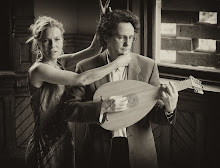
Here's a couple of pictures of us rehearsing Saturday's Rococo concert. 8PM, Heliconian Hall, 35 Hazelton Ave. Details here. Rococo is sometimes a dirty word in classical music and the music is pooh-poohed, but I am really enjoying this concert. The composers' names are not very well known. Porro has his own Wikipedia page. Merchi is talked about in James Tyler's book on the early guitar which is here on Google Books. That book also says that Chabran was a guitar teacher as well as a violinist, so he probably wouldn't have minded the guitar accompanying his sonata. That's why the cat can hang out inside the unused harpsichord.

Canzonetta – Un jour sur la coudrette Pierre Porro (1750-1831)
Ariette – Voyez dans les vergers Francesco Alberti
Romance - Au fond d’un bois Solitaire Giacomo Merchi (1730-aft.1789)
Sonate in D Maj Pietro Nardini (1722-1793)
La Plainte de Fabian – En vain j’adresse Porro
Pour Jeanette Merchi
La Serenade – Astre des nuits Porro

Intermission

Me promeant du Logis Merchi
Quel tourment Jean Jacques Rousseau (1712–1778)
Sonate in G Major Charles Chabran (fl 1752–1785)
Le Quittance Mutuelle – Charmante Iris Merchi
Le Saule du Malheureux – Charmant valon Porro

Thursday, February 17, 2011


We were running through some of the songs we've chosen for the Rococo concert yesterday. One of the books has guitar tablature right under the octave treble clef (which they use nowadays for guitar music) so you have the choice of what you like to read. Today we will be looking through a book of songs by the philosopher Rousseau. Those songs mostly have a continuo part that I will make up chords for on the guitar.

Chris and I also read through a couple of violin sonatas and chose a couple. Those are also continuo parts.

At the top is the guitar I'll be playing. It has five courses tuned like the top five of a 12-string guitar. During the late 18th century players were increasingly taking the second string of each pair off, but I will keep them on as some did. (I also like reading the tablature better than the octave treble clef.) At the very end of the century some guitars had a sixth pair, and one or two of the songs we're doing have the option of taking some notes down an octave.

Below is the Comtesse d'Egmont, who was a Spanish noblewoman who kept a salon in Paris. I think the above guitar is more like hers than the one that Madame de Pompadour is playing in the one at the bottom of this post.


Thursday, February 3, 2011


The programme notes for Saturday's concert. There'll be some blabbing too between the pieces if you want to know more. The picture is from a ceiling in Rosenborg Castle, where Danish King Christian IV lived. So, depending on when the picture was executed, maybe that lute player there is John Dowland.

See the previous post for the pieces I'll be playing, see the previous one to that to listen to an mp3 of the Ferrabosco Pavan I'll be playing.

Blame Not My Lute

The first music specifically for the lute, the most important solo and accompanying instrument in the Renaissance, appeared around the beginning of the 1500’s in Italy. That country is the centre of lute playing for the first four decades of the century and the lute style is consolidated in the works of Francesco da Milano. His oeuvre is almost entirely comprosed of Fantasias or Ricercars, that is to say, free instrumental pieces, but other Italian contemporaries based works on motets, Mass movements, madrigals and chansons, often decorating the hit vocal music of the day. By the middle of the century, though, France had become the centre of lute playing and, unsurprisingly, the country that gave us ballet increasingly chose more or less stylized dances as their favoured mode of expression. As France descended into sectarian chaos, and as England emerged from the same towards the end of the century, the latter became not just the centre of lute playing, but a net exporter of string players of all kinds. Several North European courts had an English lute player or violin band leader.

The first lute methods printed in England were translations from the French. John Dowland’s first job, at age 19, was as lutenist to the English ambassador to France. It’s natural, then, that his complete solo lute works contains about 60 dance pieces (pavans, galliards and almains, or allemandes), 7 Fancies (English for fantasia), and a few settings of popular ballad tunes. French dances dominate manuscripts and the few printed sources of lute solos as well.

Besides picking up experience with dances and lute playing while in France, Dowland also picked up Catholicism. He claimed this prevented him from ever being engaged by Elizabeth as a court lutenist, despite being the most famous instrumentalist in Europe (his works are in manuscripts from Scotland to the Ukraine). More likely he was the victim of government cutbacks at the increasingly frugal court. After a visit to Italy where he added to his compositional quiver the chromaticism and dissonance of the madrigalists Gesualdo and Marenzio, Dowland was employed by the Landgrave of Hesse and the King of Denmark, who fired him for being undependable. Back in England, a place was found for him at James I’s court, replacing a lutenist who had been dead 40 years.

Holborne appears to have been a gentleman, and it is not clear that his employment with Elizabeth was primarily as a lutenist. Apart from one song and a pavan in a collection of lute music, his printed works are for cittern solo and a collection of dances for 5-part string or wind band. It is hard to know if his lute solos in manuscripts, which are mainly versions of these 5-part pieces, are arrangements by him or someone else.

Ferrabosco was a Bolognese who was one of Elizabeth’s lutenists. He left England in a hurry when he was embroiled in the murder of one of Philip Sidney’s servants. Pilkington is known to us as a madrigal composer, though he dabbled in lute playing. Robinson published the first completely English lute method. And then there is Anon. and the nearly Anons. Whitfield and E.E. We are lucky that at least one of their works have made it through to us.

Tuesday, February 1, 2011


Here's what I'll be playing on Saturday I think. 8PM Heliconian Hall. More details at the website.


Philipes Pavan Peter Phillips (c.1560-1628)

Passion Anthony Holborne (c.1545-1602)

Sir John Smith his Almaine John Dowland (1563-1626)


Semper Dowland Semper Dolens Dowland

The Fairy Round Holborne

The Night Watch Holborne


The Most Sacred Queen Elizabeth, her Galliard Dowland

Robin is to the Greenwood gone Anon.

The Right Honourable Robert Earle of Essex his Galliard Dowland


Pavin Alfonso Ferrabosco I (1543-1588)

Mellancoly Galliard Dowland

Merry Melancholie Thomas Robinson (c. 1560-1609)


Hearts Ease Anon.

Kemps Jig Anon.

Dump Philli Anon.


------------Intermission-------------

A Doompe E.E.

Lachrimae Dowland

Bara Faustus Dream Anon.


Countesse of Pembrookes Paradice Holborne

The Right Honourable the Lady Rich, Her Galliard Dowland

O deare lyfe Anon.


Go from my Window Francis Pilkington (c1565-1638)

Willsons Wylde Anon.

The English Huntsuppe John Whitfield (fl.1588-1620)


A Dream Dowland?

Packingtounes Galliard Anon.

Packingtounes Pound Anon.

Forlorne Hope Fancye Dowland


Monday, January 17, 2011


Happy Birthday (or at least, happy baptism day) Alfonso Ferrabosco the Elder, lutenist to Elizabeth I, composer, spy, accessory to murder, father of that other Alfonso and integral plot device in Rose Tremain's bestselling Music and Silence. You can download the mp3 of his pavan above for free of course by clicking here.

Friday, December 31, 2010


Here's the program for the New Year's Day concert. Above are some pictures of the rehearsal. Concerts are 8PM Jan. 1, 2PM Jan. 2nd at the Heliconian Hall, 35 Hazelton Ave. Get there early as it will possibly sell out. Doors open a 1/2 hour before concert time.

A New Year’s Day Concert

Cantata - Risoluto son gia Antonio Caldara (1671-1736)

Recitativo-Aria-Recitativo-Risoluto


Sonata "Victori Der Christen" Heinrich Biber (1644-1704)

Der Türken Anmarsch-Der Türken Belägerung Der Stadt Wien-Der Türken Stürmen-Anmarsch Der Christen-Treffen Der Christen-Durchgang Der Türken Victori Der Christen


Per commando del mio bene Antonio Caldara

Aria-Recitativo-Aria


Aria in Modi Variata Wolfgang Ebner (1612-65)


Intermission


Piéces in F# minor Jacques St. Luc (1616 – c. 1710)

Tombeau De Mr. François Ginter, Allemand-Courante-Sarabande -Menuet


Toccatina-Capriccio Ferdinand Richter (1651- 1711)


Cantata- All’ombra di sospetto Antonio Vivaldi (1678-1741)

Recitativo-Aria,-Larghetto-Recitativo-Aria, Allegro


The Musicians in Ordinary

Named after the singers and lutenists who performed in the most intimate quarters of the Stuart monarchs’ palace, The Musicians In Ordinary for the Lutes and Voices dedicate themselves to the performance of early solo song and vocal chamber music. Soprano Hallie Fishel and lutenist John Edwards have been described as ‘winning performers of winning music’. Now in their 10th anniversary season of concerts in Toronto, they have concertized and lectured across North America at institutions ranging from the scholarly to those for a more general public: the Universities of Alberta and Toronto, Trent, Syracuse, York Universities, the Bata Shoe Museum and Artists in Residence at Lafayette College in Easton, Pennsylvania. Their CD Sleep Wayward Thoughts, Elizabethan and Jacobean music on the various facets of slumber, is available at intermission.


Guests

Christopher Verrette is in his 18th season as a member of Tafelmusik Baroque Orchestra, with which he is a frequent soloist and concert master both in Canada and abroad. He is a graduate of Indiana University, where he was awarded the first-ever Performer's Certificate for accomplishment on the Baroque violin and was a student of Stanley Ritchie. Since that time he has been committed to the growth of Early Music in the American Midwest as a founding member of Ensemble Voltaire (Indianapolis) and the Chicago Baroque Ensemble and has collaborated with numerous period-instrument ensembles around North America. In recent seasons he has played music from six centuries on violins, vielle, rebec, viola and viola d'amore. His recordings range from old favourites like Beethoven and Mozart symphonies and Pachelbel's Canon, to hitherto unrecorded sonatas by Bertali and other seventeenth century composers, new arrangements of Playford tunes on Throw the House out of the Windowe for Marquis records, John Welsman's score for the independent Canadian film The Limb Salesman, the soundtracks of Touchstone Pictures’ Casanova and CBC Television’s series The Tudors.


Recipient of the 2007 Montreal Baroque Prize for Audaciousness and Musicality, harpsichordist Sara-Anne Churchill is in demand as an orchestral player, chamber musician and soloist. She has recently appeared with I Furiosi Baroque Ensemble, Aradia Ensemble, Orchestra London, Niagara Symphony, Mississauga Symphony, The Musicians in Ordinary and Capella Intima. One of the first graduates of the new Advanced Certificate in Performance-Baroque Option, jointly offered by the University of Toronto and Tafelmusik Baroque Orchestra, Sara has also received instruction from Olivier Fortin, Skip Sempé, Richard Egarr, Carole Cerasi and Luc Beauséjour. While completing a Bachelor of Arts in Music at the University of Western Ontario she developed an intense interest in early music and historical keyboards and studied harpsichord with Sandra Mangsen. Sara completed a Masters of Arts in Musicology at UWO in 2006. Her thesis, a translation and commentary of a French baroque harpsichord continuo treatise, was later published in Performance Practice Review. She currently studies with Charlotte Nediger and is a candidate for the Doctorate of Musical Arts in Harpsichord Performance at the University of Toronto.


A New Year’s Day Concert

After a glut of Messiahs and other pre-Christmas concerts, the Toronto concert calendar listings, and particularly those on the Early Music calendar, get rather thin in the first weeks of the New Year. We offer again this year a selection of Viennese music as an alternative to the Blue Danubes and Tristch-Trastch Polkas of the Vienna Philharmonic Orchestra’s New Year’s Day Concert and those of their imitators.


Antonio Caldara was born in Venice and was employed at St. Mark’s Church as a cellist. In 1708 he moved to Rome where he worked with Handel, Corelli and the Scarlattis. After Handel’s departure for England, Caldara followed him as Cardinal Ruspoli’s maestro di capella and in 1717 gained employment at the Imperial court in Vienna, where he was responsible for operas on the birthdays and name days of the Emperor and his consort, as well as other operas and sacred music. This enormous workload meant his salary peaked at a whopping 3900 florins, but he felt the need to supplement it by writing operas for the courts of other Austrian nobles. He is said to have died of a stroke brought on by exhaustion.


Curiously, the sonata celebrating the victory of the Imperial forces at the Siege of Vienna began life as a sonata depicting the Crucifixion composed by Biber. This rather astonishing re-application of a ‘program’ might have been made by the ‘Schmelzer’, to whom the piece is attributed in the manuscript, and who probably composed the last movement, not found in Biber’s sonata. Johann Schmelzer was a violinist at Vienna, but died before the siege, so perhaps his son Andreas was the adapter. The piece is written for scordatura violin. The three lower strings are tuned up a whole tone, but the music notates, not the pitches, but where the violinist is to put his fingers. For example, on a normally tuned violin placing the first finger on the second string gives B, but because it is tuned up, even though a B is notated, it sounds as C. The violin part, then, looks like musical gibberish.


Ebner was the organist at Stephansdom, Vienna, and was associated with the Imperial court from 1637 until his death in 1665. He was obviously highly favoured since his salary was double that of the now more famous Froberger. Ebner began as the organist for the Kapelle and later became the Kapellmeister at the Cathedral and the official composer for the ballet. Most of his music was destroyed in World War II -- the best-known pieces that survive are the variations for harpsichord based on a theme by Emperor Ferdinand III himself. Hailing from Würzburg, Richter was recognized by Pachelbel as the greatest representative of south German keyboard music. Upon his appointment as court and chamber musician to Leopold, Richter taught two future emperors, as well as Leopold’s other children.


Italian plucked string players at the court included Orazio Clementi (theorbo and guitar) and Francesco Conti (theorbo and mandolin). These men played obbligato parts in operas. The theorbo, though we might think of it as the chordal part of the basso continuo group, was still much used as the melodic bass instrument, interchangeable with the cello or viol, well into the 18th century. It is in this role we use it in the cantatas. Lutenist Jacques Saint-Luc played the French baroque lute, which then had 11 pairs of strings and was tuned to an open d-minor chord, with basses tuned to whatever scale the piece required. His pieces show that multiculturalism flourished in the Holy Roman Empire, at least as far as matters concerning instrumental music. St. Luc was born in what is now Belgium, but was then the Hapsburg Netherlands. He came to Vienna, where he was employed by Prince Eugene of Savoy. His Tombeau on the death of François Ginter (Adam Franz Günter) is in the key favoured by French lutenists for tombeaux. The lack of open strings in F# minor gives the lute a covered quality.


Antonio Vivaldi visited Vienna on the many tours he undertook towards the end of his life, some with the singer Anna Girò. The presence of her sister as chaperone on these tours did nothing to stop gossip that Anna was his mistress, and in fact suggestions were made that the arrangement was even more scandalous than just that of an old priest sleeping with a young singer. Emperor Charles VI invited Vivaldi to come to Vienna and as Vivaldi’s music went out of fashion in Venice in his last years he picked up and moved to the Austrian capital. Before he could get established the Emperor died and a period of mourning meant a moratorium of public performances. Vivaldi himself died penniless the same year and was buried in Vienna in a pauper’s grave. His house was on the site of the hotel where Vienna’s famous Sachertorte is said to have been invented.


Translations

Risoluto son gia, tiranno amore

Recitative

I am now determined, tyrant Love, to dissolve those bonds which held me a base prisoner for so long. My rational soul teaches me that you falsely betray every faithful heart. Now I am learning to scorn the proud disdain, which brought so much torment to this unfortunate soul Now your true worth awaits you, imminently. The heart will put bitter war before treasonous peace.

Aria

Arms, deceptions, arrows, chariot, you have wielded these, blind ingrate, against this injured heart. Standing firm always affects one so that fleeing with your passion, with triumph and away from fear.

Recitative

That fearful panic that spurs the soul to flight in the face of danger is mostly submission, since it recognizes the greater of that which is the danger itself, and when the unexpected calamity arrives, it enters and tears apart the ill-defended breast, which it found already weakened, which the weapons of Love at last conquer. Better is burning courage than vile fear.

Aria

War, war, to arms, to arms! Thus shall I dare to advance into the palace of glory. My heart shall hold fast to that duty until either death or victory makes my valour worthy.


Sonata "Victori Der Christen"

Der Türken Anmarsch - Advance of the Turks

Der Türken Belägerung Der Stadt Wien-The Turks Besiege the city of Vienna

Der Türken Stürmen-The Turkish Assault

Anmarsch Der Christen-The Advance of the Christians

Treffen Der Christen-The Christian Engagement

Durchgang Der Türken-Withdrawl of the Turks

Victori Der Christen-Victory of the Christians


Per commando del mio bene

Aria

By order of my beloved, my heart languishes in a thousand sufferings, but my heart cannot endure so many injuries of guilt; It is immersed in a sea of troubles, every hope of salvation from such hardship, between help and constancy, is already lost.

Recitative

Wretched! How did I sin? What did I do? If I deserved the suffering which pierces my heart, you stars, my enemies, say it, or say it yourself tyrannous Phyllis! Say it! But before you condemn me, cruel one, to such harsh martyrdom, to such heavy scorn, I protest to you and I swear to you that I am not, nor ever was, guilty. If before punishing me you had listened to me, you would know that my faithful heart could never offend you, cruel one, neither in thought, alas, nor in desire. Wretched! How did I sin? What did I do?

Aria

Innocence is worthless, faithfulness is useless, neither do I hope for pity from a thankless beauty. Cruel disdain and false pity fear constant and faithful love with cruel indifference and proud severity.


All’ombra di sospetto

Recitative

From the shadow of suspicion, my constancy, suffering, loses somewhat its confidence, and to such beautiful allurement, some trust departs.

Aria

The heart is not accustomed to the bittersweetness of love, which soothes suffering with its fegned charm. Scorn will come to those who love passionately on impulse.

Recitative

O, how many lovers, true and faithful, are deluded by shrewd flattery amid the chains of love. Many languish, and frequently blood is shed to prove true love. Formed from the ardor of charming beauty, the soul struggles each hour, and the derided lover is deceived again and again.

Aria

False happiness is the real torture of the loving follower. Merciless beauty has darts, those glances that waver with distress.