Monday, December 20, 2010


The program for the New Year's Day concert is coming together. There'll be some late 17th century music as well as some 18th century.

Hallie will be singing two cantatas with violin by Antonio Caldara who was at Vienna from 1717 till his death from a stroke, perhaps brought on by overwork, in 1736. His court duties were to provide an opera for birthday and the name day of the Emperor and his consort as well as a large scale oratorio every Lent. The 3,900 Florins he was getting a year he was getting a year for that was not enough apparently, so he took on work composing operas for other Austrian nobles on the side.

There'll be a Vivaldi cantata. Vivaldi died and was buried in a pauper's grave in Vienna. He moved there to start afresh as an opera composer just before the Emperor died. Operas were cancelled during the period of mourning, so he never caught on.

Sara Anne Churchill will play some variations by Wolfgang Ebner on a theme by Emperor Ferdinand III and Chris Verrette will be playing a sonata attributed to 'Schmelzer' (probably Andreas, since his more famous dad, Johann was dead by the event) in the manuscript which is a programatic piece on the defeat of the Turks in the Seige of Vienna. Except it's probably really a piece by Biber and the subject is the Crucifixion. There's a picture of the score above. You'll see the violin is tuned to a scordatura with the lower three strings up a tone from where they are usually. The notes on the staff tell you where to put your fingers as if the strings were tuned normally, rather than representing the pitches that come out, so the violin part looks like musical gibberish.

There might be some pieces by Jacques St. Luc for the French lute in F# minor, which apparently the French baroque lute players thought was the saddest of all keys. (Later plucked string players have attributed that quality to the key of D minor. See this video.) Many memorial pieces called Tombeaux were composed in that key by French lutenists perhaps because it has a muted, covered quality on the French lute, since there are no open strings. The viol player Marais made his Tombeau de Lully in that key too, but says if you are going to accompany it with a keyboard, you should tune up a half step and have the keyboardist play in G minor, because the temperament in F# minor would sound awful.

Saturday, December 4, 2010


Tomorrow we are singing a set on the Christmas concert of St. Martin's Chorale. We'll be doing Alessandro Grandi's O quam tu pulchra es, which is a mash up of phrases from the Song of Solomon which is commonly applied to the adoration of the Virgin Mary. Then we'll do a motet that is specifically about her by Barbara Strozzi, O Maria. It uses phrases and images from the Song of Solomon more freely. Both of these sound like good old Italian love songs of the 1620s (Grandi) and 1650s (Strozzi). The groaning suspensions that Grandi uses to set the phrase, 'hurry up and come because I am languishing with love' is especially unrestrained in its graphic depictiveness.

The Counter-Reformation really worked hard to dazzle the church goers with beautiful things that would draw them into devotion, and the beautiful BVM and love songs to her were very popular for churches, and the chambers of princes. You'd think that people would have had enough of silly love songs, but they hadn't in church in 1630, if they were in Latin.

We'll finish off with a Cantata by Maurizio Cazzati, in Italian, so not church music if indeed the others were, and not for private devotions. It starts off 'Che fo, che tardo?' What am I doing? Why am I hanging around?' when the baby Jesus has been born. It's a great piece.


Monday, November 29, 2010


We are getting ready for a series of Advent Vespers services at the lovely chapel at St. John's Dixie Cemetery. We'll be joined by Alexa Wing, soprano, Graham Robinson, bass, and Justin Haynes on bass viol.

This week we'll be doing a Motet Psalm by William Lawes and some music from the Division Viol by Christopher Simpson.

William Lawes was killed in the Seige of Chester in the English Civil war. His Psalm settings for two trebles or tenors, a bass singer and thorough bass were published in 1648 and are dedicated to Charles I, by then deposed, but not executed, so there is a political sense to the book. As well as William's Psalms there are some by his brother Henry (who edited the book) and several elegies to William by John Wilson, Simon Ives and other composers. You can download pdfs of the part books here. There are a few of the Psalms that have been recorded, but they don't get the attention that reflects their popularity in the mid-17th century.


Tuesday, October 26, 2010


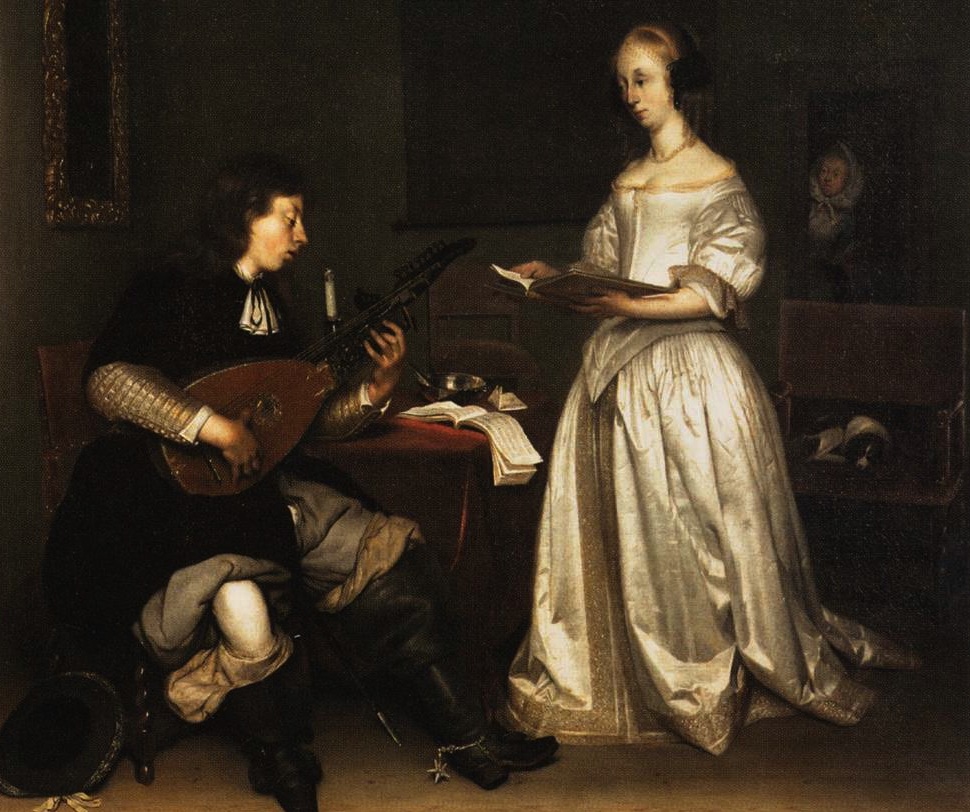
Here is the program and notes for Saturday's concert at Heliconian Hall. Click on the link for location etc. The picture above is by Gerard ter Borch. It's possible there may be one or two changes.

Songs for Anne Greene by John Danyel (1564-c1626)
Coy Daphne fled/Chast Daphne fled
Eyes looke no more
Let not Cloris thinke

Lute Lessons from Margaret Board’s Lute Book
Delyght Pavin John Johnson (d. 1594)
Delght Gallyard John Johnson
The Lady Phillyes Mask Anon.
I cannot keepe my wyfe at howme Anon.

Songs for Anne Greene by John Danyel
Time cruell Time
Thou prety Bird
Like as the Lute

Ann Twice Her Book
O let us howle some heavy note Robert Johnson (c1583-c1634)
Have you seen the bright lily grow Robert Johnson

Intermission

Eliz. Davenant Her book
Have you seen but a bright lily grow Robert Johnson
Woods rocks and mountains Robert Johnson

Songs for the Egerton Sisters by Henry Lawes (1595-1622)
Sweet stay awhile
Sweet Echo
To a Lady, singing the former Song

Lute Lessons from Margaret Board’s Lute Book
Midnight John Dowland (1563-1626)
Solus cum sola Dowland
Lady Banning her Almand John Stuart (d. 1625?)

Songs for the Egerton Sisters by Henry Lawes
The Rose
To a Lady, more affable since the War began
Tavola - In quel gelato core

The Musicians in Ordinary
Named after the singers and lutenists who performed in the most intimate quarters of the Stuart monarchs’ palace, The Musicians In Ordinary for the Lutes and Voices dedicate themselves to the performance of early solo song and vocal chamber music. Soprano Hallie Fishel and lutenist John Edwards have been described as ‘winning performers of winning music’. This is their 10th anniversary season of concerts in Toronto, and they concertize and lecture regularly at universities and museums across North America.

Before the Restoration, the English stage, was not a place where the educated woman was permitted to exercise the skills she had acquired in the sister arts of rhetoric and music. The more intimate and controlable domestic performance space, however was her’s to command.

John Danyel was the brother of the poet and playwright Samuel, who is the author of the lyrics ‘Lyke as the Lute’ and ‘Time cruell Time.’ John Danyel’s Songs for the Lute, Viol and Voice of 1606 is dedicated to Mistress Anne Greene, the daughter of a wealthy if not particualrly well-pedigreed knight, Sir William Greene. Danyel worked as a household musician for the Greene family. A few lines from his verse dedication will make clear the function of the songs in the collection.

To Mrs. Anne Grene…
That which was onely privately composed,
For your delight, Faire Ornament of Worth,
Is here, come to bee publikely disclosed:
And to an universall view put forth.

These songs, then, were written for Anne to enjoy, and probably sing in her lessons with Danyel.

Before he was engaged at court, Henry Lawes also worked as a household musician, for the more illustrious Egerton family. His duties included teaching the daughters of John Egerton, the Earl of Bridgewater, to sing. Lawes’ dedicated his Ayres and Dialogues of 1658 is to Alice and Mary Egerton, by then Countess of Carbery and Lady Herbert of Cherbury. The dedication says of the songs ‘most of them were composed when I was employed to attend to your Ladishipp’s education in musick’, that is, some 30 years earlier. Lady Alice performed and sang in Milton’s Comus, for which Lawes wrote the music. Since ‘Sweet stay awhile’ preceeds the songs Lawes wrote for that masque in Lawes’ autograph songbook, we can presume it was written when he was still teaching the girls.

While young women were not allowed to perform on the public stage in this period, we can be sure that they wanted to sing the latest stage hits at home if the contents of the songbooks written out by Ann Twice and Elizabeth Davenant are anything to go by. From Ben Jonson’s The Devil is an Ass we hear the song ‘Have you seen the bright lily grow’, and from John Webster’s The Duchess of Malfi we present the dramatic ‘O let us howle.’

Margaret Board appears to have taken some lessons from John Dowland about 1620. By this time Dowland was complaining about the new musicians at court. Perhaps he assigned Margaret the pieces in here book by long dead composers like John Johnson, while she filled in the gaps with the latest masque and ballad tunes.


Wednesday, October 20, 2010


It was all TV and radio for us for the last few days. We chatted with the excellent Donna G on her program The More the Merrier on CIUT radio on Saturday about the upcoming Her Leaves be Green concert. There is a podcast of the show available at the link to her program.

On Monday were were on Daytime Toronto, where Hallie was identified as having 'the voice of an angel' by the presenter. The other presenter, Chris, was blown away, literally and figuratively, when the diminutive Hallie opened up the hood an revved it up a bity for the higher stuff in Henry Lawes and John Donne's Sweet stay awhile, he sitting on the couch next to her. He then reached over and moved the mic on the coffee table back a foot or so.

This coming Saturday we'll be doing part of the Leaves be Green show at an academic conference at University of Toronto. Prof. Deanne Williams will doing a paper called The Paratextual Girl.

At the top is Mary Wroth with a theorbo. She is pretty proud of it I think.

Thursday, October 7, 2010


The pieces for the Musicians In Ordinary season opener at the Heliconian at the end of the month (download the brochure below for more details) are pretty much set. It's hard to time things when you are actually playing them; you are concentrating on the words or getting your fingers in the right place so you forget what the minute hand was on when you started or you are so pleased you got through it you forget you were timing it or, most likely, you crash and burn and don't get through it at all.

So if a piece has been recorded you can see how long it took someone else to play it and unless they play it twice as slow or fast, that's a good enough estimate.

Thus it was that I was looking on itunes to find how long it would take to play John Dowland's pavan Solus cum Sola. The title means 'alone (masculine) with alone (feminine)' or maybe 'He and She Alone Together', and since you leave your daughter alone in a room with her lute teacher it seemed a good thing to play. You may have read in the news that Apple Inc. boss Ian Apple has been censoring slightly risque apps for the iphone and it seems that his crusade has expanded to cleanse the works of lute composers of the Jacobean era. The word 'cum' in Solus cum Sola has had the 'u' replaced with an asterisk. This also seems to be the case with all the Baroque and Classical mass movements that start with the words C*m sancto spiritu. I will never be able to listen to Bach's Mass in B Minor in the same way again.

Sunday, October 3, 2010


I have been thinking for the last couple of days about the intersection of lutes and the emergency services. I have not been thinking about it very hard, because, as you can imagine, there's not many places they meet.

One is the diary entry that records that Inigo Jones, architect and designer of Stuart masques was sent to see the constable because the theorbo he was importing might be 'some engine brought from Popish countries to destroy the king.' (But it's abbreviated, so it might not even be constable.)

The other is this amazing picture from the Lute Society Journal. You can see this fireman rescuing a lute and an end table from a fire at the library in Linkoping, Sweden in 1996. According to the article inside the lute is by a maker called Raphael Mest, (c1590-after1658). The two headed arrangement which you can just about see would not be common in southern Germany, so I wonder if it was added later for a collector because the 2 peg-box arrangement looks kind of cool. Anyway, thanks to this fireman we'll never know the answer to the question 'What's the difference between a 10 or 11 course lute they'd be making in Fussen in the early 1600's and a 12-course two headed Dutch lute? (The answer, adapted from the viola joke repertoire, would be the one burns longer, but there is also 'holds more beer' etc.)