Tuesday, November 24, 2009


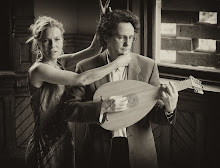
Here is the concert program order for this coming Saturday's concert. Above is a picture of us performing at the Heliconian last year (we are at Emmanuel College Chapel on Saturday)

The Resurrection from The Rosary Sonatas Heinrich Biber (1644-1704)

Sonata-Surrexit Christus Hodie-Adagio

Prelude Thomas Baltzar (1630-63)

Suzanne ung jour

Sonata from Concerti ecclesiastici Giovanni Paolo Cima (c.1570- 1622)

Sonata Seconda from Sonate…per il violino Giovanni Battista Fontana (c.1571-c.1630)

Toccata per Spinetta e Violino Girolamo Frescobaldi (1583-1643)

Sonata Variata from Sonate Op. 8 Biagio Marini (c1597-1665)


Intermission


Sonata Violino Solo Georg Muffat (1653-1704)

Adagio-Allegro-Adagio-Allegro

Pieces in E minor Nicola Matteis (fl.1670 - 1698)

Preludio in Fantasia-Allegro-Aria Malinconica-Giga-Sarabanda con Affetto

Sonata Giuseppe Valentini (1681-1753)

Preludio-Allemanda-Largo-Giga-Minuè


The beginning of the month had us at a conference on Early Modern Women at University of Maryland at College Park. We took part in a session on the women of the Sidney family and performance with Profs. Katie Larson, Linda Phylis Austern and Jeanice Brooks. 'Has she a strong voice? I love a lady when she puts forth her voice makes the room rattle,' Mary Sidney Wroth, Countess of Montgomery has Amphilanthus say.

We then did our concert on music written for girls to learn by John Danyel and Henry Lawes. Here's the cover of the program for that. Always have someone else proofread stuff.


Hallie gets ready for our concert:
Then is was off to Brooklyn where we stayed with Prof. Janette Tilley and her friend More McCormack. We led a seminar at CUNY's Grad Center (formerly B. Altman's department store on 5th Ave.) on "What really happened at Spanish courts in the 17th c. for musical entertainments?" (Answer: Long narrative poems declaimed on stock melodies rather than little villancicos.)

Here's the full program of the girl concert:

Her Leaves be Green

Miss Anne Greene

Coy Daphne fled John Danyel (1564-c1626)

Eies looke no more Danyel

Lyke as the Lute Danyel

Rosamond Danyel

Chast Daphne fled Danyel

Gaspara Stampa 1523-1554

Amor, lo stato tuo After Vincenzo Galilei (c.1520 –1591)

Gagliarda La Gasparina Giulio Abondante (fl1546 -1587)

Excerpt from Rilke’s Duino Elegies

Oimè, le notti mie colme di gioia, Cosimo Bottegari (1564-1620)

Songs for the Egerton Sisters

Sweet stay awhile Henry Lawes (1595-1622)

Coranto René Saman (fl 1610-31)

The God of love my shepherd is Lawes

Countess of Pembrooks Funeralls Anthony Holborne (c1545-1602)

Tavola - In quel gelato core Lawes

Before the Restoration the English stage was not a place where the educated woman was permitted to exercise her skills in the sister arts of rhetoric and music. The more intimate and controlable domestic performance space was hers to command.

John Danyel was the brother of the poet and playwright Samuel, and ‘Lyke as the Lute’ is a lyric by him. John’s Songs for the Lute Viol and Voice of 1606 is dedicated to Mistress Anne Greene, the daughter of a wealthy, if not very well-pedigreed knight, Sir William Greene, who employed Danyel as a household musician. A few lines from his verse dedication will make clear the function of the songs in the collection.

To Mrs. Anne Grene…

That which was onely privately composed,

For your delight, Faire Ornament of Worth,

Is here, come to bee publikely disclosed:

And to an universall view put forth.

Before his court engagement Henry Lawes also worked as a household musician, for the more illustrious Egerton family. His duties included teaching the daughters of John Egerton, the Earl of Bridgewater. Lawes’ dedicated his Ayres and Dialogues of 1653 is to Alice and Mary, by then Countess of Carbery and Lady Herbert of Cherbury. The dedication says of the songs ‘most of them were composed when I was employed to attend to your Ladishipp’s education in musick’. Along with a song from that print, we present a psalm paraphrase by George Herbert, Mary’s brother-in-law, solos from Lord Herbert’s Lutebook, and an ayre from Lawes’ autograph songbook. Since ‘Sweet stay awhile’ preceeds the songs written for Milton’s Comus we can presume it was written when he was still teaching the girls.

Gaspara Stampa and her sister were moved to Venice when her father died and her mother exploited the children’s musical and poetic talents as she opened her house as a salon. We set two of Gaspara’s poems to extant melodic formulas that fit any sonnets as was perhaps the most common way of hearing sung poetry in mid-16th century Italy. We also present a much later poet’s lines on her to a plainchant melody.

Saturday, November 7, 2009

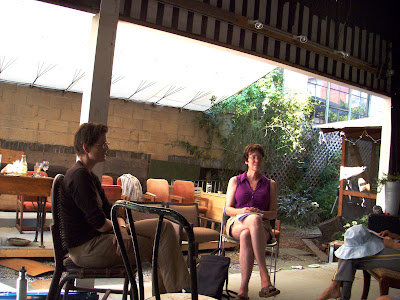
On Wed. we did a lunchtime concert at St. Paul's on the Green in Norwalk Ct. Lovely place as you can see below.


Then we hopped on a train and came to the conference on Early Modern Women at University of Maryland. Thurs. was the session on the Sidney women and performance. Friday night was a concert of music for Miss Anne Green, Gaspara Stampa and the Egerton sisters. Here's Hallie getting ready for that.


The internets here at the hotel are nearly non-existent. More when we get somewhere with better access.

Tuesday, November 3, 2009


A nice picture by Alexandra Guerson from the Centre for Reformation and Renaissance Studies conference on marriage. Who knew they still make film? Who knew they still make black and white film?

Sunday, October 18, 2009

Here are the program and some pics from the Anatomy of Melancholy show.
Hallie in the hall at CIUT Radio.

David Klausner and Hallie before the concert.

The full script, with Burton's words can be read here:
Anatomy of Melancholy 09 height="500" width="100%" > value="http://d1.scribdassets.com/ScribdViewer.swf?document_id=21261409&access_key=key-261t9cv2yfhzeg0l8c4r&page=1&version=1&viewMode=">

The program:

Flow my teares fall from your springs - John Dowland (1563-1626)

If fluds of teares could cleanse my follies past

I saw my Lady weepe

Merry Melancholie - Thomas Robinson (fl. c 1600)

Semper Dowland Semper Dolens

Now cease my wandring eies

Mourne, mourne, day is with darknesse fled

Lachrimae Pavan

A Shepeard in a shade, his plaining made

Times eldest sonne, olde age the heyre of ease

Dye not before thy day, poore man condemned


Intermission


Melancholly Galliard

Cleare or cloudie sweet as Aprill showring

O sweet woods the delight of solitarinesse

Dump Philli - Anon.

Sorrow stay, lend true repentant teares

Please restrain any applause till intermission and the end of the concert.

David Klausner was a founding member of the Toronto Consort, with whom he played for twenty years, specializing in early wind instruments. Since his retirement from the Consort he has appeared regularly as a bassoonist with orchestras in the Toronto area. For the past thirty years he has taught regularly at early music summer schools in Canada, Europe, and the United States. In his other life he is Professor of English and Medieval Studies, and Vice-Dean for Interdisciplinary Affairs in the Faculty of Arts & Science, University of Toronto. His areas of research include the documentary history of early drama in England and the social history of music.

Hallie Fishel, soprano, takes particular interest in the poetry and the historical pronunciation of the texts she sings, and enjoys lecturing on these topics, as well as other aspects of performance practice and the role of music in early modern culture, at colleges and universities across North America. She studied both traditional operatic technique and early music at Indiana University, with Thomas Binkley, Margaret Harshaw and Paul Elliott, and at the Longy School of School of Music with Laurie Monahan. With Musicians in Ordinary, she has also been heard playing the rebec, lira da braccio, and a little guitar. Hallie teaches voice privately and acts as a consultant to both singers and public speakers on matters of vocal health. She has served as soprano soloist at the Church of the Redeemer, Toronto, and as Director of Music at Trinity Anglican Church, Port Credit.

John Edwards specializes in playing numerous historical plucked string instruments, from the medieval lute to the theorbo to the nineteenth century guitar. Though he plays continuo lutes with orchestras, Mr. Edwards has always had a love of song and is in high demand as an accompanist and coach. Recently graduated as an M.A. from York University, he is a Fellow of the Centre for Reformation and Renaissance Studies at the University of Toronto and has given lectures and demonstrations throughout North America.

An Anatomy of Melancholy

From the last years of Elizabeth’s reign through James’s melancholy and its attendants became a theme, even an obsession with artists. Few Shakespeare plays are without at least one character who exhibits symptoms of this disease. There were plenty of macro reasons to feel melancholy; high unemployment, inflation, a government in debt and a parliament paralyzed. Poets and musicians, though, tend to focus on the micro causes of black bile, or melancholia, to give it its Greek name.

Lucy, Countess of Bedford cultivated an image of herself as the light (‘Lucy’) in the darkness for many artists working with the imagery of melancholy. John Donne, Samuel Danyel and John Dowland were all her creatures. Dowland’s Second Book of Songs was dedicated to Lucy, and it is from this book that all of the songs heard this evening are taken. Dowland compiled the book while working for the King of Denmark, and it seems tailored to cash in on the vogue for melancholy as well as reminding the reader of a society retirement party he wrote the music for (Times eldest sonne), and allying the composer with the ill-fated Earl of Essex (The text of O sweet woods is probably a plaint by Essex to Elizabeth). It also features a song with an amorous shepherd whining on a riverbank, because Dowland knew that pastoral verse was ‘as you like it.’ Dowland, like Lucy, seems to have been cultivating an image he being ‘semper dolens’, ever sad.

Robert Burton, Oxford scholar, wrote only one book in his life, though he revised and expanded it for nearly a quarter of a century from its publication in 1621. One of his aim seems to have been to collect all the information about the melancholy disease, though his stated aim is more personal. ‘I write of melancholy, by being busy to avoid melancholy.’ His straggly life’s work is a mass of quotations from the ancients and ‘neoterics’ frequently digressing into such subjects as the nature of air, spirits, and in the Third Partition, love. His treatise of love melancholy and its causes very often strays from the ‘scientific’ purposes of the book to the edges of poetry. We will leave the last word to Burton:

But to leave all declamatory speeches in praise of divine music, I will confine myself to my proper subject: besides that excellent power it hath to expel many other diseases, it is a sovereign remedy against despair and melancholy, and will drive away the devil himself.

Sunday, August 16, 2009

Gearing Up


We are gearing up for 2009-2010. Hallie and I rehearsed for our first concert which will be a multi disciplinary performance at Tricia Postle's Majlis Arts with dancer Gauri Vanarase and poet Camille Martin. We had a preliminary get together on Friday. We'll be performing some of Camille's poems to 16th and 17th century melodic formulae like Ciacona, Folia etc. and accompanying some dance with the same. Here are a couple of snaps of the preliminary rehearsal which will give you an idea of the space too.
We are also preparing for a show at CUNY Grad Center in NY in early September. More on that tomorrow.

Friday, May 1, 2009


Here's the program and the notes.
Maria Cortegiano
Ricercar Franciscus Bossinensis (fl 1509)
Se non dormi donna ascolta Anon.
Ricercar Bossinensis
O passi sparsi Sebastiano Festa (d. 1524)
Ricercar Bossinensis
Piango el mio fidel servire Anon.
Ricercar Bossinensis
O dolce diva mia Peregrinus Cesena (fl 1510-20)

Tullia d'Aragona c. 1510-56
Varchi il cui raro
Fantasias (Nos. 5,6 &7) Francesco da Milano (1497-1543)
S'io'l feci unqua

Franceschina Bellamano
Donna se 'l cor Ippolito Tromboncino (fl 1540-60s)
Vostra belta si bella Tromboncino
Io moro Tromboncino
Se voi dolc'et pietosi Tromboncino

Intermission

Gaspara Stampa 1523-1554
Amor, lo stato tuo e proprio quale After Vincenzo Galilei (c. 1520-91)
El Pass'e Mezo – Gagliarda La Gasparina Giulio Abondante (fl1546 -1587)

Veronica Franco 1546-1591
Fors’anco Amor Cosimo Bottegari (1564-1620)

Lucia di Filippo Gagnolanti d. 1593
Romanesca Galilei
Torna deh torna Giulio Caccini (c1550–1618)
Fantasia Anon.
Fillide mia Caccini
Fantasia Anon.
Amarilli Caccini
Dalla porta d’oriente Caccini

If an aristocrat in Renaissance Italy were very liberal minded, he might let his wife embroider a pillow to place on the window sill to cushion her elbow while she watched the goings-on in the street. Wives were seldom anywhere unchaperoned and their lives were largely cloisetered.

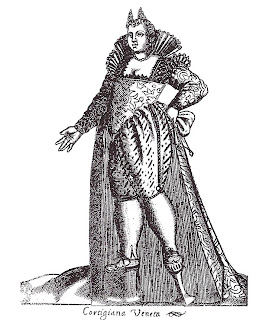
The courtesan, on the other hand, was free to roam both amorously and intellectually. The ‘cortegiano honeste’ was musician, poet and muse. She didn’t have a price list and customers, she had ‘friends’ who gave her ‘gifts’. Pietro Aretino, a satirist who knew a thing or two about courtesans, tells us that musical instruments and musical hangers-on were among the most important things for the aspiring courtesan to acquire. In one of Aretino’s dialogues Nanna, an old pro, tells Pippa, her protégé, ‘Ask this man for a lute, another for a harpsichord, this man for a viola and that for a lira. Then get the maestri to come and teach you music, getting them to play for you for nothing, paying them with hopes and promises.’

What we know about Maria the courtesan’s repertoire comes from a manuscript of poetry collected by a Domenico Arrighi. He seems to have been quite smitten by Maria, a Roman who moved to Florence. Many of the poems have notes saying that she sang this one or that and these rubrics are often more effusive: ‘This song was her favorite, and she sang it so well that everyone would fall in love with her on hearing her sing it so beautifully.’ We have intabluated the tenor and bass parts of Se non dormi, Piango and O dolce diva for lute since this was the most common mode of performance for the frottola. O passi sparsi is from an English arrangement of Festa’s frottola which is the most famous setting of Petrarch’s text.

Hardly any music survives for the lira da braccio, an instrument which was used to accompany quasi-improvised solo recitation-song in the 15th and 16th century. Hallie reconstructs such a performance from such sources as do survive to perform poems by the most celebrated of the courtesan poets, Tullia. As well as her sonnets, which include many to lovers and patrons like Varchi, she published a philosophic Dialogue on the Infinity of Love from which this concert takes its name. Who better to write on the subject than a professional?

Pietro Aretino was an avid letter writer, and published collections of them. One letter invites the greatest singing teacher of Renaissance Venice, Ippolito Tromboncino, to dinner, saying that the courtesan, and Ippolito’s student, Francheschina will be there, as will the great painter Titian. A painting of Titian’s shows a disinterested Venus staring off into the distance as a lute player serenades her longingly. Could this be Ippolito and Franceschina? He certainly looks as if he will be rewarded with nothing but ‘hopes and promises’.

The performance of poetic forms to stock melodic and chord changes was perhaps the most common form of song in our period. We perform Gaspara’s sonnet to a formula which fits all sonnets and uses the Folia chord changes. The lute chords are notated in rudimentary notation in the hand of Vincenzo Galilei, though we obtain the melody other sources. We sing a passage from one of Veronica’s long terza rime to a textless ‘aria’ for that poetic form from Cosimo Bottegari’s lute song book. We have also sung passages from Dante’s Inferno to the same tune, since any terza rima can be performed to it.

But it’s not clear who was a courtesan. Gaspara was of noble birth, but her family was broke. She had several lovers who gave her ‘gifts’. Lucia was a singer at the Medici court. When there was some doubt about the potency of a noble who was about to marry a Medici daughter Lucia was sent to Venice (what happens in Venice stays in Venice) with the man in question. When she became pregnant the test was passed and he wed the Medici. Lucia was married to singer and composer Giulio Caccini, who received a dowry of several times his annual salary, paid by Ferdinand de Medici. Sleeping with the boss’ future son-in-law in exchange for a huge cash payment for your household would seem to be far beyond the normal duties of a singer. The edges of courtesanship were quite blurry in the 16th century. We might be more certain saying courtesans were independent women, accomplished poets and musicians than women who took money for sex.